
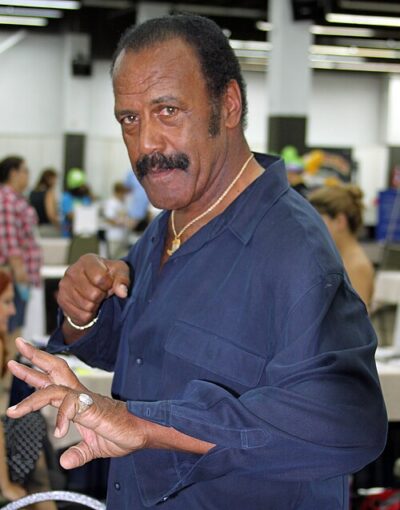
Fred Williamson
Fred Williamson is an American football player and actor. Born March 5, 1938, in Gary. Teams include Pittsburgh Steelers and Northwestern Wildcats football. Educated at Northwestern University and Weinberg College of Arts and Sciences.
Facts
17 facts · 1 confirmed by two sources · 7 cited · 9 from one source
Where this comes from
Papalocal keeps its own record. It started from these sources; what each one said is kept here as it was copied, so a change on their side never changes this page by itself. Tap one to read its version.
What Wikidata says · copied November 15, 2026 · revision 2568210734
- Described as
- American football player and actor
- Other names
- Frederick Robert Williamson
- Born
- March 5, 1938 · 1 reference
- Born in
- Gary · 1 reference
- Citizen of
- United States
- Occupation
- actor · 1 reference; film director; film actor; American football player · 1 reference; screenwriter · 2 references; film producer · 1 reference; manufacturer · 1 reference; director · 1 reference
- Education
- Northwestern University · 1 reference; Weinberg College of Arts and Sciences
- Teams
- Pittsburgh Steelers; Northwestern Wildcats football · 1 reference
- Sport
- American football · 1 reference
- Height
- 1.91 m (6 ft 3 in)
- Wikipedias with a page
- 30
Wikidata item Q1452569 (wikidata.org/wiki/Q1452569), public domain (CC0). Copied November 15, 2026.
What Wikipedia says · copied November 15, 2026 · revision 1384223703
Frederick Robert Williamson (born March 5, 1938), nicknamed "the Hammer", is an American actor, filmmaker, and former football player. He played professional football as a defensive back, primarily in the American Football League (AFL) during the 1960s. He was a top sports star during the decade, and became a leading man in blaxploitation and action films beginning in the 1970s.
Williamson played college football for the Northwestern Wildcats, and played in the National Football League (NFL) with the Pittsburgh Steelers for one season. In the AFL, Williamson played cornerback with the Oakland Raiders for four seasons, becoming a three-time AFL All-Star (1961, '62, '63). He then played three seasons with the Kansas City Chiefs, where was a one-time AFL champion ('66). During his football career, he earned the nickname "the Hammer" for his aggressive playing style, which incorporated martial arts techniques.
After retiring from football in 1968, Williamson made a string of guest and supporting roles on television and in films. He played his first leading role in the blaxploitation Western The Legend of Nigger Charley (1972), which he reprised in two sequels. He starred as Tommy Gibbs in the 1973 crime drama film Black Caesar and its sequel Hell Up in Harlem. Williamson also had roles in other 1970s blaxploitation films such as Hammer (1972), That Man Bolt (1973), Three the Hard Way (1974), and Bucktown (1975). Later in the decade, he worked extensively in Italian cinema, and also began to direct and produce his own films.
- Born, in its opening lines
- March 5, 1938
From the Wikipedia article “Fred Williamson” (en.wikipedia.org/wiki/Fred_Williamson), by its contributors, under CC BY-SA 4.0 (creativecommons.org/licenses/by-sa/4.0/). Copied November 15, 2026; not changed.
Confirmed Two sources agree. Cited One source, and it names where it got it. One source One source, without a reference of its own. Sources disagree The sources disagree. We show the best-supported value and keep theirs below.
