
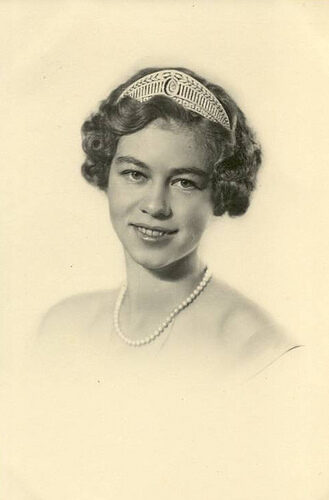
Frederica of Hanover
Frederica of Hanover was a Queen consort of Greece as the wife of King Paul; daughter of Ernest Augustus, Duke of Brunswick. Born April 18, 1917, in Blankenburg. Died February 6, 1981, in Madrid. Educated at North Foreland Lodge. Awards include Grand Cross of the Legion of Honour, Grand Cross Special Class of the Order of Merit of the Federal Republic of Germany and Knight Grand Cross of the Order of Merit of the Italian Republic.
Facts
25 facts · 2 confirmed by two sources · 8 cited · 15 from one source
Where this comes from
Papalocal keeps its own record. It started from these sources; what each one said is kept here as it was copied, so a change on their side never changes this page by itself. Tap one to read its version.
What Wikidata says · copied November 16, 2026 · revision 2569046903
- Described as
- Queen consort of Greece as the wife of King Paul; daughter of Ernest Augustus, Duke of Brunswick (1887-1953)
- Other names
- Friederike Luise von Griechenland, Fredericka, Princess Fredericka
- Born
- April 18, 1917 · 5 references
- Died
- February 6, 1981 · 5 references
- Born in
- Blankenburg · 1 reference
- Died in
- Madrid · 1 reference
- Buried in
- Tatoi Royal Cemetery · 1 reference
- Cause of death
- cardioplegia
- Citizen of
- Germany
- Occupation
- queen
- Education
- North Foreland Lodge
- Awards
- Grand Cross of the Legion of Honour; Grand Cross Special Class of the Order of Merit of the Federal Republic of Germany (1956); Knight Grand Cross of the Order of Merit of the Italian Republic; Knight of the Order of the Elephant (1963)
- Spouse
- Paul of Greece (1938–1964) · 1 reference
- Children
- Queen Sofía of Spain · 1 reference; Constantine II of Greece · 1 reference; Princess Irene of Greece and Denmark · 1 reference
- Father
- Ernst August, Duke of Brunswick
- Mother
- Princess Viktoria Luise of Prussia · 1 reference
- Siblings
- Prince Christian Oscar of Hanover; Prince Welf Heinrich of Hanover; Ernst August, Prince of Hanover; Prince Georg Wilhelm of Hanover
- Religion
- Greek Orthodoxy (1946–) · 1 reference; Lutheranism (1917–1946)
- Wikipedias with a page
- 41
Wikidata item Q61351 (wikidata.org/wiki/Q61351), public domain (CC0). Copied November 16, 2026.
What Wikipedia says · copied November 16, 2026 · revision 1385844562
Frederica of Hanover (German: Friederike Luise; Greek: Φρειδερίκη Λουΐζα, romanized: Phreideríkē Louḯza; 18 April 1917 – 6 February 1981) was Queen of Greece from 1 April 1947 until 6 March 1964 as the wife of King Paul and Queen Mother of Greece from 6 March 1964, when her son Constantine II became King, until 8 December 1974, when the monarchy was officially abolished after a referendum.
Granddaughter of Kaiser Wilhelm II and daughter of Duke Ernest Augustus of Brunswick, Frederica was born a few months before the fall of the German Empire. Her family overthrown, she grew up between Austria and Weimar Germany, where her father owned large properties. As a teenager, she joined the Hitler Youth in 1933, before leaving to complete her studies for the next two years in the United Kingdom and then Italy. In Florence, she was received by Princess Helen of Greece and Denmark, at whose house she met the Crown Prince of Greece, Paul. The two fell in love and married two years after the restoration of the monarchy in Greece. In the years that followed, she gave birth to three children, Sophia in 1938, Constantine in 1940 and Irene in 1942.
During the Second World War, Greece was occupied by the Axis powers. The Greek royal family left the country and Frederica and her children settled first in South Africa and from 1943 in Egypt.
The changing political situation in Greece, with the rise of the EAM and the KKE, challenged the institution of the monarchy. The royal family did not return to the country until 1946, when the Greeks ratified the return and restoration of the institution in a referendum. In the period of civil war that followed, Frederica developed a strong social activity to support the efforts of the government and the Crown. She organised a network to help refugees affected by the forces of the Democratic Army, creating the so-called "children's towns", an initiative that was widely criticised by opponents of the Crown.
After the death of Paul I in 1964, the dowager queen retired from public life. However, according to the prevailing historiographical view, she continued to influence the fate of the country through her son, now King Constantine II. Frederica was widely regarded as Constantine's éminence grise and continued to be attacked by the opposition, who blamed her for the tensions between the palace and the government of Georgios Papandreou (1964–1965).
- Born, in its opening lines
- April 18, 1917
- Died, in its opening lines
- February 6, 1981
From the Wikipedia article “Frederica of Hanover” (en.wikipedia.org/wiki/Frederica_of_Hanover), by its contributors, under CC BY-SA 4.0 (creativecommons.org/licenses/by-sa/4.0/). Copied November 16, 2026; not changed.
Confirmed Two sources agree. Cited One source, and it names where it got it. One source One source, without a reference of its own. Sources disagree The sources disagree. We show the best-supported value and keep theirs below.
