
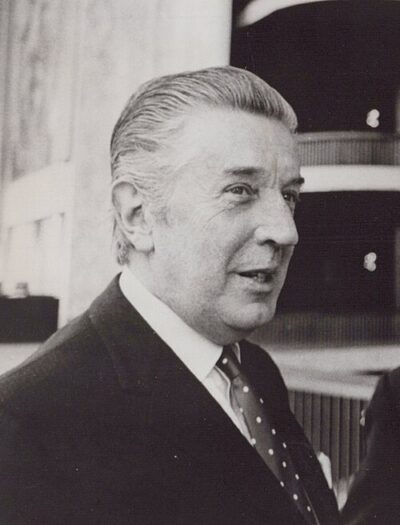
Frederick Ashton
Frederick Ashton was a British dancer and choreographer. Born September 17, 1904, in Guayaquil. Died August 18, 1988, in Eye. Educated at Dover College. Awards include Commander of the Order of the British Empire, commander of the Order of the Dannebrog and Companion of Honour.
Facts
25 facts · 2 confirmed by two sources · 8 cited · 15 from one source
Where this comes from
Papalocal keeps its own record. It started from these sources; what each one said is kept here as it was copied, so a change on their side never changes this page by itself. Tap one to read its version.
What Wikidata says · copied November 16, 2026 · revision 2569642105
- Described as
- British dancer and choreographer (1904–1988)
- Other names
- Frederick William Mallandaine Ashton, Sir Frederick William Mallandaine Ashton, Sir Frederick Ashton
- Born
- September 17, 1904 · 9 references
- Died
- August 18, 1988 · 6 references
- Born in
- Guayaquil · 1 reference
- Died in
- Eye · 2 references
- Name at birth
- Frederick William Mallandaine Ashton · 1 reference
- Citizen of
- United Kingdom; United Kingdom of Great Britain and Ireland (–1927)
- Occupation
- dancer · 1 reference; choreographer · 1 reference; ballet dancer; screenwriter; librettist; ballet master · 1 reference
- Education
- Dover College
- Awards
- Commander of the Order of the British Empire; commander of the Order of the Dannebrog; Companion of Honour; Order of Merit; Knight of the Legion of Honour; National Dance Awards; Queen Elizabeth II Coronation Award
- Field
- dance choreography; ballet · 1 reference; dance · 1 reference; choreography · 1 reference
- Wikipedias with a page
- 47
Wikidata item Q711073 (wikidata.org/wiki/Q711073), public domain (CC0). Copied November 16, 2026.
What Wikipedia says · copied November 16, 2026 · revision 1383217246
Sir Frederick William Mallandaine Ashton (17 September 1904 – 18 August 1988) was a British ballet dancer and choreographer. He also worked as a director and choreographer in opera, film and revue.
Determined to be a dancer despite the opposition of his conventional middle-class family, Ashton was accepted as a pupil by Léonide Massine and then by Marie Rambert. In 1926 Rambert encouraged him to try his hand at choreography, and though he continued to dance professionally, with success, it was as a choreographer that he became famous.
Ashton was chief choreographer to Ninette de Valois, from 1935 until her retirement in 1963, in the company known successively as the Vic-Wells Ballet, the Sadler's Wells Ballet and the Royal Ballet. He succeeded de Valois as director of the company, serving until his own retirement in 1970.
Ashton is widely credited with the creation of a specifically English genre of ballet. Among his best-known works are Façade (1931), Symphonic Variations (1946), Cinderella (1948), La fille mal gardée (1960), Monotones I and II (1965), Enigma Variations (1968) and the ballet film The Tales of Beatrix Potter (1971).
- Born, in its opening lines
- September 17, 1904
- Died, in its opening lines
- August 18, 1988
From the Wikipedia article “Frederick Ashton” (en.wikipedia.org/wiki/Frederick_Ashton), by its contributors, under CC BY-SA 4.0 (creativecommons.org/licenses/by-sa/4.0/). Copied November 16, 2026; not changed.
Confirmed Two sources agree. Cited One source, and it names where it got it. One source One source, without a reference of its own. Sources disagree The sources disagree. We show the best-supported value and keep theirs below.
