
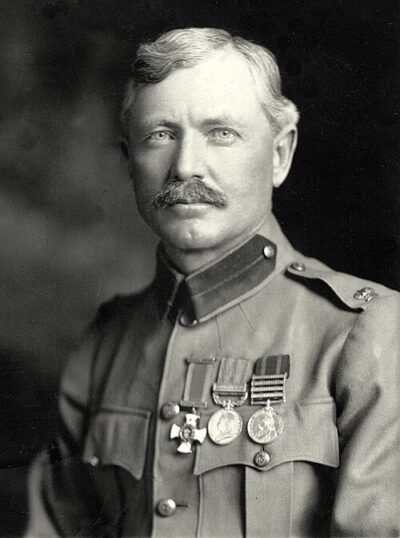
Frederick Russell Burnham
Frederick Russell Burnham was a father of scouting; military scout; soldier of fortune; oil man; writer; rancher. Born May 11, 1861, in Blue Earth County. Died September 15, 1947, in Santa Barbara. Awards include Distinguished Service Order and Honorary Scout.
Facts
20 facts · 1 confirmed by two sources · 9 cited · 9 from one source · 1 where the sources disagree
What’s different
- Died: we show September 15, 1947 (Sources disagree). Wikipedia says September 1, 1947
Where this comes from
Papalocal keeps its own record. It started from these sources; what each one said is kept here as it was copied, so a change on their side never changes this page by itself. Tap one to read its version.
What Wikidata says · copied November 15, 2026 · revision 2554511849
- Described as
- father of scouting; military scout; soldier of fortune; oil man; writer; rancher (1861–1947)
- Born
- May 11, 1861 · 3 references
- Died
- September 15, 1947 · 3 references
- Born in
- Blue Earth County
- Died in
- Santa Barbara
- Buried in
- Three Rivers Cemetery · 1 reference
- Citizen of
- United States
- Occupation
- explorer; writer; soldier · 1 reference; military officer · 1 reference; Major · 1 reference
- Awards
- Distinguished Service Order; Honorary Scout
- Field
- scouting · 1 reference; military service · 1 reference; nature conservation · 1 reference
- Children
- Roderick Deane Burnham · 1 reference
- Father
- Edwin Otway Burnham · 1 reference
- Military branch
- British Army
- Military rank
- Major
- Wikipedias with a page
- 27
Wikidata item Q458036 (wikidata.org/wiki/Q458036), public domain (CC0). Copied November 15, 2026.
What Wikipedia says · copied November 15, 2026 · revision 1379845567
Frederick Russell Burnham (May 11, 1861 – September 1, 1947) was an American scout and world-traveling adventurer. He is known for his service to the British South Africa Company and to the British Army in colonial Africa, and for teaching woodcraft to Robert Baden-Powell in Rhodesia. Burnham helped inspire the founding of the international Scouting Movement.
Burnham was born on a Dakota Sioux Indian reservation in Minnesota, in the small village of Tivoli near the city of Mankato; there he learned the ways of Native Americans as a boy. By the age of 14, he was supporting himself in California, while also learning scouting from some of the last of the cowboys and frontiersmen of the American Southwest. Burnham had little formal education, never finishing high school. After moving to the Arizona Territory in the early 1880s, he was drawn into the Pleasant Valley War, a feud between families of ranchers and sheepherders. He escaped and later worked as a civilian tracker for the United States Army in the Apache Wars. Feeling the need for new adventures, Burnham took his family to southern Africa in 1893, seeing Cecil Rhodes's Cape to Cairo Railway project as the next undeveloped frontier.
Burnham distinguished himself in several battles in Rhodesia and South Africa and became Chief of Scouts. Despite his U.S. citizenship, his military title was British and his rank of major was formally given to him by King Edward VII. In special recognition of Burnham's heroism, the King invested him into the Companions of the Distinguished Service Order, giving Burnham the highest military honors earned by any American in the Second Boer War. He had become friends with Baden-Powell during the Second Matabele War in Rhodesia, teaching him outdoor skills and inspiring what would later become known as Scouting. Burnham returned to the United States, where he became involved in national defense efforts, business, oil, conservation, and the Boy Scouts of America (BSA).
During World War I, Burnham was selected as an officer and recruited volunteers for a U.S. Army division similar to the Rough Riders, which Theodore Roosevelt intended to lead into France. For political reasons, the unit was disbanded without seeing action. After the war, Burnham and his business partner John Hays Hammond formed the Burnham Exploration Company; they became wealthy from oil discovered in California. Burnham joined several new wilderness conservation organizations, including the California State Parks Commission. In the 1930s, he worked with the BSA to save the big horn sheep from extinction. This effort led to the creation of the Kofa and Cabeza Prieta National Wildlife Refuges in Arizona. He earned the BSA's highest honor, the Silver Buffalo Award, in 1936, and remained active in the organization at both the regional and national level until his death in 1947. To symbolize the friendship between Burnham and Baden-Powell, the mountain beside Mount Baden-Powell in California was formally named Mount Burnham in 1951.
- Born, in its opening lines
- May 11, 1861
- Died, in its opening lines
- September 1, 1947
From the Wikipedia article “Frederick Russell Burnham” (en.wikipedia.org/wiki/Frederick_Russell_Burnham), by its contributors, under CC BY-SA 4.0 (creativecommons.org/licenses/by-sa/4.0/). Copied November 15, 2026; not changed.
Confirmed Two sources agree. Cited One source, and it names where it got it. One source One source, without a reference of its own. Sources disagree The sources disagree. We show the best-supported value and keep theirs below.
