
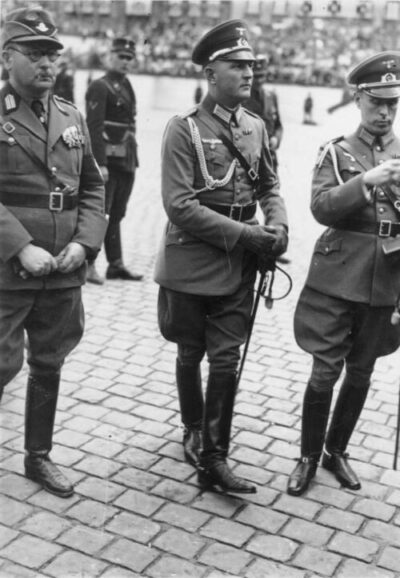
Friedrich Hoßbach
Friedrich Hoßbach was a German general. Born November 22, 1894, in Unna. Died September 10, 1980, in Göttingen. Awards include Military Merit Cross III. Class and Knight's Cross of the Iron Cross with Oak Leaves.
Facts
13 facts · 2 confirmed by two sources · 5 cited · 6 from one source
What’s different
- Born: we show November 22, 1894 (Confirmed). Wikidata also lists November 21, 1894
Where this comes from
Papalocal keeps its own record. It started from these sources; what each one said is kept here as it was copied, so a change on their side never changes this page by itself. Tap one to read its version.
What Wikidata says · copied November 17, 2026 · revision 2569178914
- Described as
- German general (1894-1980)
- Other names
- Friedrich Hossbach
- Born
- November 22, 1894 · 1 reference; November 21, 1894 · 1 reference
- Died
- September 10, 1980 · 2 references
- Born in
- Unna · 1 reference
- Died in
- Göttingen · 1 reference
- Buried in
- Göttingen City Cemetery · 1 reference
- Citizen of
- Germany
- Occupation
- writer · 2 references; army officer
- Awards
- Military Merit Cross III. Class; Knight's Cross of the Iron Cross with Oak Leaves
- Military branch
- German Army · 1 reference
- Military rank
- general; general · 1 reference
- Wikipedias with a page
- 24
Wikidata item Q62731 (wikidata.org/wiki/Q62731), public domain (CC0). Copied November 17, 2026.
What Wikipedia says · copied November 17, 2026 · revision 1379860621
Friedrich Hossbach (22 November 1894 – 10 September 1980) was a German staff officer in the Wehrmacht who, as a military adjutant to Adolf Hitler in 1937, created the document detailing Hitler's expansionist plans. It later became known as the Hossbach Memorandum.
- Born, in its opening lines
- November 22, 1894
- Died, in its opening lines
- September 10, 1980
From the Wikipedia article “Friedrich Hossbach” (en.wikipedia.org/wiki/Friedrich_Hossbach), by its contributors, under CC BY-SA 4.0 (creativecommons.org/licenses/by-sa/4.0/). Copied November 17, 2026; not changed.
Confirmed Two sources agree. Cited One source, and it names where it got it. One source One source, without a reference of its own. Sources disagree The sources disagree. We show the best-supported value and keep theirs below.
