
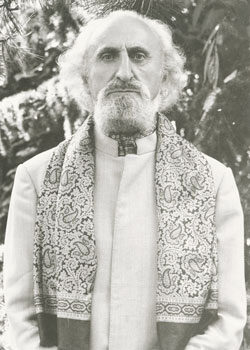
Frithjof Schuon
Frithjof Schuon was a Swiss philosopher, poet and painter. Born June 18, 1907, in Basel. Died May 5, 1998, in Bloomington. Known for The Transcendent Unity of Religions, Logic and Transcendence and Understanding Islam.
Facts
19 facts · 2 confirmed by two sources · 6 cited · 11 from one source
Where this comes from
Papalocal keeps its own record. It started from these sources; what each one said is kept here as it was copied, so a change on their side never changes this page by itself. Tap one to read its version.
What Wikidata says · copied November 16, 2026 · revision 2567539213
- Described as
- Swiss philosopher, poet and painter (1907-1998)
- Other names
- Isâ Nûr ad-Dîn, Isa Nur ad-Din, Fritjof Schuon, Sheikh Issa Nureddin Ahmad al-Shadhili al-Darqawi al-Alawi al-Maryami
- Born
- June 18, 1907 · 3 references
- Died
- May 5, 1998 · 3 references
- Born in
- Basel · 1 reference
- Died in
- Bloomington · 1 reference
- Citizen of
- Switzerland · 1 reference
- Occupation
- philosopher; poet; painter; philosopher of religion · 1 reference
- Known for
- The Transcendent Unity of Religions; Logic and Transcendence; Understanding Islam; Form and Substance in Religions; The Transfiguration of Man
- Field
- spirituality
- Spouse
- Catherine Schuon · 1 reference
- Religion
- Islam · 1 reference
- Website
- http://www.frithjof-schuon.com/; http://it.fschuon.info
- Wikipedias with a page
- 35
Wikidata item Q123382 (wikidata.org/wiki/Q123382), public domain (CC0). Copied November 16, 2026.
What Wikipedia says · copied November 16, 2026 · revision 1367016944
Frithjof Schuon ( SHOO-on; German: [ˈfʁɪtjɔf ˈʃuːɔn]; 18 June 1907 – 5 May 1998) was a Swiss philosopher and spiritual leader, belonging to the Traditionalist School of Perennialism. He was the author of more than twenty works in French on metaphysics, spirituality, religion, anthropology, and art. He was also a painter and a poet.
With René Guénon and Ananda Coomaraswamy, Schuon was one of the major 20th-century representatives of the philosophia perennis. Like them, he affirmed the reality of an absolute Principle – God – from which the universe emanates, and maintained that all divine revelations, despite their differences, possess a common essence: one and the same Truth. He also shared with them the certitude that man is potentially capable of supra-rational knowledge, and undertook a sustained critique of the modern mentality severed, according to him, from its traditional roots. Following Plato, Plotinus, Adi Shankara, Meister Eckhart, Ibn Arabī, and other metaphysicians, Schuon sought to affirm the metaphysical unity between the Principle and its manifestation.
Initiated by Sheikh Ahmad al-Alawī into the Sufi Shādhilī order, he founded the Tarīqa Maryamiyya. His writings emphasize the universality of metaphysical doctrine, along with the necessity of practicing a religion; he also insists on the importance of the virtues and of beauty.
Schuon cultivated close relationships with a large number of personages of diverse religious and spiritual horizons. He had a particular interest in the traditions of the North American Plains Indians, maintaining firm friendships with a number of their leaders and being adopted into both a Lakota Sioux tribe and the Crow tribe. Having spent a large part of his life in France and Switzerland, at the age of 73 he moved to Bloomington, Indiana, where he had a community of disciples.
- Born, in its opening lines
- June 18, 1907
- Died, in its opening lines
- May 5, 1998
From the Wikipedia article “Frithjof Schuon” (en.wikipedia.org/wiki/Frithjof_Schuon), by its contributors, under CC BY-SA 4.0 (creativecommons.org/licenses/by-sa/4.0/). Copied November 16, 2026; not changed.
Confirmed Two sources agree. Cited One source, and it names where it got it. One source One source, without a reference of its own. Sources disagree The sources disagree. We show the best-supported value and keep theirs below.
