
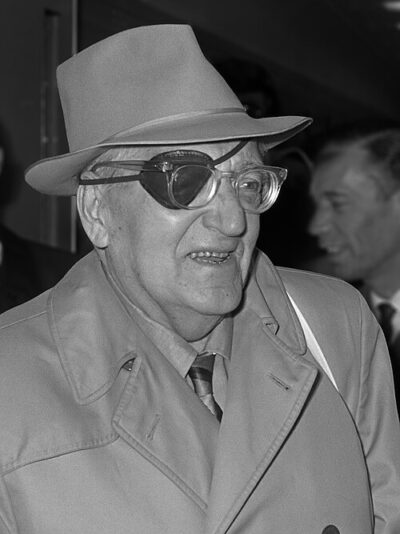
Fritz Lang
Fritz Lang was an Austrian filmmaker. Born December 5, 1890, in Vienna. Died August 2, 1976, in Beverly Hills. Positions held include President of the Jury at the Cannes Festival (1964). Known for Metropolis, M and Destiny. Educated at Königliche Kunstgewerbeschule München and TU Wien. Awards include German Film Award, Officer of Arts and Letters and Commander's Cross of the Order of Merit of the Federal Republic of Germany.
Facts
37 facts · 2 confirmed by two sources · 10 cited · 25 from one source
Where this comes from
Papalocal keeps its own record. It started from these sources; what each one said is kept here as it was copied, so a change on their side never changes this page by itself. Tap one to read its version.
What Wikidata says · copied November 13, 2026 · revision 2568859771
- Described as
- Austrian filmmaker (1890–1976)
- Other names
- Friedrich Christian Anton Lang, Friedrich Christian Anton "Fritz" Lang, Fritz Lang (1890–1976)
- Born
- December 5, 1890 · 14 references
- Died
- August 2, 1976 · 14 references
- Born in
- Vienna · 3 references
- Died in
- Beverly Hills · 1 reference
- Buried in
- Forest Lawn Memorial Park
- Name at birth
- Friedrich Christian Anton Lang
- Citizen of
- Germany; United States (1939–) · 1 reference; Austria · 1 reference
- Occupation
- film director · 2 references; screenwriter · 1 reference; actor; film editor; film actor; film producer · 1 reference; director · 2 references; writer · 1 reference
- Positions held
- President of the Jury at the Cannes Festival (1964)
- Education
- Königliche Kunstgewerbeschule München; TU Wien · 1 reference
- Genre
- Expressionism · 1 reference
- Known for
- Metropolis; M; Destiny; Die Nibelungen; Dr. Mabuse the Gambler
- Awards
- German Film Award; Officer of Arts and Letters; Commander's Cross of the Order of Merit of the Federal Republic of Germany; star on Hollywood Walk of Fame · 1 reference; Karl Troop Cross · 1 reference; The Life Career Award (1976) · 2 references
- Spouse
- Thea von Harbou (1922–1933); Lily Latté · 1 reference; Lisa Rosenthal (1919–1921) · 1 reference
- Religion
- Christianity; Judaism
- Wikipedias with a page
- 76
Wikidata item Q19504 (wikidata.org/wiki/Q19504), public domain (CC0). Copied November 13, 2026.
What Wikipedia says · copied November 13, 2026 · revision 1382262022
Friedrich Christian Anton Lang (Austrian German: [ˈfriːdrɪç ˈkrɪsti̯a(ː)n ˈantɔn ˈlaŋ]; December 5, 1890 – August 2, 1976), better known as Fritz Lang (Austrian German: [ˈfrɪts ˈlaŋ]), was an Austrian film director, screenwriter, and producer, who worked in Germany and later the United States. One of the best-known émigrés from Germany's school of Expressionism, he was dubbed the "Master of Darkness" by the British Film Institute. He has been cited as one of the most influential filmmakers of all time.
Lang's work spans five decades, from the Expressionist silent films of his first German creative period to his short stay in Paris and his work as a Hollywood director to his last three films made in Germany. Lang's most celebrated films include the futuristic science-fiction film Metropolis (1927) and the influential M (1931), a film noir precursor. His 1929 film Woman in the Moon showcased the use of a multi-stage rocket, and also pioneered the concept of a rocket launch pad (a rocket standing upright against a tall building before launch having been slowly rolled into place) and the rocket-launch countdown clock.
His other major films include Dr. Mabuse the Gambler (1922) and its sequel The Testament of Dr. Mabuse (1933), Die Nibelungen (1924), and after moving to Hollywood in 1934, Fury (1936), You Only Live Once (1937), Hangmen Also Die! (1943), The Woman in the Window (1944), Scarlet Street (1945) and The Big Heat (1953). He became a naturalized citizen of the United States in 1939. He returned to Germany in the late 1950s, directing a two-part adaptation of his ex-wife Thea von Harbou's novel The Indian Tomb, and a third Dr. Mabuse film (1960).
- Born, in its opening lines
- December 5, 1890
- Died, in its opening lines
- August 2, 1976
From the Wikipedia article “Fritz Lang” (en.wikipedia.org/wiki/Fritz_Lang), by its contributors, under CC BY-SA 4.0 (creativecommons.org/licenses/by-sa/4.0/). Copied November 13, 2026; not changed.
Confirmed Two sources agree. Cited One source, and it names where it got it. One source One source, without a reference of its own. Sources disagree The sources disagree. We show the best-supported value and keep theirs below.
