
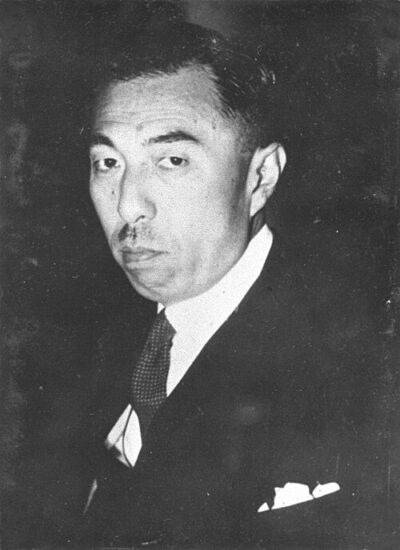
Fumimaro Konoe
Fumimaro Konoe was a politician and former Prime Minister of Japan. Born October 12, 1891, in Kōjimachi-ku. Died December 16, 1945, in Tekigaisō Park. Positions held include Prime Minister of Japan (1937–1941), member of the House of Peers and Chairman of the Privy Council of Japan. Known for Konoe Memorial. Educated at Kyoto Imperial University and Kyoto University Graduate School of Law & Faculty of Law. Awards include Order of the Rising Sun, 1st class, Order of the Sacred Treasure, 1st Class and Knight grand cross of the order of the crown of Italy.
Facts
38 facts · 2 confirmed by two sources · 5 cited · 31 from one source
Where this comes from
Papalocal keeps its own record. It started from these sources; what each one said is kept here as it was copied, so a change on their side never changes this page by itself. Tap one to read its version.
What Wikidata says · copied November 16, 2026 · revision 2567574043
- Described as
- politician and former Prime Minister of Japan (1891–1945)
- Born
- October 12, 1891 · 10 references
- Died
- December 16, 1945 · 9 references
- Born in
- Kōjimachi-ku
- Died in
- Tekigaisō Park
- Buried in
- Konoe Family Cemetery · 1 reference
- Cause of death
- cyanide poisoning
- Citizen of
- Empire of Japan
- Occupation
- politician · 1 reference; jurist · 1 reference; head of government · 1 reference
- Positions held
- Prime Minister of Japan (1937–1941); member of the House of Peers; Chairman of the Privy Council of Japan
- Political party
- Taisei Yokusankai
- Education
- Kyoto Imperial University; Kyoto University Graduate School of Law & Faculty of Law; Tokyo Imperial University; First Higher School; Taimei Elementary School
- Member of
- Kayōkai
- Known for
- Konoe Memorial
- Awards
- Order of the Rising Sun, 1st class; Order of the Sacred Treasure, 1st Class (1934); Knight grand cross of the order of the crown of Italy; Taishō Enthronement Commemorative Medal · 1 reference; Showa Enthronement Commemorative Medal · 1 reference; Capital Rehabilitation Commemorative Medal · 1 reference; 2600th National Anniversary Commemorative Medal · 1 reference
- Spouse
- Chiyoko Konoe
- Children
- Fumitaka Konoe; Noguchi Akiko; Michitaka Konoe; Yoshiko Hosokawa · 1 reference
- Father
- Konoe Atsumaro
- Mother
- Sawako Konoe · 1 reference
- Siblings
- Tadamaro Miyagawa · 1 reference; Naomaro Konoe · 1 reference; Hidemaro Konoye · 1 reference
- Wikipedias with a page
- 50
Wikidata item Q315594 (wikidata.org/wiki/Q315594), public domain (CC0). Copied November 16, 2026.
What Wikipedia says · copied November 16, 2026 · revision 1383002003
Prince Fumimaro Konoe (近衞 文麿, Konoe Fumimaro; 12 October 1891 – 16 December 1945) was a Japanese politician who served as Prime Minister of Japan from 1937 to 1939 and from 1940 to 1941. He presided over the Japanese invasion of China in 1937 and breakdown in relations with the United States which eventually culminated in the Second World War's expansion to the Asia-Pacific theater. Konoe also played a central role in transforming Japan into a totalitarian state by pushing through the State General Mobilization Law and establishing the Imperial Rule Assistance Association.
Born in Tokyo to a prominent aristocratic family, Konoe graduated from Kyoto University and took up his father's seat in the House of Peers in 1916. He was a member of the Japanese delegation at the Paris Peace Conference following World War I, and served as president of the House of Peers from 1933 to 1937. In June 1937, Konoe became prime minister of Japan on the recommendation of his mentor Saionji Kinmochi. When the Marco Polo Bridge Incident took place a month later, he oversaw an escalation of tensions with China which ultimately culminated in the Second Sino-Japanese War. During the early years of the conflict, Konoe's government presided over numerous victories against Chinese forces as well as the widespread perpetration of war crimes (including the Nanjing Massacre). In 1938, he enacted the State General Mobilization Law which massively expanded the government's control over Japanese civilians in order to place the country on a war footing. In January 1939, Konoe resigned as the Japanese military proved unable to achieve a decisive victory in China.
After resigning as Japan's head of government, Konoe served as chairman of the Privy Council until being once again appointed prime minister in July 1940. Later that year, he founded the Imperial Rule Assistance Association and oversaw the signing of the Tripartite Pact with Nazi Germany and Fascist Italy. During his second premiership, Konoe also presided over the Japanese invasion of French Indochina, the formal recognition of Wang Jingwei's puppet government in Nanjing and the conclusion of the Soviet–Japanese Neutrality Pact. Despite attempting to resolve growing tensions with the United States, a rigid timetable imposed by the military on the negotiations and Konoe's own inflexibility set the two countries on the path to war. Politically isolated, Konoe resigned as premier in October 1941 and was replaced by Hideki Tojo. Six weeks later, the Pacific War broke out after the Japanese attack on Pearl Harbor.
Konoe remained a close advisor to Emperor Hirohito until the end of World War II and played a key role in the fall of the Tōjō Cabinet in 1944. At the start of the Allied occupation of Japan in August 1945, he briefly served as a minister in the cabinet of Prince Naruhiko Higashikuni, but came under suspicion of war crimes. On 16 December 1945, Konoe committed suicide by ingesting cyanide before he could be arrested by the authorities.
- Born, in its opening lines
- October 12, 1891
- Died, in its opening lines
- December 16, 1945
From the Wikipedia article “Fumimaro Konoe” (en.wikipedia.org/wiki/Fumimaro_Konoe), by its contributors, under CC BY-SA 4.0 (creativecommons.org/licenses/by-sa/4.0/). Copied November 16, 2026; not changed.
Confirmed Two sources agree. Cited One source, and it names where it got it. One source One source, without a reference of its own. Sources disagree The sources disagree. We show the best-supported value and keep theirs below.
