
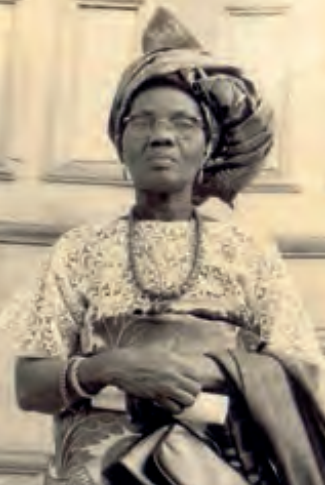
Funmilayo Ransome-Kuti
Funmilayo Ransome-Kuti was a Nigerian educator, political campaigner, suffragist, and women's rights activist. Born October 25, 1900, in Abeokuta. Died April 13, 1978, in Lagos. Positions held include political campaign. Educated at University of Ibadan and Abeokuta Grammar School. Awards include Lenin Peace Prize.
Facts
25 facts · 2 confirmed by two sources · 8 cited · 15 from one source
Where this comes from
Papalocal keeps its own record. It started from these sources; what each one said is kept here as it was copied, so a change on their side never changes this page by itself. Tap one to read its version.
What Wikidata says · copied November 16, 2026 · revision 2565845470
- Described as
- Nigerian educator, political campaigner, suffragist, and women's rights activist
- Other names
- Funmilayo Anikulapo-Kuti, The Mother of Africa, doyenne of female rights in Nigeria, Frances Abigail Olufunmilayo Olufela Folorunso Thomas, Funmilayo Aníkúlápó-Kuti, Oloye of the Yoruba people, Lioness of Lisab, Francis Abigail Olufunmilayo Thomas
- Born
- October 25, 1900 · 4 references
- Died
- April 13, 1978 · 3 references
- Born in
- Abeokuta · 2 references
- Died in
- Lagos · 2 references
- Cause of death
- falling from height · 2 references
- Name at birth
- Francis Abigail Olufunmilayo Thomas · 1 reference
- Citizen of
- Nigeria · 1 reference
- Occupation
- teacher · 1 reference; politician · 1 reference; activist · 1 reference; suffragette
- Positions held
- political campaign
- Political party
- National Council of Nigeria and the Cameroons (1951) · 1 reference
- Worked for
- activist · 1 reference
- Education
- University of Ibadan · 1 reference; Abeokuta Grammar School (1914–1917) · 1 reference
- Member of
- Abeokuta Women's Union (1932–) · 1 reference; Women's International Democratic Federation · 1 reference
- Awards
- Lenin Peace Prize · 1 reference
- Spouse
- Israel Olutodun Ransome-Kuti · 2 references
- Children
- Beko Ransome-Kuti · 1 reference; Olikoye Ransome-Kuti · 1 reference; Fela Kuti · 1 reference
- Father
- Josiah Ransome-Kuti · 1 reference
- Lived in
- Abeokuta
- Wikipedias with a page
- 39
Wikidata item Q226122 (wikidata.org/wiki/Q226122), public domain (CC0). Copied November 16, 2026.
What Wikipedia says · copied November 16, 2026 · revision 1385916138
Chief Funmilayo Ransome-Kuti (born Frances Abigail Olufunmilayo Olufela Folorunso Thomas; 25 October 1900 – 13 April 1978), also known as Funmilayo Aníkúlápó-Kuti, was a Nigerian educator, political organizer, and women's rights advocate who intellectually engaged with anti-imperialist, Pan-Africanist, and feminist ideologies. Ransome-Kuti also identified herself as an African Socialist.
Funmilayo Ransome-Kuti was born in Abeokuta, in Ogun State, Nigeria. She was the first female student to attend the Abeokuta Grammar School. As a young adult, she worked as a teacher, organizing some of the earliest preschool classes in the country and arranging literacy classes for lower-income women, laying important foundations for feminist education scholarship in Africa.
During the 1940s, Ransome-Kuti established the Abeokuta Women's Union, and advocated for women’s rights in Nigeria, demanding better representation of women in local governing bodies and an end to unfair taxes on market women. Ransome-Kuti led marches and protests of up to 10,000 women, forcing the ruling Alake of Egbaland to temporarily abdicate in 1949. As Ransome-Kuti’s political influence grew, she took part in the Nigerian independence movement, attending conferences and joining overseas delegations to discuss proposed national constitutions. Spearheading the creation of both the Nigerian Women’s Union and the Federation of Nigerian Women’s Societies, she advocated for women's suffrage in Nigeria. She became a noted member of international peace and women's rights movements.
Ransome-Kuti became vice president of the Women's International Democratic Federation (WIDF) in 1953, and would later lead the Nigerian branch of the Women's International League for Peace and Freedom (WILPF) in 1963. While in these roles, Ransome-Kuti helped build connections between Nigeria's independence movement and feminist, anti-colonial networks around the world. Her international work also drew political attention; British colonial authorities refused to renew her passport in 1957 and the United States denied her a visa in 1958, both citing suspected communist ties during the Cold War era.
Ransome-Kuti received the Lenin Peace Prize, and was also awarded membership in the meritoriousOrder of the Niger for her work. In her later years, she supported her sons' criticism of Nigeria's military governments.
Funmalayo Ransome-Kuti died at the age of 77, after being wounded in a military raid on family property.
Ransome-Kuti's had three children: a daughter, the musician and activist Fela Kuti (born Olufela Ransome-Kuti, d. 1997); a younger son, activist and physician Beko Ransome-Kuti (d. 2006); and an older son, a paediatrician, long-time professor of medicine and public health (in Africa and the United States), and former Health Minister of Nigeria, Olikoye Ransome-Kuti (d. 2004).
- Born, in its opening lines
- October 25, 1900
- Died, in its opening lines
- April 13, 1978
From the Wikipedia article “Funmilayo Ransome-Kuti” (en.wikipedia.org/wiki/Funmilayo_Ransome-Kuti), by its contributors, under CC BY-SA 4.0 (creativecommons.org/licenses/by-sa/4.0/). Copied November 16, 2026; not changed.
Confirmed Two sources agree. Cited One source, and it names where it got it. One source One source, without a reference of its own. Sources disagree The sources disagree. We show the best-supported value and keep theirs below.
