
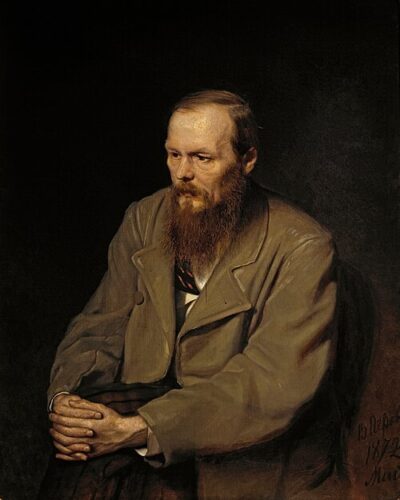
Fyodor Dostoyevsky
Fyodor Dostoyevsky was a Russian novelist and philosopher. Born October 30, 1821, in Mariinsky Hospital for the Poor. Died January 28, 1881, in Saint Petersburg. Known for Notes from Underground, Crime and Punishment and The Idiot. Educated at Military Engineering-Technical University and Nikolay engineering school.
Facts
37 facts · 0 confirmed by two sources · 7 cited · 27 from one source · 3 where the sources disagree
What’s different
- Born: we show October 30, 1821 (Sources disagree). Wikipedia says November 11, 1821
- Died: we show January 28, 1881 (Sources disagree). Wikipedia says February 9, 1881
- Cause of death: we show epilepsy (Sources disagree). Wikidata also lists pulmonary emphysema
Where this comes from
Papalocal keeps its own record. It started from these sources; what each one said is kept here as it was copied, so a change on their side never changes this page by itself. Tap one to read its version.
What Wikidata says · copied November 16, 2026 · revision 2569135619
- Described as
- Russian novelist and philosopher (1821–1881)
- Other names
- Fyodor Dostoevsky, Fyodor Mikhailovich Dostoevsky, Fyodor Doestoevsky, Doestoevsky, F.M. Dostoiewski, Fyodor Mikhaylovich Dostoievski, Dostoievski, Fyodor Dostoievski, Fyodor Mikhaylovich Dostoyevsky, Fëdor Mihajlovič Dostoevskij
- Born
- October 30, 1821 · 4 references
- Died
- January 28, 1881 · 10 references
- Born in
- Mariinsky Hospital for the Poor · 3 references
- Died in
- Saint Petersburg · 9 references
- Buried in
- Tikhvin Cemetery (1881) · 1 reference
- Cause of death
- epilepsy; pulmonary emphysema
- Citizen of
- Russian Empire
- Occupation
- translator; poet · 1 reference; novelist; essayist; short story writer; philosopher · 3 references; biographer; writer · 7 references
- Education
- Military Engineering-Technical University; Nikolay engineering school
- Member of
- Saint Petersburg Academy of Sciences
- Known for
- Notes from Underground; Crime and Punishment; The Idiot; Demons; The Brothers Karamazov; The House of the Dead; The Gambler; Poor Folk · 1 reference; The Double · 1 reference
- Spouse
- Anna Dostoyevskaya (1867–) · 2 references; Maria Dostoevskaya (1857–) · 1 reference
- Children
- Lyubov Dostoevskaya · 1 reference; Fyodor Dostoyevsky
- Father
- Mikhail Andreyevich Dostoevsky
- Mother
- Maria Dostoyevskaya
- Siblings
- Mikhail Dostoyevsky; Andrey Dostoyevsky; Nikolaj Michajlovič Dostoevskij
- Religion
- Russian Orthodox Church
- Wikipedias with a page
- 258
Wikidata item Q991 (wikidata.org/wiki/Q991), public domain (CC0). Copied November 16, 2026.
What Wikipedia says · copied November 16, 2026 · revision 1384016969
Fyodor Mikhailovich Dostoevsky (11 November [O.S. 30 October] 1821 – 9 February [O.S. 28 January] 1881) was a Russian philosopher, novelist, short-story writer, essayist, and journalist. He is regarded as one of the greatest novelists in both Russian and world literature, and many of his works are considered highly influential masterpieces. Dostoevsky's literary works explore the human condition in the troubled political, social and spiritual atmospheres of 19th-century Russia, and engage with a variety of philosophical and religious themes. His most acclaimed novels include Crime and Punishment (1866), The Idiot (1869), Demons (1872), The Adolescent (1875) and The Brothers Karamazov (1880). His Notes from Underground, a novella published in 1864, is considered one of the first works of existentialist literature.
Born in Moscow in 1821, Dostoevsky was introduced to literature at an early age through fairy tales and legends and through books by Russian and foreign authors. His mother died in 1837, and around the same time, he left school to enter the Nikolayevsky Engineering Academy. After graduating, he worked as an engineer and briefly enjoyed a lavish lifestyle, translating books to earn extra money. In the mid-1840s, he wrote his first novel, Poor Folk, which gained him entry into Saint Petersburg's literary circles. However, he was arrested in 1849 for belonging to a literary group, the Petrashevsky Circle, that discussed banned books critical of Tsarist Russia. Dostoevsky was sentenced to death, but the sentence was commuted at the last moment. He spent four years in a Siberian hard labour camp, which inspired him to write The House of the Dead (1860–1862). Aside from the labour camp, there also followed six years of compulsory military service in exile. In the following years, Dostoevsky worked as a journalist, publishing and editing several magazines of his own and later A Writer's Diary, a collection of his writings. He began to travel around Western Europe and developed a gambling addiction, which led to financial hardship. For a time, he had to beg for money, but he eventually became one of the most widely read and highly regarded Russian writers.
Dostoevsky's body of work consists of thirteen novels, three novellas, seventeen short stories, and numerous other works. His writings were widely read both within and beyond his native Russia, influencing an equally great number of later writers, including Russians such as Aleksandr Solzhenitsyn and Anton Chekhov, the philosophers Albert Camus and Jean-Paul Sartre, and the emergence of existentialism and Freudianism. Friedrich Nietzsche called him "the only psychologist from whom I had something to learn" in Twilight of the Idols. His books have been translated into over 170 languages.
- Born, in its opening lines
- November 11, 1821
- Died, in its opening lines
- February 9, 1881
From the Wikipedia article “Fyodor Dostoevsky” (en.wikipedia.org/wiki/Fyodor_Dostoevsky), by its contributors, under CC BY-SA 4.0 (creativecommons.org/licenses/by-sa/4.0/). Copied November 16, 2026; not changed.
Confirmed Two sources agree. Cited One source, and it names where it got it. One source One source, without a reference of its own. Sources disagree The sources disagree. We show the best-supported value and keep theirs below.
