
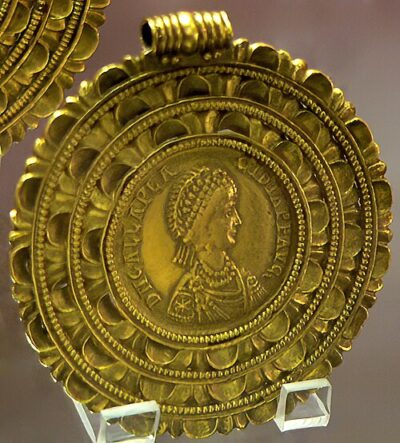
Galla Placidia
Galla Placidia was the 4th-century Roman Empress. Born 386, in Constantinople. Died November 27, 450, in Rome. Positions held include Roman Empress.
Facts
20 facts · 0 confirmed by two sources · 9 cited · 11 from one source
Where this comes from
Papalocal keeps its own record. It started from these sources; what each one said is kept here as it was copied, so a change on their side never changes this page by itself. Tap one to read its version.
What Wikidata says · copied November 16, 2026 · revision 2567352876
- Described as
- 4th-century Roman Empress
- Other names
- Aelia Galla Placidia
- Born
- 386
- Died
- November 27, 450 · 3 references
- Born in
- Constantinople · 1 reference
- Died in
- Rome · 1 reference
- Buried in
- Mausoleum of Honorius
- Citizen of
- Ancient Rome; Byzantine Empire
- Occupation
- politician
- Positions held
- Roman Empress
- Spouse
- Ataulf; Constantius III · 2 references
- Children
- Valentinian III · 2 references; Justa Grata Honoria; Theodosius
- Father
- Theodosius I · 1 reference
- Mother
- Galla · 1 reference
- Siblings
- Arcadius · 2 references; Honorius · 3 references; Pulcheria
- Religion
- Christianity
- Wikipedias with a page
- 48
Wikidata item Q237907 (wikidata.org/wiki/Q237907), public domain (CC0). Copied November 16, 2026.
What Wikipedia says · copied November 16, 2026 · revision 1378713004
Galla Placidia (392/93 – 27 November 450), daughter of the Roman emperor Theodosius I, was a mother, tutor, and advisor to emperor Valentinian III. She was queen consort to Ataulf, King of the Visigoths, from 414 until his death in 415, briefly empress consort to Constantius III in 421, and managed the government administration as a regent during the early reign of Valentinian III until her death.
From the Wikipedia article “Galla Placidia” (en.wikipedia.org/wiki/Galla_Placidia), by its contributors, under CC BY-SA 4.0 (creativecommons.org/licenses/by-sa/4.0/). Copied November 16, 2026; not changed.
Confirmed Two sources agree. Cited One source, and it names where it got it. One source One source, without a reference of its own. Sources disagree The sources disagree. We show the best-supported value and keep theirs below.
