
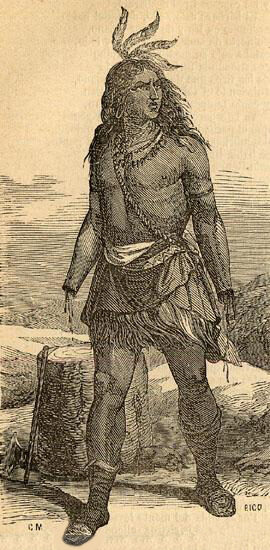
Galvarino was a Mapuche warrior. Born September 21, 1490. Died November 30, 1557.
Facts
3 facts · 1 confirmed by two sources · 0 cited · 2 from one source
Where this comes from
Papalocal keeps its own record. It started from these sources; what each one said is kept here as it was copied, so a change on their side never changes this page by itself. Tap one to read its version.
What Wikidata says · copied November 17, 2026 · revision 2523838412
- Described as
- Mapuche warrior
- Born
- September 21, 1490
- Died
- November 30, 1557
- Occupation
- military personnel
- Wikipedias with a page
- 24
Wikidata item Q965840 (wikidata.org/wiki/Q965840), public domain (CC0). Copied November 17, 2026.
What Wikipedia says · copied November 17, 2026 · revision 1366374164
Galvarino (died c. November 30, 1557) was a famous Mapuche warrior during the majority of the early part of the Arauco War. He fought and was taken prisoner along with 150 other Mapuche, in the Battle of Lagunillas against governor García Hurtado de Mendoza. As punishment for insurrection, some of these prisoners were condemned to amputation of their right hand and nose, while others such as Galvarino had both hands cut off. Galvarino and the rest were then released as a lesson and warning for the rest of the Mapuche. Mendoza sent him to inform general Caupolicán of the number and quality of the people which had entered their land again, to put some fear into him, among other means that were tried, so that he might submit without coming to blows.
When returning to the Mapuche, he appeared before Caupolicán and the council of war, showing them his mutilations, crying out for justice and a greater rising of the Mapuche against this Spanish invader like the one of Lautaro. For his bravery and gallantry, he was named by the council to command a squadron. With knives fastened on both mutilated wrists replacing his hands, he fought next to Caupolicán in the following campaign until the Battle of Millarapue, where his squadron fought against that of governor Mendoza himself and he was able to strike down the second in command.He came commanding as a sergeant and animating his men this way: "Ea, my brothers, see that you all fight very well, you do not want me as I am without hands, so that you will not be able to work nor to eat, if you do not give it to them!" And he raised those arms on high, showing them to cause them to fight with more spirit and saying to them: "Those that you are going to fight with cut them, and also will do to whichever of you they take, and nobody is allowed to flee but to die, because you die defending your mother country." He moved ahead of the squadron a distance, and said with a loud voice that he would die first and though he no longer had hands, that he would do what he could with his teeth.Jerónimo de Vivar, Crónica, Capítulo CXXXIII. "My Brothers, why have you stopped attacking these Christians, seeing the manifest damage that from the day which they entered our kingdom until today they have done and are doing? And they still will do to you what you see that they have done and they are doing? And still they will do to you what you see that they have done to me, cut your hands off, if you are not diligent in making the most of wreaking destruction on these so injurious people for us and or our children and women."Pedro Mariño de Lobera, Crónica del Reino de Chile, Libro 2 Capítulo IV
However, Mendoza's command broke Galvarino's division after over an hour of combat and won the battle, killing 3,000 Mapuche and capturing over 800 including him. Mendoza ordered him to be executed by being thrown to the dogs.
In the book La Araucana, written by Alonso de Ercilla, he explains that the real death of Galvarino was by hanging.
- Died, in its opening lines
- November 30, 1557
From the Wikipedia article “Galvarino” (en.wikipedia.org/wiki/Galvarino), by its contributors, under CC BY-SA 4.0 (creativecommons.org/licenses/by-sa/4.0/). Copied November 17, 2026; not changed.
Confirmed Two sources agree. Cited One source, and it names where it got it. One source One source, without a reference of its own. Sources disagree The sources disagree. We show the best-supported value and keep theirs below.
