
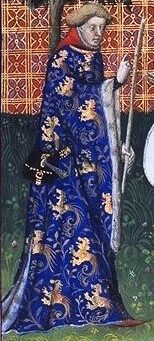
Gaston III, Count of Foix
Gaston III, Count of Foix was a Count of Foix, Viscount of Bearn and writer. Born April 30, 1331, in Orthez. Died August 1, 1391, in L'Hôpital-d'Orion. Positions held include French co-prince of Andorra (1343–1391) and count of Foix (1343–1391). Known for Livre de chasse and Le livre des oraisons.
Facts
20 facts · 2 confirmed by two sources · 0 cited · 18 from one source
Where this comes from
Papalocal keeps its own record. It started from these sources; what each one said is kept here as it was copied, so a change on their side never changes this page by itself. Tap one to read its version.
What Wikidata says · copied November 18, 2026 · revision 2555398888
- Described as
- Count of Foix, Viscount of Bearn and writer (1331–1391)
- Other names
- Gaston Febus, Gaston Fébus, Gaston Phœbus, Gaston III de Foix, Gaston III
- Born
- April 30, 1331
- Died
- August 1, 1391
- Born in
- Orthez
- Died in
- L'Hôpital-d'Orion
- Cause of death
- stroke
- Citizen of
- Kingdom of France
- Occupation
- writer; poet; hunter
- Positions held
- French co-prince of Andorra (1343–1391); count of Foix (1343–1391) · 1 reference
- Known for
- Livre de chasse; Le livre des oraisons
- Spouse
- Agnès de Navarre (1349–) · 1 reference
- Children
- Bernal de Foix, 1st Count of Medinaceli; Yvain de Foix; Gaston of Foix-Béarn · 1 reference
- Father
- Gaston II, Count of Foix
- Mother
- Eleanor of Comminges
- Siblings
- Pierre de Béarn
- Wikipedias with a page
- 21
Wikidata item Q386816 (wikidata.org/wiki/Q386816), public domain (CC0). Copied November 18, 2026.
What Wikipedia says · copied November 18, 2026 · revision 1363800040
Gaston III, known as Gaston Phoebus or Fébus (30 April 1331 – 1 August 1391), was the count of Foix (as Gaston III) and viscount of Béarn (as Gaston X) from 1343 until his death.
Gaston III was overlord of approximately ten territories located between Gascony and Languedoc. During the Hundred Years' War, he established his domination over the Pre-Pyrenees by playing on the conflicts between French and English monarchies. He authored the Livre de chasse, an illustrated manuscript on hunting. Gaston used the name Fébus, using the Occitan spelling, after a crusade in Prussia in reference to the Greco-Roman sun-god Apollo (known contemporaneously as Phoibos).
The only legitimate child of Gaston II, Count of Foix, and Aliénor of Comminges, Gaston inherited a fragmented territory that paid homage to the king of France as well as the king of England. During the Hundred Years' War, he claimed sovereignty over Béarn on 25 September 1347. He won decisive victories against the House of Armagnac (the ancestral enemies of his house), thus ensuring the union between Béarn and Foix. Gaston left no legitimate heir, as he likely killed his only legitimate son, Gaston, in 1380 for attempting to assassinate him.
Gaston constructed and strengthened several fortresses during his life. Endowed with immense wealth, Gaston III notably built the Château de Montaner to symbolize the union between Béarn and Foix. Known as the prince of the Pyrenees, Gaston ruled as an enlightened despot, playing the role of lord protector for his people. Gaston III is prominent in Pyrenean history due to his reign, but also from the accounts of various chroniclers and contemporaries, including Jean Froissart in his Chronicles.
- Born, in its opening lines
- April 30, 1331
- Died, in its opening lines
- August 1, 1391
From the Wikipedia article “Gaston III of Foix” (en.wikipedia.org/wiki/Gaston_III_of_Foix), by its contributors, under CC BY-SA 4.0 (creativecommons.org/licenses/by-sa/4.0/). Copied November 18, 2026; not changed.
Confirmed Two sources agree. Cited One source, and it names where it got it. One source One source, without a reference of its own. Sources disagree The sources disagree. We show the best-supported value and keep theirs below.
