
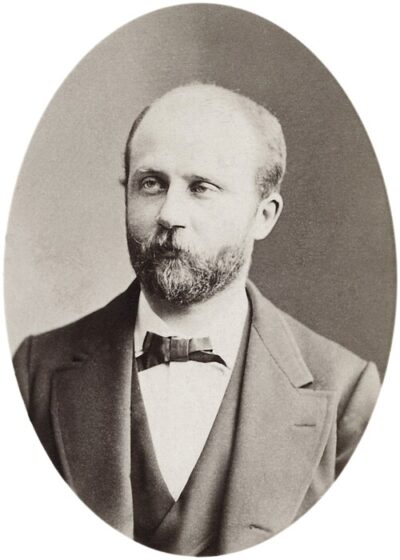
Gaston Maspero
Gaston Maspero was a French egyptologist. Born June 24, 1846, in former 1st arrondissement of Paris. Died June 30, 1916, in Paris. Positions held include Perpetual Secretary of the Académie des Inscriptions et Belles-Lettres and chairperson. Educated at École Normale Supérieure and Lycée Louis-le-Grand. Awards include Commander of the Legion of Honour and Knight Commander of the Order of St Michael and St George.
Facts
36 facts · 1 confirmed by two sources · 15 cited · 19 from one source · 1 where the sources disagree
What’s different
- Born: we show June 24, 1846 (Sources disagree). Wikipedia says June 23, 1846
Where this comes from
Papalocal keeps its own record. It started from these sources; what each one said is kept here as it was copied, so a change on their side never changes this page by itself. Tap one to read its version.
What Wikidata says · copied November 16, 2026 · revision 2565560304
- Described as
- French egyptologist (1846–1916)
- Other names
- Gaston Camille Charles Maspero, Sir Gaston Camille Charles Maspero, G. Maspero
- Born
- June 24, 1846 · 1 reference
- Died
- June 30, 1916 · 13 references
- Born in
- former 1st arrondissement of Paris · 1 reference
- Died in
- Paris · 2 references
- Buried in
- Montparnasse Cemetery
- Name at birth
- Gaston Camille Charles Maspero · 1 reference
- Citizen of
- France (1870–); Kingdom of Italy (1861–1870)
- Occupation
- Egyptologist · 1 reference; archaeologist · 1 reference; university teacher · 1 reference; folklorist; writer · 1 reference; art historian · 2 references; orientalist · 1 reference
- Positions held
- Perpetual Secretary of the Académie des Inscriptions et Belles-Lettres; chairperson
- Worked for
- Collège de France (1874–1916) · 1 reference; École pratique des hautes études; Institut Français d'Archéologie Orientale; Supreme Council of Antiquities; Boulaq Museum
- Education
- École Normale Supérieure; Lycée Louis-le-Grand
- Member of
- Académie des Inscriptions et Belles-Lettres (1883–1916) · 2 references; American Academy of Arts and Sciences; Royal Prussian Academy of Sciences; The Queen's College; Academy of Sciences of Turin (1885–) · 1 reference; Royal Netherlands Academy of Arts and Sciences · 1 reference; Accademia Nazionale dei Lincei (1895–) · 1 reference
- Awards
- Commander of the Legion of Honour; Knight Commander of the Order of St Michael and St George
- Children
- Georges Maspero · 1 reference; Henri Maspero · 1 reference; Jean Maspero · 1 reference
- Wikipedias with a page
- 41
Wikidata item Q311816 (wikidata.org/wiki/Q311816), public domain (CC0). Copied November 16, 2026.
What Wikipedia says · copied November 16, 2026 · revision 1334003841
Sir Gaston Camille Charles Maspero (23 June 1846 – 30 June 1916) was a French Egyptologist and director general of excavations and antiquities for the Egyptian government. Widely regarded as the foremost Egyptologist of his generation, he began his career teaching Egyptian language in Paris becoming a professor at the Collège de France. In 1880, he led an archaeological mission to Egypt, which later became the Institut Français d'Archéologie Orientale.
In 1881, Maspero's investigation led to the discovery of a hidden tomb near Dayr al-Baḥrī, containing 40 mummies, including pharaohs Seti I, Amenhotep I, Thutmose III, and Ramses II. His study of these findings was published in Les Momies royales de Deir-el-Bahari (1889). After a brief period in Paris, he returned to Egypt to organize a vast collection of antiquities at a museum in Cairo's Būlāq district, which later became the foundation of the Egyptian Museum established in 1902. During his second tenure as director general (1899–1914), Maspero regulated excavations, combated illicit trade, preserved monuments, and oversaw the archaeological survey of Nubia.
Maspero was highly regarded for his versatility and contributions to Egyptology. He authored the comprehensive Histoire ancienne des peuples de l’Orient classique (1895–1897) and was the first editor and translator of the Pyramid Texts, known as the Book of the Dead. His work extended to art, mythology, and religion, influencing many through his role as editor of the Recueil de travaux and Director of the Egyptian Service des Antiquités. Maspero's son, Henri Maspero, became a notable sinologist and scholar of East Asia.
- Born, in its opening lines
- June 23, 1846
- Died, in its opening lines
- June 30, 1916
From the Wikipedia article “Gaston Maspero” (en.wikipedia.org/wiki/Gaston_Maspero), by its contributors, under CC BY-SA 4.0 (creativecommons.org/licenses/by-sa/4.0/). Copied November 16, 2026; not changed.
Confirmed Two sources agree. Cited One source, and it names where it got it. One source One source, without a reference of its own. Sources disagree The sources disagree. We show the best-supported value and keep theirs below.
