
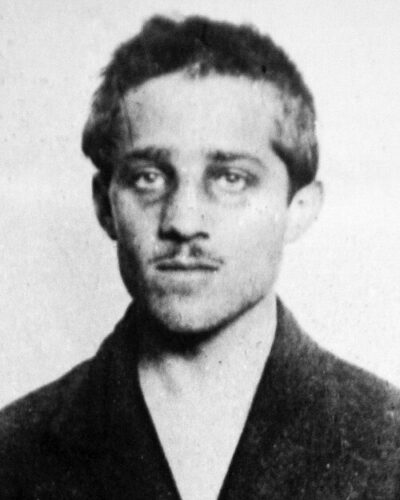
Gavrilo Princip
Gavrilo Princip was a Bosnian Serb assassin. Born July 13, 1894, in Obljaj. Died April 28, 1918, in Theresienstadt Small Fortress. Educated at First Belgrade Gymnasium.
Facts
15 facts · 1 confirmed by two sources · 5 cited · 8 from one source · 1 where the sources disagree
What’s different
- Born: we show July 13, 1894 (Sources disagree). Wikipedia says July 25, 1894
Where this comes from
Papalocal keeps its own record. It started from these sources; what each one said is kept here as it was copied, so a change on their side never changes this page by itself. Tap one to read its version.
What Wikidata says · copied November 16, 2026 · revision 2569042930
- Described as
- Bosnian Serb assassin (1894–1918)
- Born
- July 13, 1894 · 1 reference
- Died
- April 28, 1918 · 6 references
- Born in
- Obljaj · 4 references
- Died in
- Theresienstadt Small Fortress · 4 references
- Buried in
- Vidovdan Heroes chapel · 1 reference
- Cause of death
- tuberculosis
- Citizen of
- Austria–Hungary · 1 reference
- Occupation
- revolutionary · 1 reference
- Education
- First Belgrade Gymnasium
- Member of
- Young Bosnia
- Field
- assassination of Archduke Franz Ferdinand · 1 reference
- Father
- Petar Princip
- Mother
- Marija Princip
- Religion
- Serbian Orthodox Church
- Lived in
- Sarajevo
- Wikipedias with a page
- 99
Wikidata item Q80492 (wikidata.org/wiki/Q80492), public domain (CC0). Copied November 16, 2026.
What Wikipedia says · copied November 16, 2026 · revision 1385010545
Gavrilo Princip (Serbian Cyrillic: Гаврило Принцип, pronounced [ɡǎʋrilo prǐnt͡sip]; 25 July 1894 – 28 April 1918) was a Bosnian Serb student who assassinated Archduke Franz Ferdinand, heir presumptive to the throne of Austria-Hungary, and his wife Sophie, Duchess of Hohenberg, in Sarajevo on 28 June 1914. The assassination set off the July Crisis, a series of events that within one month led to the outbreak of World War I.
Princip was born in western Bosnia to a poor Serb family. Aged 13, he was sent to Sarajevo, the capital of Austrian-occupied Bosnia, to study at the Merchants' School. He later transferred to the gymnasium, where he became politically aware. In 1911, he joined Young Bosnia, a secret local society aiming to free Bosnia from Austrian rule and achieve the unification of the South Slavs. After attending anti-Austrian demonstrations in Sarajevo, he was expelled from school and walked to Belgrade, Serbia, to continue his education. During the First Balkan War, Princip traveled to Southern Serbia to volunteer with the Serbian army's irregular forces fighting against the Ottoman Empire but was rejected for being too small and weak.
In 1913, following the unexpected success of the Serbians in the war against the Ottomans, the Austrian military governor of Bosnia, Oskar Potiorek, declared a state of emergency, dissolved the parliament, imposed martial rule, and banned Serbian public, cultural, and educational societies. Inspired by assassination attempts against Imperial officials by Slavic nationalists and anarchists, Princip persuaded two other young Bosnians to join a plot to assassinate the heir to the Habsburg Empire during his announced visit to Sarajevo. The Black Hand, a Serbian secret society with ties to Serbian military intelligence, provided the conspirators with weapons and training before facilitating their re-entry into Bosnia.
On Sunday 28 June 1914, during the royal couple's visit to Sarajevo, the then-teenager Princip mortally wounded Franz Ferdinand and Sophie by firing a pistol into their open car. Princip was arrested immediately by Austro-Hungarian authorities and tried alongside 24 others, all Bosnians and thus Austro-Hungarian subjects. At his trial, Princip stated: "I am a Yugoslav nationalist, aiming for the unification of all Yugoslavs, and I do not care what form of state, but it must be free from Austria." Princip was spared the death penalty because of his age (19) and sentenced to twenty years in prison. He was imprisoned at the Terezín Fortress. The Serbian government itself did not inspire the assassination but the Austrian Foreign Office and Army used the murders as a reason for a preventive war which led directly to World War I.
Princip died on 28 April 1918 of tuberculosis, worsened by harsh prison conditions, that had already led to the amputation of his right arm. His legacy is viewed as controversial; many Serbs regard him as a hero who stood against colonial oppression and slavery, while Bosniaks and Croats frequently view him as a terrorist.
- Born, in its opening lines
- July 25, 1894
- Died, in its opening lines
- April 28, 1918
From the Wikipedia article “Gavrilo Princip” (en.wikipedia.org/wiki/Gavrilo_Princip), by its contributors, under CC BY-SA 4.0 (creativecommons.org/licenses/by-sa/4.0/). Copied November 16, 2026; not changed.
Confirmed Two sources agree. Cited One source, and it names where it got it. One source One source, without a reference of its own. Sources disagree The sources disagree. We show the best-supported value and keep theirs below.
