
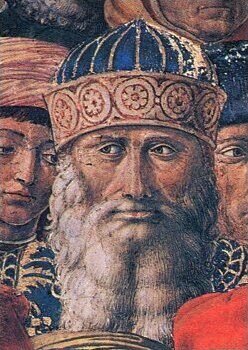
Gemistus Pletho
Gemistus Pletho was the 15th-century Byzantine Greek philosopher. Born 1355, in Constantinople. Died June 26, 1452, in Mystras.
Facts
8 facts · 1 confirmed by two sources · 2 cited · 4 from one source · 1 where the sources disagree
What’s different
- Born: we show 1355 (Sources disagree). Wikipedia says 1360
Where this comes from
Papalocal keeps its own record. It started from these sources; what each one said is kept here as it was copied, so a change on their side never changes this page by itself. Tap one to read its version.
What Wikidata says · copied November 16, 2026 · revision 2569550126
- Described as
- 15th-century Byzantine Greek philosopher
- Other names
- Georgios Gemistus
- Born
- 1355 · 11 references
- Died
- June 26, 1452 · 2 references
- Born in
- Constantinople · 1 reference
- Died in
- Mystras · 1 reference
- Buried in
- Tempio Malatestiano · 2 references
- Citizen of
- Byzantine Empire
- Occupation
- philosopher
- Field
- philosophy
- Wikipedias with a page
- 44
Wikidata item Q220313 (wikidata.org/wiki/Q220313), public domain (CC0). Copied November 16, 2026.
What Wikipedia says · copied November 16, 2026 · revision 1380215255
Georgios Gemistos Plethon (Greek: Γεώργιος Γεμιστὸς Πλήθων; Latin: Georgius Gemistus Pletho; c. 1355/1360 – 1452/1454), commonly known as Gemistos Plethon, was a Greek scholar and one of the most renowned philosophers of the Late Byzantine era. He was a chief pioneer of the revival of Greek scholarship in Western Europe. As revealed in his last literary work, the Nomoi or Book of Laws, which he circulated only among close friends, he rejected Christianity in favour of a return to the worship of the classical Hellenic gods, mixed with ancient wisdom based on Zoroaster and the Magi.
In 1438–1439, he reintroduced Plato's ideas to Western Europe during the Council of Florence in a failed attempt to reconcile the East–West Schism. Plethon also formulated his political vision in several speeches throughout his life. The boast in one of the speeches that "We are Hellenes by race and culture" and his proposal of a reborn Byzantine Empire following a utopian Hellenic system of government centered in Mystras, have generated discussion about Byzantine and modern Greek identity. In this regard, Plethon has been labelled both "the last Hellene" and "the first modern Greek". He is also remembered for kickstarting the Florentine Renaissance.
- Born, in its opening lines
- 1360
- Died, in its opening lines
- 1452
From the Wikipedia article “Gemistos Plethon” (en.wikipedia.org/wiki/Gemistos_Plethon), by its contributors, under CC BY-SA 4.0 (creativecommons.org/licenses/by-sa/4.0/). Copied November 16, 2026; not changed.
Confirmed Two sources agree. Cited One source, and it names where it got it. One source One source, without a reference of its own. Sources disagree The sources disagree. We show the best-supported value and keep theirs below.
