
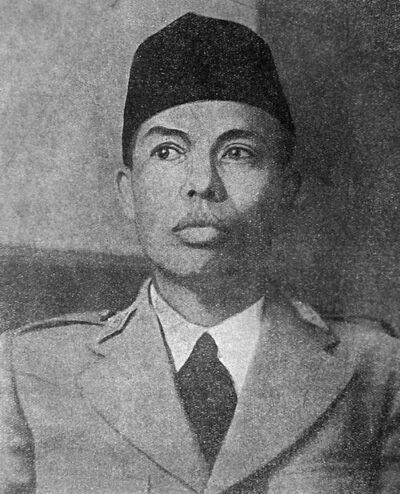
General Soedirman
General Soedirman was a first Commander-in-Chief of the Indonesian armed forces. Born January 24, 1916, in Purbalingga. Died January 29, 1950, in Magelang. Positions held include Commander of the Indonesian National Armed Forces. Educated at Hollandsch-Inlandsche School and Meer Uitgebreid Lager Onderwijs. Awards include National Hero of Indonesia, Star of the Republic of Indonesia and Bintang Mahaputera.
Facts
30 facts · 2 confirmed by two sources · 9 cited · 18 from one source · 1 where the sources disagree
What’s different
- Born in: we show Purbalingga (Sources disagree). Wikidata also lists Bantarbarang
Where this comes from
Papalocal keeps its own record. It started from these sources; what each one said is kept here as it was copied, so a change on their side never changes this page by itself. Tap one to read its version.
What Wikidata says · copied November 17, 2026 · revision 2570764620
- Described as
- first Commander-in-Chief of the Indonesian armed forces
- Other names
- Soedirman, Si Kaji, Sang Jenderal, Panglima Besar, Jenderal Besar, Panglima di antara Panglima, Generalissimo
- Born
- January 24, 1916 · 4 references
- Died
- January 29, 1950 · 2 references
- Born in
- Purbalingga · 1 reference; Bantarbarang · 1 reference
- Died in
- Magelang
- Buried in
- Kusumanegara Heroes' Cemetery
- Cause of death
- tuberculosis
- Citizen of
- Indonesia
- Occupation
- military personnel · 1 reference; teacher · 2 references; politician · 1 reference; head teacher · 1 reference; resistance fighter; military officer; soldier · 1 reference
- Positions held
- Commander of the Indonesian National Armed Forces
- Education
- Hollandsch-Inlandsche School (–1930) · 1 reference; Meer Uitgebreid Lager Onderwijs (1932–1935)
- Member of
- Muhammadiyah; Hizbul Wathan
- Awards
- National Hero of Indonesia; Star of the Republic of Indonesia; Bintang Mahaputera; Bintang Sakti · 1 reference
- Spouse
- Siti Alfiah · 1 reference
- Father
- Raden Tjokrosunarjo · 1 reference
- Religion
- Islam
- Military branch
- army
- Military rank
- brigadier general; general; Jenderal Besar
- Wikipedias with a page
- 25
Wikidata item Q2367329 (wikidata.org/wiki/Q2367329), public domain (CC0). Copied November 17, 2026.
What Wikipedia says · copied November 17, 2026 · revision 1385814525
Sudirman (Old Spelling: Soedirman; 24 January 1916 – 29 January 1950) was an Indonesian military officer and revolutionary during the Indonesian National Revolution and the first commander of the Indonesian National Armed Forces.
Born in Purbalingga, Dutch East Indies, Sudirman moved to Cilacap in 1916 and was raised by his uncle. A diligent student at a Muhammadiyah-run school, he became respected within the community for his devotion to Islam. After dropping out of teacher's college, in 1936 he began working as a teacher, and later headmaster, at a Muhammadiyah-run elementary school. After the Japanese occupied the Indies in 1942, Sudirman continued to teach, before joining the Japanese-sponsored Defenders of the Homeland (PETA) as a battalion commander in Banyumas in 1944. In this position he put down a rebellion by his fellow soldiers, but was later interned in Bogor. After Indonesia proclaimed its independence on 17 August 1945, Sudirman led a break-out then went to Jakarta to meet President Sukarno. Tasked with overseeing the surrender of Japanese soldiers in Banyumas, he established a Division of the People's Safety Body there. On 12 November 1945, at an election to decide the military's commander-in-chief in Yogyakarta, Sudirman was chosen over Oerip Soemohardjo in a Close vote. While waiting to be confirmed, Sudirman ordered an assault on British and Dutch forces in Ambarawa. The ensuing battle and British withdrawal strengthened Sudirman's popular support, and he was ultimately confirmed on 18 December.
During the following three years Sudirman saw negotiations with the returning Dutch colonial forces fail, first after the Linggadjati Agreement – which Sudirman participated in drafting – and then the Renville Agreement; he was also faced with internal dissent, including a 1948 coup attempt. He later blamed these issues for his tuberculosis, which led to his right lung collapsing in November 1948. On 19 December 1948, several days after Sudirman's release from the hospital, the Dutch launched an assault on the capital. Sudirman and a small contingent escaped Dutch forces and left the city, making their headquarters at Sobo, near Mount Lawu. There Sudirman commanded military activities throughout Java, including a show of force in Yogyakarta on 1 March 1949. When the Dutch began withdrawing, in July 1949 Sudirman was recalled to Yogyakarta and forbidden to fight further. In late 1949 Sudirman's tuberculosis relapsed, and he retired to Magelang, where he died slightly more than a month after the Dutch recognised Indonesia's independence. He is buried at Semaki Heroes' Cemetery in Yogyakarta.
Sudirman's death was mourned throughout Indonesia, with flags flown at half-mast and thousands gathering to see his funeral convoy and procession. He continues to be highly respected in Indonesia. His guerrilla campaign has been credited with developing the army's esprit de corps, and the 100-kilometre (62 mi) long route he took must be followed by Indonesian cadets before graduation. Sudirman featured prominently on the 1968 series of rupiah banknotes, and has numerous streets, museums, and monuments named after him. On 10 December 1964, he was declared a National Hero of Indonesia.
- Born, in its opening lines
- January 24, 1916
- Died, in its opening lines
- January 29, 1950
From the Wikipedia article “Sudirman” (en.wikipedia.org/wiki/Sudirman), by its contributors, under CC BY-SA 4.0 (creativecommons.org/licenses/by-sa/4.0/). Copied November 17, 2026; not changed.
Confirmed Two sources agree. Cited One source, and it names where it got it. One source One source, without a reference of its own. Sources disagree The sources disagree. We show the best-supported value and keep theirs below.
