
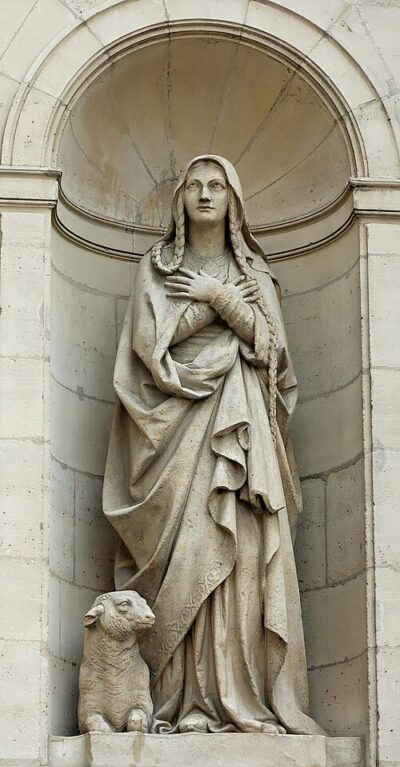
Genevieve of Paris
Genevieve of Paris was a Patron saint of Paris (c.419/422 - c.502/512). Born 423, in Nanterre. Died 502, in Paris.
Facts
7 facts · 0 confirmed by two sources · 0 cited · 7 from one source
Where this comes from
Papalocal keeps its own record. It started from these sources; what each one said is kept here as it was copied, so a change on their side never changes this page by itself. Tap one to read its version.
What Wikidata says · copied November 16, 2026 · revision 2553821509
- Described as
- Patron saint of Paris (c.419/422 - c.502/512)
- Other names
- Saint Geneviève, Saint Genevieve, Genovefa, Genoveva, St. Genevieve, Geneviève, St Genevieve
- Born
- 423
- Died
- 502
- Born in
- Nanterre
- Died in
- Paris
- Buried in
- Saint-Étienne-du-Mont
- Citizen of
- Western Roman Empire
- Religion
- Christianity
- Wikipedias with a page
- 48
Wikidata item Q235863 (wikidata.org/wiki/Q235863), public domain (CC0). Copied November 16, 2026.
What Wikipedia says · copied November 16, 2026 · revision 1384903930
Genevieve (French: Sainte Geneviève; Latin: Genovefa; and Genofeva; c. 419/422 AD – 502/512 AD) was a consecrated virgin, and is one of the patron saints of Paris in the Catholic Church, and she is also venerated in the Eastern Orthodox Church. Her feast day is on 3 January.
Recognized for her religious devotion at a young age, she met Germanus of Auxerre and Lupus of Troyes when she was a child and dedicated herself to a virginal life. Miracles and healings began to happen around her early on, and she became known for changing the weather. She moved from Nanterre, her hometown, to Paris after her parents died and became known for her piety, healings, and miracles, although the residents of Paris resented her and would have killed her if not for Germanus's interventions. Her prayers saved Paris from being destroyed by the Huns under Attila in 451 and other wars; her organisation of the city's women was called a "prayer marathon" and Genevieve's "most famous feat". She was involved in two major construction projects in Paris, a basilica in the honour of Saint Denis of Paris in 475 and the Basilica of the Holy Apostles, dedicated to Saint Peter and Saint Paul c. 500.
She was recognized as the patron saint of Paris in the 14th century. She was "a favorite of both the humblest residents and of the Bourbon family, and was equally venerated by Erasmus and revolutionary fishwives" and was considered "a cultural symbol which Parisians shared, appropriated, negotiated, and used according to specific communal assumptions and traditions".
Genevieve was publicly invoked during emergencies related to the needs and expectations of the residents of Paris 153 times between 885 and October 1791, ranging from spontaneous and less-ritualized invocations and processions with her reliquary during the Middle Ages to highly ritualized ones said before her unveiled reliquary in the years leading up to the French Revolution. As times and conditions changed in Paris, so did the ways in which Genevieve was invoked and processed. As new calamities threatened the city and new intercessions to her were needed, new associations, images, and metaphors were required. Devotion to her remained popular throughout the history of Paris, although devotion to her has never returned to its pre-Revolutionary popularity and unifying status.
From the Wikipedia article “Genevieve” (en.wikipedia.org/wiki/Genevieve), by its contributors, under CC BY-SA 4.0 (creativecommons.org/licenses/by-sa/4.0/). Copied November 16, 2026; not changed.
Confirmed Two sources agree. Cited One source, and it names where it got it. One source One source, without a reference of its own. Sources disagree The sources disagree. We show the best-supported value and keep theirs below.
