
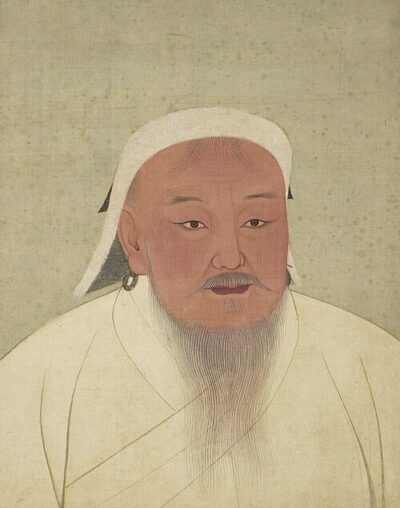
Genghis Khan
Genghis Khan was a founder and first khan of the Mongol Empire. Born May 31, 1162, in Delüün Boldog. Died August 25, 1227, in Yinchuan. Positions held include Khagan of the Mongol Empire (1206–1227).
Facts
40 facts · 0 confirmed by two sources · 14 cited · 24 from one source · 2 where the sources disagree
What’s different
- Born: we show May 31, 1162 (Sources disagree). Wikipedia says August 25, 1227
- Name at birth: we show ᠲᠡᠮᠦᠵᠢᠨ (Sources disagree). Wikidata also lists Тэмүжин
Where this comes from
Papalocal keeps its own record. It started from these sources; what each one said is kept here as it was copied, so a change on their side never changes this page by itself. Tap one to read its version.
What Wikidata says · copied November 16, 2026 · revision 2570030380
- Described as
- founder and first khan of the Mongol Empire (1162–1227)
- Other names
- Chinggis Khan, Tiemuzhen, Temujin, Chengjisihan, Jenghiz, Emperor Taizu, Chingiz, Chingiz Khan, Jenghis Khan, Borjigin Temüjin, Jenghis, Temuchin
- Born
- May 31, 1162
- Died
- August 25, 1227 · 3 references
- Born in
- Delüün Boldog
- Died in
- Yinchuan
- Buried in
- Mausoleum of Genghis Khan
- Cause of death
- horse fall
- Name at birth
- ᠲᠡᠮᠦᠵᠢᠨ; Тэмүжин
- Citizen of
- Mongol Empire
- Occupation
- military leader; traditional leader or chief; monarch
- Positions held
- Khagan of the Mongol Empire (1206–1227)
- Spouse
- Börte; Khulan Khatun; Gürbesu; Yesui; Yesugen; Chahe
- Children
- Jochi · 1 reference; Chagatai Khan · 3 references; Ögedei Khan · 1 reference; Tolui · 1 reference; Wuluchi · 1 reference; Alahaibieji · 1 reference; Tümelün · 1 reference; Chechiyegen · 1 reference; Yeli'andun · 1 reference; Al-Altan · 1 reference; Qojin · 1 reference; Kölgen · 1 reference
- Father
- Yesugei
- Mother
- Hoelun · 1 reference
- Siblings
- Qasar; Behter; Belgutei; Hachiun; Temüge; Temulin · 1 reference
- Religion
- Tengrism · 1 reference
- Military branch
- Military of the Mongol Empire
- Wikipedias with a page
- 210
Wikidata item Q720 (wikidata.org/wiki/Q720), public domain (CC0). Copied November 16, 2026.
What Wikipedia says · copied November 16, 2026 · revision 1382341259
Genghis Khan (born Temüjin; c. 1162 – 18 or 25 August 1227), also known as Chinggis Khan, was the founder and first khan of the Mongol Empire. After spending most of his life uniting the Mongol tribes, he launched a series of military campaigns, conquering large parts of China and Central Asia.
Genghis Khan was born Temüjin between 1155 and 1167 as the eldest child of Yesugei, a Mongol chieftain of the Borjigin clan, and his wife Hö'elün. When Temüjin was eight, his father died and his family was abandoned by its tribe. Reduced to near-poverty, Temüjin killed his older half-brother Behter to secure his familial position. His charismatic personality helped to attract his first followers and to form alliances with two prominent steppe leaders named Jamukha and Toghrul; they worked together to retrieve Temüjin's newlywed wife Börte, who had been kidnapped by raiders. As his reputation grew, his relationship with Jamukha deteriorated into open warfare. Temüjin was badly defeated in c. 1187, and may have spent the following years as a subject of the Jin dynasty; upon reemerging in 1196, he swiftly began gaining power. Toghrul came to view Temüjin as a threat and launched a surprise attack on him in 1203. Temüjin regrouped and overpowered Toghrul. After defeating the Naiman tribe and executing Jamukha, he was left as the sole ruler on the Mongolian steppe.
Temüjin formally adopted the title "Genghis Khan", the meaning of which is uncertain, at an assembly in 1206. Carrying out reforms designed to ensure long-term stability, he transformed the Mongols' tribal structure into an integrated meritocracy dedicated to the service of the ruling family. After thwarting a coup attempt from a powerful shaman, Genghis began to consolidate his power. In 1209, he led a large-scale raid against the neighbouring Western Xia, who agreed to Mongol terms the following year. He then launched a campaign against the Jin dynasty, which lasted for four years and ended in 1215 with the capture of the Jin capital Zhongdu. His general Jebe annexed the Central Asian state of Qara Khitai in 1218. The following year, Genghis invaded the Khwarazmian Empire following the execution of his envoys; the campaign toppled the Khwarazmian state and devastated the regions of Transoxiana and Khorasan, while Jebe and his colleague Subutai led an expedition that reached Georgia and Kievan Rus'. In 1227, Genghis died while subduing the rebellious Western Xia. Following a two-year interregnum, his third son and heir Ögedei acceded to the throne in 1229.
Genghis Khan remains a controversial figure. He was generous and intensely loyal to his followers, but ruthless towards his enemies. He welcomed advice from diverse sources in his quest for world domination, for which he believed the shamanic supreme deity Tengri had destined him. The Mongol army under Genghis killed millions of people, yet his conquests also facilitated unprecedented commercial and cultural exchange over a vast geographical area. He is remembered as a backward, savage tyrant in Russia and the Arab world while Western scholarship since the 1990s has begun to reassess the previous view of him as a barbarian warlord. He was posthumously deified in Mongolia; modern Mongolians recognise him as the founding father of their nation.
- Born, in its opening lines
- August 25, 1227
From the Wikipedia article “Genghis Khan” (en.wikipedia.org/wiki/Genghis_Khan), by its contributors, under CC BY-SA 4.0 (creativecommons.org/licenses/by-sa/4.0/). Copied November 16, 2026; not changed.
Confirmed Two sources agree. Cited One source, and it names where it got it. One source One source, without a reference of its own. Sources disagree The sources disagree. We show the best-supported value and keep theirs below.
