
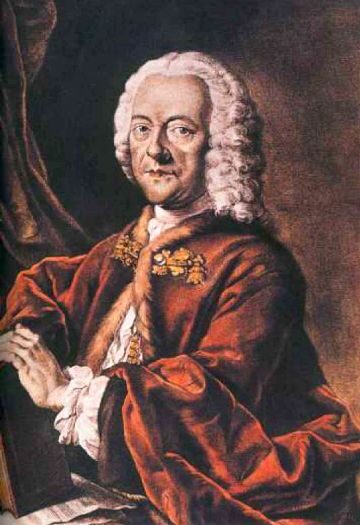
Georg Philipp Telemann
Georg Philipp Telemann was a German composer. Born March 14, 1681, in Magdeburg. Died June 25, 1767, in Hamburg. Positions held include chapelmaster, court chapel master (1723–) and composer. Known for Water Music, Emma und Eginhard and Germanicus. Educated at Leipzig University and Lessing-Gymnasium.
Facts
44 facts · 1 confirmed by two sources · 10 cited · 32 from one source · 1 where the sources disagree
What’s different
- Born: we show March 14, 1681 (Sources disagree). Wikipedia says March 24, 1681
Where this comes from
Papalocal keeps its own record. It started from these sources; what each one said is kept here as it was copied, so a change on their side never changes this page by itself. Tap one to read its version.
What Wikidata says · copied November 16, 2026 · revision 2569097289
- Described as
- German composer
- Other names
- Telemann, G. P. Telemann
- Born
- March 14, 1681 · 11 references
- Died
- June 25, 1767 · 16 references
- Born in
- Magdeburg · 4 references
- Died in
- Hamburg · 4 references
- Buried in
- Hamburg
- Cause of death
- pneumonia
- Citizen of
- Holy Roman Empire
- Occupation
- classical composer; chapelmaster; organist · 1 reference; composer · 2 references; independent publisher · 1 reference; conductor · 1 reference; musician · 1 reference
- Positions held
- chapelmaster; court chapel master (1723–); composer
- Education
- Leipzig University; Lessing-Gymnasium
- Instrument
- organ
- Known for
- Water Music; Emma und Eginhard (1728); Germanicus (1704); Der neumodische Liebhaber Damon (1719); Der geduldige Socrates (1721); Sieg der Schönheit (1722); Orpheus (1726); Miriways (1728); Flavius Bertaridus (1729); Don Quichotte auf der Hochzeit des Comacho (1761)
- Field
- opera; religious music; chamber music
- Spouse
- Anna Catharina Textor; Amelia Elisabeth Juliana Eberlin · 1 reference; Maria Catharina Textor; Maria Catharina Telemann · 1 reference
- Children
- Johannes Telemann · 1 reference; Heinrich Matthias Telemann; Johann Barthold Joachim Telemann; Benedictus Eberhard Wilhelm Telemann; Andreas Telemann · 1 reference
- Father
- Heinrich Telemann
- Religion
- Lutheranism
- Wikipedias with a page
- 75
Wikidata item Q75854 (wikidata.org/wiki/Q75854), public domain (CC0). Copied November 16, 2026.
What Wikipedia says · copied November 16, 2026 · revision 1375003884
Georg Philipp Telemann (German: [ˈɡeːɔʁk ˈfiːlɪp ˈteːləman]; 24 March 1681 [O.S. 14 March 1680] – 25 June 1767) was a German Baroque composer and multi-instrumentalist. He is one of the most prolific composers in history, at least in terms of surviving works. Telemann was considered by his contemporaries to be one of the leading German composers of the time, and he was compared favourably both to his friend Johann Sebastian Bach, who made Telemann the godfather and namesake of his son Carl Philipp Emanuel, and to George Frideric Handel, whom Telemann also knew personally.
Almost completely self-taught in music, he became a composer against his family's wishes. After studying in Magdeburg, Zellerfeld, and Hildesheim, Telemann entered the University of Leipzig to study law, but eventually settled on a career in music. He held important positions in Leipzig, Sorau, Eisenach, and Frankfurt before settling in Hamburg in 1721, where he became musical director of that city's five main churches. While Telemann's career prospered, his personal life was always troubled: his first wife died less than two years after their marriage, and his second wife had extramarital affairs and accumulated a large gambling debt before leaving him. As part of his duties, he wrote a considerable amount of music for educating organists under his direction. This includes 48 chorale preludes and 20 small fugues (modal fugues) to accompany his chorale harmonisations for 500 hymns. His music incorporates French, Italian, and German national styles, and he was at times even influenced by Polish popular music. He remained at the forefront of all new musical tendencies, and his music stands as an important link between the late Baroque and early Classical styles. The Telemann Museum in Hamburg is dedicated to him.
- Born, in its opening lines
- March 24, 1681
- Died, in its opening lines
- June 25, 1767
From the Wikipedia article “Georg Philipp Telemann” (en.wikipedia.org/wiki/Georg_Philipp_Telemann), by its contributors, under CC BY-SA 4.0 (creativecommons.org/licenses/by-sa/4.0/). Copied November 16, 2026; not changed.
Confirmed Two sources agree. Cited One source, and it names where it got it. One source One source, without a reference of its own. Sources disagree The sources disagree. We show the best-supported value and keep theirs below.
