
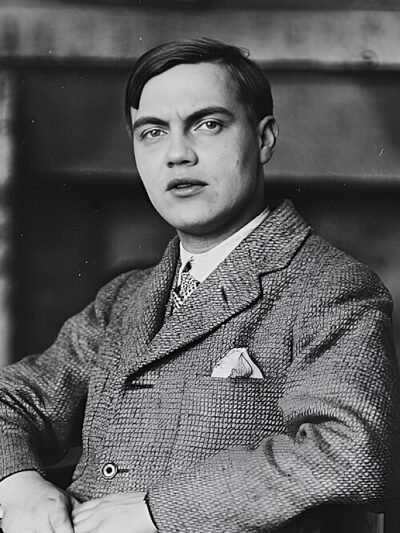
George Antheil
George Antheil was an American avant-garde composer, pianist, author and inventor. Born July 8, 1900, in Trenton. Died February 12, 1959, in New York City. Known for Tom Sawyer, Symphony No. 4 and Secret communication system. Educated at Trenton Central High School. Awards include Guggenheim Fellowship, EFF Award and National Inventors Hall of Fame.
Facts
25 facts · 2 confirmed by two sources · 9 cited · 14 from one source
Where this comes from
Papalocal keeps its own record. It started from these sources; what each one said is kept here as it was copied, so a change on their side never changes this page by itself. Tap one to read its version.
What Wikidata says · copied November 15, 2026 · revision 2557891541
- Described as
- American avant-garde composer, pianist, author and inventor (1900–1959)
- Born
- July 8, 1900 · 4 references
- Died
- February 12, 1959 · 13 references
- Born in
- Trenton · 2 references
- Died in
- New York City · 2 references
- Buried in
- Riverview Cemetery · 1 reference
- Cause of death
- myocardial infarction
- Name at birth
- Georg Johann Carl Antheil · 1 reference
- Citizen of
- United States
- Occupation
- composer · 3 references; pianist · 1 reference; film score composer; inventor · 1 reference
- Education
- Trenton Central High School · 1 reference
- Genre
- opera; symphony
- Instrument
- piano
- Known for
- Tom Sawyer; Symphony No. 4; Secret communication system
- Awards
- Guggenheim Fellowship (1932) · 1 reference; EFF Award (1997); National Inventors Hall of Fame (2014) · 1 reference
- Field
- composer; film score
- Spouse
- Böske Antheil · 1 reference
- Wikipedias with a page
- 33
Wikidata item Q137739 (wikidata.org/wiki/Q137739), public domain (CC0). Copied November 15, 2026.
What Wikipedia says · copied November 15, 2026 · revision 1383455570
George Johann Carl Antheil ( AN-tyle; July 8, 1900 – February 12, 1959) was an American avant-garde composer, pianist, author, and inventor whose modernist musical compositions explored the sounds – musical, industrial, and mechanical – of the early 20th century. Spending much of the 1920s in Europe, Antheil returned to the United States in the 1930s, and thereafter composed music for films, and eventually, television. As a result of this work, his style became more tonal. A man of diverse interests and talents, Antheil was constantly reinventing himself. He wrote magazine articles, an autobiography, a mystery novel, and newspaper and music columns.
In 1941, Antheil and the actress Hedy Lamarr developed a radio guidance system for Allied torpedoes that used a code (stored on a punched paper tape) to synchronize frequency changes, referred to as frequency hopping, between the transmitter and receiver. It is one of the spread spectrum techniques that became widely used in modern telecommunications. This work led to their induction into the National Inventors Hall of Fame in 2014.
- Born, in its opening lines
- July 8, 1900
- Died, in its opening lines
- February 12, 1959
From the Wikipedia article “George Antheil” (en.wikipedia.org/wiki/George_Antheil), by its contributors, under CC BY-SA 4.0 (creativecommons.org/licenses/by-sa/4.0/). Copied November 15, 2026; not changed.
Confirmed Two sources agree. Cited One source, and it names where it got it. One source One source, without a reference of its own. Sources disagree The sources disagree. We show the best-supported value and keep theirs below.
