
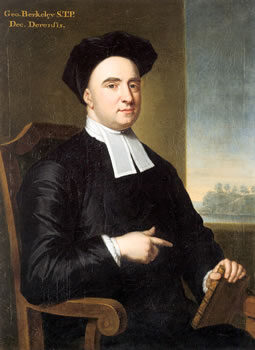
George Berkeley
George Berkeley was an Irish idealist philosopher and Anglican bishop. Born March 12, 1685, in Dysart Castle. Died January 14, 1753, in Oxford. Positions held include Dean of Derry (1724–1733), Dean of Dromore (1721–1724) and Roman Catholic Bishop of Cloyne (1734–1753). Known for De Motu, An Essay Towards a New Theory of Vision and A Treatise Concerning the Principles of Human Knowledge. Educated at Trinity College, Dublin and Kilkenny College.
Facts
39 facts · 2 confirmed by two sources · 11 cited · 26 from one source
Where this comes from
Papalocal keeps its own record. It started from these sources; what each one said is kept here as it was copied, so a change on their side never changes this page by itself. Tap one to read its version.
What Wikidata says · copied November 16, 2026 · revision 2567720362
- Described as
- Irish idealist philosopher and Anglican bishop (1685–1753)
- Other names
- Bishop Berkeley, Bishop George Berkeley
- Born
- March 12, 1685 · 12 references
- Died
- January 14, 1753 · 10 references
- Born in
- Dysart Castle
- Died in
- Oxford · 2 references
- Buried in
- Christ Church Cathedral, Oxford · 1 reference
- Citizen of
- Kingdom of Ireland
- Occupation
- philosopher · 1 reference; Anglican priest; writer · 1 reference; epistemologist; philosopher of science; metaphysician; Christian minister · 1 reference; theologian · 1 reference
- Positions held
- Dean of Derry (1724–1733) · 1 reference; Dean of Dromore (1721–1724) · 1 reference; Roman Catholic Bishop of Cloyne (1734–1753) · 1 reference
- Education
- Trinity College, Dublin; Kilkenny College
- Known for
- De Motu; An Essay Towards a New Theory of Vision; A Treatise Concerning the Principles of Human Knowledge; Three Dialogues between Hylas and Philonous; The Theory of Vision, or Visual Language; The Analyst; Siris; The Querist
- Field
- philosophy; theology; education; epistemology; metaphysics; philosophy of science
- Spouse
- Anne Forster (1728–) · 1 reference
- Children
- Lucia Berkeley · 1 reference; Henry Berkeley · 1 reference; George Berkeley · 2 references
- Father
- William Berkeley · 1 reference
- Religion
- Anglicanism
- Wikipedias with a page
- 112
Wikidata item Q82049 (wikidata.org/wiki/Q82049), public domain (CC0). Copied November 16, 2026.
What Wikipedia says · copied November 16, 2026 · revision 1385650722
George Berkeley ( BARK-lee; 12 March 1685 – 14 January 1753), known as Bishop Berkeley (Bishop of Cloyne of the Anglican Church of Ireland), was an Anglo-Irish philosopher, writer, and clergyman who is regarded as the founder of immaterialism, a philosophical theory he developed which later came to be known as subjective idealism. He has also been called "the father of idealism" by German philosopher Arthur Schopenhauer. Berkeley played a leading role in the empiricism movement and was one of its pioneers. He was among the most cited philosophers of 18th-century Europe, and his works deeply influenced later thinkers such as Immanuel Kant and David Hume.
In 1709, Berkeley published his first major work An Essay Towards a New Theory of Vision, in which he discussed the limitations of human vision and advanced the theory that the proper objects of sight are not material objects, but light and colour. This foreshadowed his most well-known philosophical work A Treatise Concerning the Principles of Human Knowledge, published in 1710, which, after its poor reception, he rewrote in dialogue form and published under the title Three Dialogues Between Hylas and Philonous in 1713. In this book, Berkeley's views were represented by Philonous (Greek: "lover of mind"), while Hylas ("hyle", Greek: "matter") embodies Berkeley's opponents, in particular John Locke.
Berkeley argued against Isaac Newton's doctrine of absolute space, time and motion in De Motu (On Motion), first published in 1721. His arguments were a notable precursor to those of Ernst Mach and Albert Einstein. In 1732, he published Alciphron, a Christian apologetic against the free-thinkers, and in 1734, he published The Analyst, a critique of the foundations of calculus, which was influential in the development of mathematics. In his work on immaterialism, Berkeley's theory denies the existence of material substance and instead contends that familiar objects like tables and chairs are ideas perceived by the mind and, as a result, cannot exist without being perceived. Berkeley is also known for his critique of abstraction, an important premise in his argument for immaterialism.
He died in 1753 in Oxford, and was buried in Christ Church Cathedral. Berkeley remains arguably the most influential of Irish philosophers, and interest in his ideas and works increased greatly after World War II because they tackled many of the issues of paramount interest to philosophy in the 20th century, such as the problems of perception, the difference between primary and secondary qualities, and the importance of language. Public interest in his views and philosophical ideas increased significantly in the United States during the early 19th century, and as a result, the University of California, Berkeley, the city of Berkeley, California, and Berkeley College, Yale, were all named after him.
- Born, in its opening lines
- March 12, 1685
- Died, in its opening lines
- January 14, 1753
From the Wikipedia article “George Berkeley” (en.wikipedia.org/wiki/George_Berkeley), by its contributors, under CC BY-SA 4.0 (creativecommons.org/licenses/by-sa/4.0/). Copied November 16, 2026; not changed.
Confirmed Two sources agree. Cited One source, and it names where it got it. One source One source, without a reference of its own. Sources disagree The sources disagree. We show the best-supported value and keep theirs below.
