
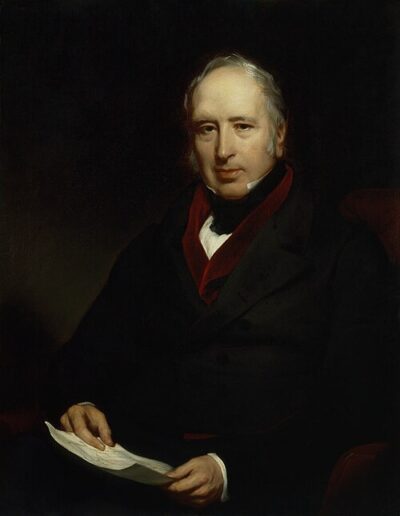
George Cayley
George Cayley was a British aeronautics engineer. Born December 27, 1773, in Scarborough. Died December 15, 1857, in Brompton. Positions held include member of the 11th Parliament of the United Kingdom (1832–1834).
Facts
23 facts · 2 confirmed by two sources · 13 cited · 8 from one source
Where this comes from
Papalocal keeps its own record. It started from these sources; what each one said is kept here as it was copied, so a change on their side never changes this page by itself. Tap one to read its version.
What Wikidata says · copied November 16, 2026 · revision 2559449862
- Described as
- British aeronautics engineer (1773-1857)
- Other names
- Sir George Cayley, 6th Bt.
- Born
- December 27, 1773 · 8 references
- Died
- December 15, 1857 · 7 references
- Born in
- Scarborough · 1 reference
- Died in
- Brompton
- Buried in
- Church of All Saints, Brompton-by-Sawdon
- Citizen of
- United Kingdom of Great Britain and Ireland
- Occupation
- aerospace engineer; inventor; politician · 1 reference; military flight engineer; engineer · 1 reference; aircraft pilot · 1 reference; aircraft construction · 1 reference; design engineer · 1 reference
- Positions held
- member of the 11th Parliament of the United Kingdom (1832–1834) · 1 reference
- Spouse
- Sarah Walker (1795–) · 1 reference
- Children
- Katherine Cayley · 1 reference; Emma Cayley · 1 reference; Isabella Cayley · 1 reference; Sarah Philadephia Cayley · 1 reference; Sir Digby Cayley, 7th Bt. · 1 reference
- Father
- Sir Thomas Cayley, 5th Bt. · 1 reference
- Mother
- Isabella Seton · 1 reference
- Wikipedias with a page
- 39
Wikidata item Q319362 (wikidata.org/wiki/Q319362), public domain (CC0). Copied November 16, 2026.
What Wikipedia says · copied November 16, 2026 · revision 1382160211
Sir George Cayley, 6th Baronet (27 December 1773 – 15 December 1857) was an English engineer, inventor and aviator. He was a pioneer of aeronautical engineering and is sometimes referred to as "the father of aviation", designing the first glider reliably reported to carry a human aloft. He is commonly credited as the first person to understand the underlying principles and forces of heavier-than-air flight: weight, lift, drag and thrust. He was also the inventor of the wire wheel.
In 1799, he set forth the concept of the modern aeroplane as a fixed-wing flying machine with separate systems for lift, propulsion and control. Modern aeroplane design is based on those discoveries and on the cambered wings he proposed. He constructed the first flying model aeroplane and also diagrammed the elements of vertical flight. He correctly predicted that sustained flight would not occur until a lightweight engine was developed to provide adequate thrust and lift. The Wright brothers acknowledged his importance to the development of aviation.
Cayley represented the Whig party as Member of Parliament for Scarborough from 1832 to 1835, and in 1838 helped found the UK's first Polytechnic Institute, the Royal Polytechnic Institution (now University of Westminster) and served as its chairman for many years. He was elected as a Vice-President of the Yorkshire Philosophical Society in 1824. He was a founding member of the British Association for the Advancement of Science and was a distant cousin of the mathematician Arthur Cayley.
- Born, in its opening lines
- December 27, 1773
- Died, in its opening lines
- December 15, 1857
From the Wikipedia article “George Cayley” (en.wikipedia.org/wiki/George_Cayley), by its contributors, under CC BY-SA 4.0 (creativecommons.org/licenses/by-sa/4.0/). Copied November 16, 2026; not changed.
Confirmed Two sources agree. Cited One source, and it names where it got it. One source One source, without a reference of its own. Sources disagree The sources disagree. We show the best-supported value and keep theirs below.
