
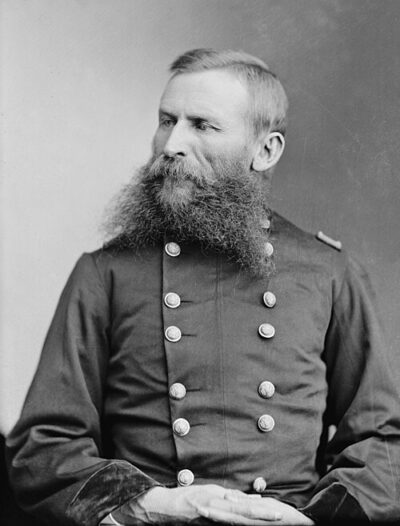
George Crook
George Crook was an United States Army general during American Civil War and Indian Wars. Born September 8, 1828, in Dayton. Died March 21, 1890, in Chicago. Educated at United States Military Academy.
Facts
12 facts · 2 confirmed by two sources · 2 cited · 8 from one source
Where this comes from
Papalocal keeps its own record. It started from these sources; what each one said is kept here as it was copied, so a change on their side never changes this page by itself. Tap one to read its version.
What Wikidata says · copied November 18, 2026 · revision 2547182073
- Described as
- United States Army general during American Civil War and Indian Wars (1828–1890)
- Born
- September 8, 1828 · 1 reference
- Died
- March 21, 1890 · 1 reference
- Born in
- Dayton
- Died in
- Chicago
- Buried in
- Arlington National Cemetery · 1 reference
- Citizen of
- United States
- Occupation
- military officer
- Education
- United States Military Academy · 1 reference
- Military branch
- Union Army; United States Army
- Military rank
- major general
- Lived in
- General Crook House · 1 reference
- Wikipedias with a page
- 18
Wikidata item Q971456 (wikidata.org/wiki/Q971456), public domain (CC0). Copied November 18, 2026.
What Wikipedia says · copied November 18, 2026 · revision 1379813661
George Crook (September 8, 1828 – March 21, 1890) was a career United States Army officer who served in the American Civil War and the Indian Wars. He is best known for commanding U.S. forces in the 1886 campaign that led to the defeat of the Apache leader Geronimo. As a result, the Apache nicknamed Crook Nantan Lupan, which means "Chief Grey Wolf."
- Born, in its opening lines
- September 8, 1828
- Died, in its opening lines
- March 21, 1890
From the Wikipedia article “George Crook” (en.wikipedia.org/wiki/George_Crook), by its contributors, under CC BY-SA 4.0 (creativecommons.org/licenses/by-sa/4.0/). Copied November 18, 2026; not changed.
Confirmed Two sources agree. Cited One source, and it names where it got it. One source One source, without a reference of its own. Sources disagree The sources disagree. We show the best-supported value and keep theirs below.
