
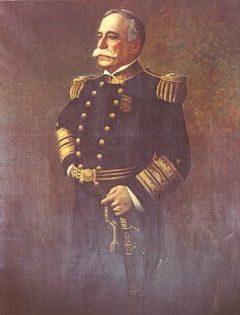
George Dewey
George Dewey was an United States Navy admiral. Born December 26, 1837, in Montpelier. Died January 16, 1917, in Washington, D.C.. Educated at Norwich University and United States Naval Academy.
Facts
19 facts · 2 confirmed by two sources · 8 cited · 9 from one source
Where this comes from
Papalocal keeps its own record. It started from these sources; what each one said is kept here as it was copied, so a change on their side never changes this page by itself. Tap one to read its version.
What Wikidata says · copied November 15, 2026 · revision 2567548741
- Described as
- United States Navy admiral (1837–1917)
- Other names
- Geo. Dewey
- Born
- December 26, 1837 · 8 references
- Died
- January 16, 1917 · 8 references
- Born in
- Montpelier · 1 reference
- Died in
- Washington, D.C. · 2 references
- Buried in
- Washington National Cathedral · 1 reference
- Citizen of
- United States
- Occupation
- military officer; writer; admiral · 1 reference; soldier · 1 reference
- Education
- Norwich University; United States Naval Academy · 1 reference
- Field
- marine transportation · 1 reference
- Spouse
- Mildred Hazen Dewey
- Father
- Julius Yemans Dewey · 1 reference
- Mother
- Mary Perrin · 1 reference
- Military branch
- United States Navy; United States · 1 reference
- Military rank
- Admiral of the Navy
- Wikipedias with a page
- 28
Wikidata item Q467093 (wikidata.org/wiki/Q467093), public domain (CC0). Copied November 15, 2026.
What Wikipedia says · copied November 15, 2026 · revision 1379809065
George Dewey (December 26, 1837 – January 16, 1917) was Admiral of the Navy, the only person in United States history to have attained that rank. He is best known for his victory at the Battle of Manila Bay during the Spanish–American War, without a single combat death.
Dewey was born in Montpelier, Vermont. At age 15, Dewey's father enrolled him at Norwich University in Northfield, Vermont. Two years later Norwich expelled him for drunkenness and herding sheep into the barracks. Subsequently, he entered the United States Naval Academy in 1854. He graduated from the academy in 1858 and was assigned as the executive lieutenant of USS Mississippi at the beginning of the Civil War. He participated in the capture of New Orleans and the Siege of Port Hudson, helping the Union take control of the Mississippi River. By the end of the war, Dewey reached the rank of lieutenant commander.
After the Civil War, Dewey undertook a variety of assignments, serving on multiple ships (including USS Constitution) and as an instructor at the Naval Academy. He also served on the United States Lighthouse Board and the Board of Inspection and Survey. He was promoted to commodore in 1896 and assigned to the Asiatic Squadron the following year. After that appointment, he began preparations for a potential war with Spain, which broke out in April 1898. Immediately after the beginning of the war, Dewey led an attack on Manila Bay, sinking or capturing the entire Spanish Pacific fleet while suffering only minor casualties. After the battle, his fleet assisted in the capture of Manila. Dewey's victory at Manila Bay was widely lauded in the United States, and he was promoted to Admiral of the Navy in 1903.
Dewey explored a run for the 1900 Democratic presidential nomination, but he withdrew from the race and endorsed President William McKinley. He served on the General Board of the United States Navy, an important policy-making body, from 1900 until his death in 1917.
- Born, in its opening lines
- December 26, 1837
- Died, in its opening lines
- January 16, 1917
From the Wikipedia article “George Dewey” (en.wikipedia.org/wiki/George_Dewey), by its contributors, under CC BY-SA 4.0 (creativecommons.org/licenses/by-sa/4.0/). Copied November 15, 2026; not changed.
Confirmed Two sources agree. Cited One source, and it names where it got it. One source One source, without a reference of its own. Sources disagree The sources disagree. We show the best-supported value and keep theirs below.
