
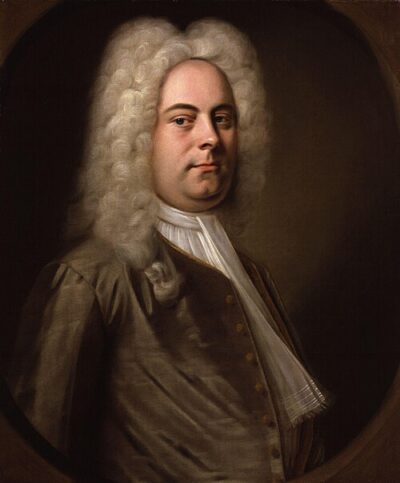
George Frideric Handel
George Frideric Handel was a German-British Baroque composer. Born February 23, 1685, in Halle (Saale). Died April 14, 1759, in Westminster. Positions held include chapelmaster (1710–) and organist. Known for Messiah, Water Music and Music for the Royal Fireworks. Educated at Martin Luther University Halle-Wittenberg.
Facts
45 facts · 1 confirmed by two sources · 8 cited · 35 from one source · 1 where the sources disagree
What’s different
- Born: we show February 23, 1685 (Sources disagree). Wikipedia says March 5, 1685
Where this comes from
Papalocal keeps its own record. It started from these sources; what each one said is kept here as it was copied, so a change on their side never changes this page by itself. Tap one to read its version.
What Wikidata says · copied November 16, 2026 · revision 2568734786
- Described as
- German-British Baroque composer (1685–1759)
- Other names
- George Frideric, G. F. Händel, George Frederick Handel, G. F. Handel, Handel, Händel
- Born
- February 23, 1685 · 5 references
- Died
- April 14, 1759 · 15 references
- Born in
- Halle (Saale) · 4 references
- Died in
- Westminster
- Buried in
- Poets' Corner
- Name at birth
- Georg Friedrich Händel
- Citizen of
- Brandenburg-Prussia; Kingdom of Great Britain (1726–) · 1 reference; Holy Roman Empire
- Occupation
- composer · 3 references; harpsichordist · 1 reference; organist · 2 references; violinist · 1 reference; opera composer (–1741) · 1 reference; impresario (–1741) · 1 reference; university teacher; court chapel master · 1 reference
- Positions held
- chapelmaster (1710–) · 1 reference; organist · 1 reference
- Education
- Martin Luther University Halle-Wittenberg (1702–1703)
- Genre
- opera; oratorio; concerto; anthem; classical music; coronation anthem
- Instrument
- pipe organ; harpsichord; oboe
- Known for
- Messiah; Water Music; Music for the Royal Fireworks; Giulio Cesare in Egitto; Alcina; Serse; Concerti grossi, Op. 6
- Father
- Georg Händel · 1 reference
- Mother
- Dorothea Händel · 1 reference
- Religion
- Lutheranism
- Lived in
- London (1712–) · 1 reference; Halle; Rome; Florence; Naples · 1 reference
- Website
- http://gfhandel.org
- Wikipedias with a page
- 162
Wikidata item Q7302 (wikidata.org/wiki/Q7302), public domain (CC0). Copied November 16, 2026.
What Wikipedia says · copied November 16, 2026 · revision 1385747468
George Frideric (or Frederick) Handel ( HAN-dəl; baptised Georg Fried[e]rich Händel, German: [ˈɡeːɔʁk ˈfʁiːdʁɪç ˈhɛndl̩] ; 5 March 1685 [O.S. 23 February 1684] – 14 April 1759) was a German-British Baroque composer well-known for his operas, oratorios, anthems, concerti grossi, and organ concerti.
Born in Halle, Handel spent his early life in Hamburg and Italy before settling in London in 1712, where he spent the bulk of his career and became a naturalised British subject in 1727. He was strongly influenced both by the middle-German polyphonic choral tradition and by composers of the Italian Baroque. In turn, Handel's music forms one of the peaks of the "high baroque" style, bringing Italian opera to its highest development, creating the genres of English oratorio and organ concerto, and introducing a new style into English church music. He is consistently recognised as one of the greatest composers of his age.
Handel started three commercial opera companies to supply the English nobility with Italian opera. In 1737 he had a physical breakdown, changed direction creatively, addressed the middle class and made a transition to English choral works. After his success with Messiah (1742), he never composed an Italian opera again. His orchestral Water Music and Music for the Royal Fireworks remain steadfastly popular. One of his four coronation anthems, Zadok the Priest, has been performed at every British coronation since 1727. He died a respected and rich man in 1759, aged 74, and was given a state funeral at Westminster Abbey.
Interest in Handel's music has grown since the mid-20th century. The musicologist Winton Dean wrote that "Handel was not only a great composer; he was a dramatic genius of the first order." His music was admired by Classical-era composers, especially Haydn, Mozart and Beethoven.
- Born, in its opening lines
- March 5, 1685
- Died, in its opening lines
- April 14, 1759
From the Wikipedia article “George Frideric Handel” (en.wikipedia.org/wiki/George_Frideric_Handel), by its contributors, under CC BY-SA 4.0 (creativecommons.org/licenses/by-sa/4.0/). Copied November 16, 2026; not changed.
Confirmed Two sources agree. Cited One source, and it names where it got it. One source One source, without a reference of its own. Sources disagree The sources disagree. We show the best-supported value and keep theirs below.
