
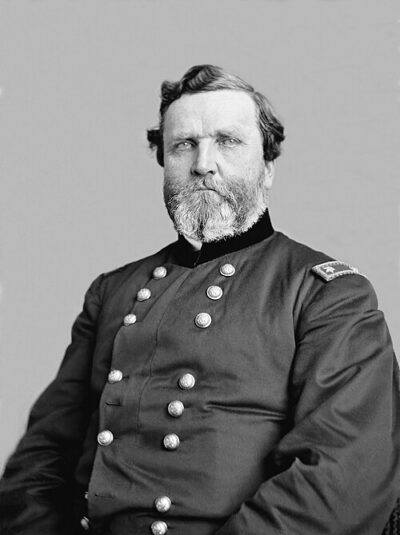
George Henry Thomas
George Henry Thomas was an United States Army general. Born July 31, 1816, in Southampton County. Died March 28, 1870, in San Francisco. Educated at United States Military Academy.
Facts
11 facts · 2 confirmed by two sources · 4 cited · 5 from one source
Where this comes from
Papalocal keeps its own record. It started from these sources; what each one said is kept here as it was copied, so a change on their side never changes this page by itself. Tap one to read its version.
What Wikidata says · copied November 16, 2026 · revision 2566992870
- Described as
- United States Army general (1816-1870)
- Born
- July 31, 1816 · 2 references
- Died
- March 28, 1870 · 2 references
- Born in
- Southampton County · 1 reference
- Died in
- San Francisco · 1 reference
- Buried in
- Oakwood Cemetery · 1 reference
- Citizen of
- United States
- Occupation
- military officer
- Education
- United States Military Academy
- Military branch
- Union Army; United States Army
- Military rank
- general · 1 reference
- Wikipedias with a page
- 23
Wikidata item Q740330 (wikidata.org/wiki/Q740330), public domain (CC0). Copied November 16, 2026.
What Wikipedia says · copied November 16, 2026 · revision 1382522321
George Henry Thomas (July 31, 1816 – March 28, 1870) was an American general in the Union Army during the American Civil War and one of the principal commanders in the Western Theater. Thomas served in the Mexican–American War, and despite being a Virginian whose home state would join the Confederate States of America during the Civil War, he was a Southern Unionist who chose to remain in the U.S. Army.
Thomas won one of the first Union victories in the war, at Mill Springs in Kentucky, and served in important subordinate commands at Perryville and Stones River. His stout defense at the Battle of Chickamauga in 1863 saved the Union Army from being completely routed, earning him his most famous nickname, "the Rock of Chickamauga." He followed soon after with a dramatic breakthrough on Missionary Ridge in the Battle of Chattanooga. In the Franklin–Nashville Campaign of 1864, he achieved one of the most decisive victories of the war, destroying the army of Confederate General John Bell Hood, his former student at West Point, at the Battle of Nashville.
Thomas had a successful record in the Civil War, but he failed to achieve the historical acclaim of some of his contemporaries, such as Ulysses S. Grant and William T. Sherman. He developed a reputation as a slow, deliberate general. In an environment rife with jealousy and avarice for promotion and recognition, Thomas stood out as an oddball for occasionally refusing promotions to positions he thought he was still incapable of fulfilling. Conversely, he sometimes regretted his refusals or found it offensive that he was passed over for promotion. After the war, he did not write memoirs to advance his legacy and died only five years after the war ended.
- Born, in its opening lines
- July 31, 1816
- Died, in its opening lines
- March 28, 1870
From the Wikipedia article “George Henry Thomas” (en.wikipedia.org/wiki/George_Henry_Thomas), by its contributors, under CC BY-SA 4.0 (creativecommons.org/licenses/by-sa/4.0/). Copied November 16, 2026; not changed.
Confirmed Two sources agree. Cited One source, and it names where it got it. One source One source, without a reference of its own. Sources disagree The sources disagree. We show the best-supported value and keep theirs below.
