
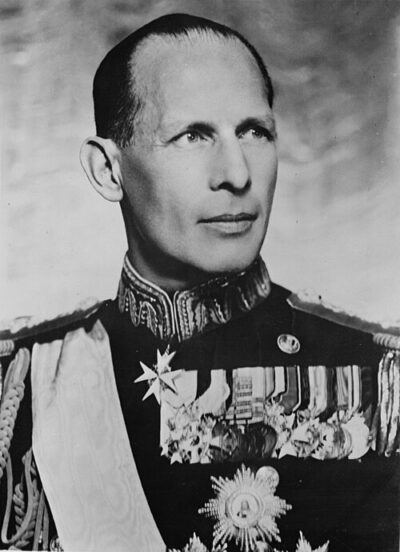
George II of Greece
George II of Greece was a King of Greece (r. 1922-1924, 1935-1947). Born July 19, 1890, in Tatoi Palace. Died April 1, 1947, in Athens. Positions held include King of the Hellenes (2 times) (1922–1947). Awards include Distinguished Service Order, Order of the White Eagle (Second Polish Republic) and War Cross.
Facts
27 facts · 2 confirmed by two sources · 3 cited · 22 from one source
Where this comes from
Papalocal keeps its own record. It started from these sources; what each one said is kept here as it was copied, so a change on their side never changes this page by itself. Tap one to read its version.
What Wikidata says · copied November 16, 2026 · revision 2557890720
- Described as
- King of Greece (r. 1922-1924, 1935-1947)
- Other names
- King George II of Greece
- Born
- July 19, 1890 · 2 references
- Died
- April 1, 1947 · 8 references
- Born in
- Tatoi Palace
- Died in
- Athens · 2 references
- Buried in
- Tatoi Royal Cemetery
- Citizen of
- Greece
- Occupation
- monarch
- Positions held
- King of the Hellenes (2 times) (1922–1947)
- Member of
- Hellenic Olympic Committee
- Awards
- Distinguished Service Order; Order of the White Eagle (Second Polish Republic) (1937); War Cross; Order of the Redeemer · 1 reference; Order of the Dannebrog · 1 reference; Knight of the Order of the Elephant (1909)
- Spouse
- Princess Elisabeth of Romania (1921–1935) · 1 reference
- Father
- Constantine I of Greece · 1 reference
- Mother
- Sophia of Prussia · 1 reference
- Siblings
- Paul of Greece; Alexander of Greece; Helen of Greece and Denmark; Princess Irene, Duchess of Aosta; Princess Katherine of Greece and Denmark
- Religion
- Church of Greece
- Military branch
- Hellenic Armed Forces · 1 reference
- Military rank
- field marshal; marshal · 1 reference
- Wikipedias with a page
- 59
Wikidata item Q152935 (wikidata.org/wiki/Q152935), public domain (CC0). Copied November 16, 2026.
What Wikipedia says · copied November 16, 2026 · revision 1383030690
George II (Greek: Γεώργιος Β', romanized: Geórgios II; 19 July [O.S. 7 July] 1890 – 1 April 1947) was King of Greece from 27 September 1922 until 25 March 1924, and again from 25 November 1935 until his death on 1 April 1947.
The eldest son of King Constantine I of Greece and Princess Sophia of Prussia, George followed his father into exile in 1917 following the National Schism, while his younger brother Alexander was installed as king. Constantine was restored to the throne in 1920 after Alexander's death, but was forced to abdicate two years later in the aftermath of the Greco-Turkish War. George acceded to the Greek throne, but after a failed royalist coup in October 1923 he was exiled to Romania. Greece was proclaimed a republic in March 1924 and George was formally deposed and stripped of Greek nationality. He remained in exile until the Greek monarchy was restored in 1935, following a rigged referendum, upon which he resumed his royal duties. The king supported Ioannis Metaxas's 1936 self-coup, which established an authoritarian, nationalist and anti-communist dictatorship known as 4th of August Regime.
Greece was overrun following a German invasion in April 1941, forcing George into his third exile. He left for Crete and then Egypt before settling in London, where he headed the Greek government-in-exile. At the end of the war, George returned to Greece after a 1946 referendum had preserved the monarchy. He died of arteriosclerosis in April 1947 at the age of 56. Having no children, he was succeeded by his younger brother, Paul. He was also a male-line first cousin of Prince Philip, Duke of Edinburgh.
- Born, in its opening lines
- July 19, 1890
- Died, in its opening lines
- April 1, 1947
From the Wikipedia article “George II of Greece” (en.wikipedia.org/wiki/George_II_of_Greece), by its contributors, under CC BY-SA 4.0 (creativecommons.org/licenses/by-sa/4.0/). Copied November 16, 2026; not changed.
Confirmed Two sources agree. Cited One source, and it names where it got it. One source One source, without a reference of its own. Sources disagree The sources disagree. We show the best-supported value and keep theirs below.
