
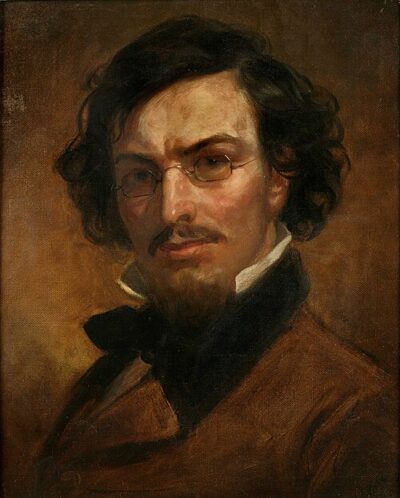
George Inness
George Inness was an American landscape painter. Born May 1, 1825, in Newburgh. Died August 3, 1894, in Bridge of Allan. Known for Moonlight in Virginia and Tragedy at Sea. Awards include Temple Silver Medal / 2nd Place.
Facts
18 facts · 2 confirmed by two sources · 10 cited · 6 from one source
Where this comes from
Papalocal keeps its own record. It started from these sources; what each one said is kept here as it was copied, so a change on their side never changes this page by itself. Tap one to read its version.
What Wikidata says · copied November 15, 2026 · revision 2563180833
- Described as
- American landscape painter (1825-1894)
- Other names
- Sr. George Inness, George, Sr. Inness, George Innes, George, Jr. Inness, Georges, Jr. Inness, George Inness, Sr., G. Inness, g. inness, Inness, geo inness, geo. inness, inness g.
- Born
- May 1, 1825 · 11 references
- Died
- August 3, 1894 · 10 references
- Born in
- Newburgh · 1 reference
- Died in
- Bridge of Allan · 2 references
- Buried in
- Rosedale Cemetery · 1 reference
- Citizen of
- United States
- Occupation
- painter · 2 references; landscape painter · 1 reference; visual artist · 1 reference
- Genre
- landscape painting · 1 reference
- Known for
- Moonlight in Virginia; Tragedy at Sea
- Awards
- Temple Silver Medal / 2nd Place (1892) · 1 reference
- Field
- landscape painting · 2 references; painting · 1 reference
- Children
- George Inness, Jr. · 1 reference; Helen Inness
- Website
- http://www.georgeinness.org/
- Wikipedias with a page
- 25
Wikidata item Q704868 (wikidata.org/wiki/Q704868), public domain (CC0). Copied November 15, 2026.
What Wikipedia says · copied November 15, 2026 · revision 1369998360
George Inness (May 1, 1825 – August 3, 1894) was an American landscape painter.
Now recognized as one of the most influential American artists of the nineteenth century, Inness was influenced by the Hudson River School at the start of his career. He also studied the Old Masters, and artists of the Barbizon school during later trips to Europe. There he was introduced to the theology of Emanuel Swedenborg, which was significant for him; he expressed that spiritualism in the works of his maturity (1879–1894).
Although Inness's style evolved through distinct stages over a prolific career that spanned more than forty years and 1,000 paintings, his works consistently earned acclaim for their powerful, coordinated efforts to elicit depth of mood, atmosphere, and emotion. Neither pure realist nor impressionist, Inness was a transitional figure. He worked to combine both the earthly and the ethereal in order to capture the complete essence of a locale in his works. A master of light, color, and shadow, he became noted for creating highly ordered and complex scenes that often juxtaposed hazy or blurred elements with sharp and refined details to evoke an interweaving of both the physical and the spiritual nature of experience. In Inness's words, he attempted through his art to demonstrate the "reality of the unseen" and to connect the "visible upon the invisible."
Within his lifetime, art critics hailed Inness as one of America's greatest artists. Often called "the father of American landscape painting," Inness is best known for his mature works that not only exemplified the Tonalist movement but also displayed an original and uniquely American style.
- Born, in its opening lines
- May 1, 1825
- Died, in its opening lines
- August 3, 1894
From the Wikipedia article “George Inness” (en.wikipedia.org/wiki/George_Inness), by its contributors, under CC BY-SA 4.0 (creativecommons.org/licenses/by-sa/4.0/). Copied November 15, 2026; not changed.
Confirmed Two sources agree. Cited One source, and it names where it got it. One source One source, without a reference of its own. Sources disagree The sources disagree. We show the best-supported value and keep theirs below.
