
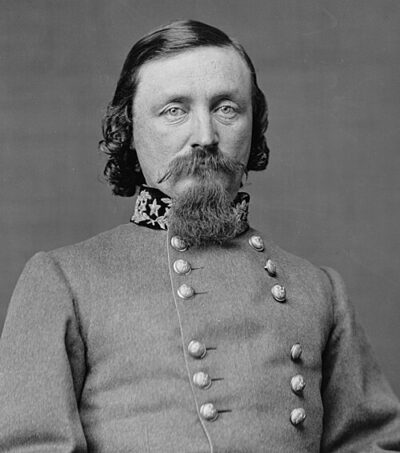
George Pickett
George Pickett was a Confederate States Army general. Born January 16, 1825, in Richmond. Died July 30, 1875, in Norfolk. Educated at United States Military Academy.
Facts
15 facts · 2 confirmed by two sources · 2 cited · 11 from one source
Where this comes from
Papalocal keeps its own record. It started from these sources; what each one said is kept here as it was copied, so a change on their side never changes this page by itself. Tap one to read its version.
What Wikidata says · copied November 15, 2026 · revision 2533432978
- Described as
- Confederate States Army general (1825–1875)
- Other names
- George E. Pickett, George Edward Pickett
- Born
- January 16, 1825 · 1 reference
- Died
- July 30, 1875 · 3 references
- Born in
- Richmond
- Died in
- Norfolk
- Buried in
- Hollywood Cemetery · 1 reference
- Citizen of
- United States
- Occupation
- military personnel; soldier · 1 reference
- Education
- United States Military Academy
- Spouse
- LaSalle Corbell Pickett
- Father
- Robert Pickett
- Siblings
- Charles Francis Pickett
- Military branch
- United States Army; Confederate States Army
- Military rank
- general
- Wikipedias with a page
- 24
Wikidata item Q454069 (wikidata.org/wiki/Q454069), public domain (CC0). Copied November 15, 2026.
What Wikipedia says · copied November 15, 2026 · revision 1383195610
George Edward Pickett (January 16, 1825 – July 30, 1875) was an American military officer who became a major general in the Confederate States Army during the American Civil War. He is best remembered for being one of the commanders at Pickett's Charge, the futile and bloody Confederate offensive on the third day of the Battle of Gettysburg that bears his name.
Pickett graduated last out of 59 cadets in the United States Military Academy class of 1846. He served as a second lieutenant in the United States Army during the Mexican–American War and is noted for his service in the Battle of Chapultepec in September 1847. After this, he served in the Washington Territory and eventually reached the rank of captain. Pickett participated in the Pig War of 1859. Near the beginning of the American Civil War, he was commissioned in the Confederate States Army, and attained the rank of brigadier general in January 1862. He commanded a brigade that saw heavy action during the Peninsula Campaign of 1862. Pickett was wounded at the Battle of Gaines's Mill on June 27.
He returned to command in September, following the Battle of Antietam, when he was given command of a division in the Right Wing of the Army of Northern Virginia, in the command of Major General James Longstreet, which became the I Corps that December. His division was lightly engaged at the Battle of Fredericksburg and, along with most of Longstreet's Corps, missed the Battle of Chancellorsville while participating in the Suffolk Campaign in 1863. During the Gettysburg campaign, his division was, much to Pickett's frustration, the last to arrive on the field. However, it was one of three divisions under the command of General Longstreet to participate in a disastrous assault on Union positions on July 3, the final day of the battle. The attack has been given the name "Pickett's Charge". In February 1864, Pickett ordered 22 North Carolinians in Union uniform hanged as deserters after a failed assault on New Bern. His military career came to an inglorious end when his division was overwhelmed and defeated at the Battle of Five Forks.
Following the war, Pickett feared prosecution for his execution of deserters and temporarily fled to Canada. An old Army friend, Ulysses S. Grant, interceded on his behalf, and he returned to Virginia in 1866. He could not rejoin the Army, so he tried his hand at farming, then selling insurance. He died at age 50 in July 1875 from an "abscess of the liver".
- Born, in its opening lines
- January 16, 1825
- Died, in its opening lines
- July 30, 1875
From the Wikipedia article “George Pickett” (en.wikipedia.org/wiki/George_Pickett), by its contributors, under CC BY-SA 4.0 (creativecommons.org/licenses/by-sa/4.0/). Copied November 15, 2026; not changed.
Confirmed Two sources agree. Cited One source, and it names where it got it. One source One source, without a reference of its own. Sources disagree The sources disagree. We show the best-supported value and keep theirs below.
