
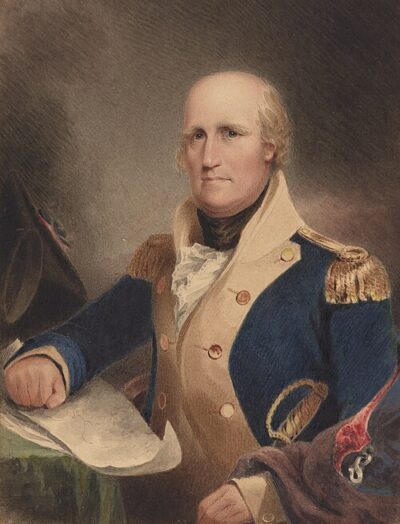
George Rogers Clark
George Rogers Clark was an American surveyor, soldier, and militia officer. Born November 19, 1752, in Charlottesville. Died February 13, 1818, in Louisville.
Facts
14 facts · 2 confirmed by two sources · 7 cited · 5 from one source
Where this comes from
Papalocal keeps its own record. It started from these sources; what each one said is kept here as it was copied, so a change on their side never changes this page by itself. Tap one to read its version.
What Wikidata says · copied November 16, 2026 · revision 2567406649
- Described as
- American surveyor, soldier, and militia officer (1752–1818)
- Other names
- Brig. Gen. George Rogers Clark
- Born
- November 19, 1752 · 7 references
- Died
- February 13, 1818 · 7 references
- Born in
- Charlottesville · 1 reference
- Died in
- Louisville · 1 reference
- Buried in
- Cave Hill Cemetery · 1 reference
- Cause of death
- stroke
- Citizen of
- United States
- Occupation
- army officer
- Father
- John Clark · 1 reference
- Mother
- Ann Rogers · 1 reference
- Siblings
- William Clark · 1 reference; Jonathan Clark · 1 reference
- Military branch
- Virginia militia · 1 reference
- Military rank
- brigadier general
- Wikipedias with a page
- 22
Wikidata item Q918990 (wikidata.org/wiki/Q918990), public domain (CC0). Copied November 16, 2026.
What Wikipedia says · copied November 16, 2026 · revision 1380609861
George Rogers Clark (November 19, 1752 – February 13, 1818) was an American military officer and surveyor from Virginia who became the highest-ranking Patriot military officer on the northwestern frontier during the Revolutionary War. He served as leader of the Virginia militia in Kentucky (then part of Virginia) throughout much of the war, and is credited for founding Louisville, Kentucky in 1778. He is best known for his captures of Kaskaskia, Illinois, in 1778 and Vincennes, Indiana, in 1779 during the Illinois campaign, which greatly weakened British influence in the Northwest Territory (then part of the British Province of Quebec) and earned Clark the nickname "Conqueror of the Old Northwest". The British ceded the entire Northwest Territory to the United States in the 1783 Treaty of Paris.
Clark's major military achievements occurred before his thirtieth birthday. Afterward, he led militia forces in the opening engagements of the Northwest Indian War, but was accused of being drunk on duty. He was disgraced and forced to resign, despite his demand for a formal investigation into the accusations. Clark left Kentucky to live in the Indiana Territory but was never fully reimbursed by the Virginian government for his wartime expenditures. During the final decades of his life, he worked to evade creditors and suffered living in increasing poverty and obscurity. He was involved in two failed attempts to open the Spanish-controlled Mississippi River to American traffic. Following a stroke and the amputation of his right leg, he became disabled. Clark was aided in his final years by family members, including his younger brother William, one of the leaders of the Lewis and Clark Expedition. He died of a stroke on February 13, 1818.
- Born, in its opening lines
- November 19, 1752
- Died, in its opening lines
- February 13, 1818
From the Wikipedia article “George Rogers Clark” (en.wikipedia.org/wiki/George_Rogers_Clark), by its contributors, under CC BY-SA 4.0 (creativecommons.org/licenses/by-sa/4.0/). Copied November 16, 2026; not changed.
Confirmed Two sources agree. Cited One source, and it names where it got it. One source One source, without a reference of its own. Sources disagree The sources disagree. We show the best-supported value and keep theirs below.
