
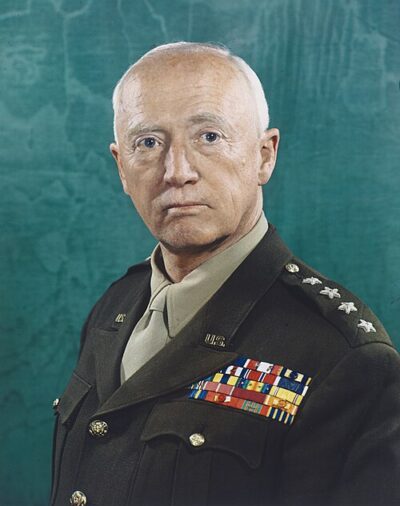
George S. Patton
George S. Patton was an United States Army general. Born November 11, 1885, in San Gabriel. Died December 21, 1945, in Heidelberg. Educated at United States Army War College and United States Military Academy. Awards include Bronze Star Medal, Knight Commander of the Order of the British Empire and Grand Cross of the Order of Wissam Alaouite.
Facts
49 facts · 2 confirmed by two sources · 7 cited · 39 from one source · 1 where the sources disagree
What’s different
- Born in: we show San Gabriel (Sources disagree). Wikidata also lists San Gabriel Valley
Where this comes from
Papalocal keeps its own record. It started from these sources; what each one said is kept here as it was copied, so a change on their side never changes this page by itself. Tap one to read its version.
What Wikidata says · copied November 13, 2026 · revision 2565967046
- Described as
- United States Army general (1885–1945)
- Other names
- The Old Man, Old Blood and Guts, Bandito, General Patton, George Smith Patton, Jr., G.S. Patton, George Patton, George Smith Patton, G.S. Patton, Jr.
- Born
- November 11, 1885 · 16 references
- Died
- December 21, 1945 · 15 references
- Born in
- San Gabriel · 1 reference; San Gabriel Valley · 1 reference
- Died in
- Heidelberg · 3 references
- Buried in
- Luxembourg American Cemetery and Memorial
- Cause of death
- traffic collision
- Citizen of
- United States
- Occupation
- autobiographer; swimmer · 1 reference; military personnel · 1 reference; army officer
- Education
- United States Army War College; United States Military Academy; United States Army Command and General Staff College; Virginia Military Institute; Douglass High School
- Member of
- 2nd Armored Division (1940–1942); I Armored Corps (1942–1943); II Corps (1943); Seventh United States Army (1943–1944); United States Army Central (1944–1945); Fifteenth United States Army (1945)
- Sport
- competitive swimming · 1 reference; modern pentathlon
- Awards
- Bronze Star Medal; Knight Commander of the Order of the British Empire; Grand Cross of the Order of Wissam Alaouite (1943); Legionnaire of Legion of Merit; Purple Heart; Order of the White Lion 4th Class; Silver Star; Grand Cross of the Order of Orange-Nassau; Companion of the Order of the Bath; Croix de guerre 1914–1918; Croix de guerre 1940–1945 (Belgium); Commander of the Legion of Honour; World War II Victory Medal; Distinguished Service Cross; Distinguished Service Medal
- Spouse
- Beatrice Banning Ayer (1910–1945) · 1 reference; Beatrice Banning Ayer Patton · 1 reference
- Children
- George Patton IV · 1 reference
- Father
- George S. Patton
- Mother
- Ruth Wilson · 1 reference
- Military branch
- United States Army (1909–1945); United States Cavalry
- Military rank
- general; general · 2 references
- Nickname
- Old Blood and Guts
- Wikipedias with a page
- 87
Wikidata item Q186492 (wikidata.org/wiki/Q186492), public domain (CC0). Copied November 13, 2026.
What Wikipedia says · copied November 13, 2026 · revision 1385505325
George Smith Patton Jr. (11 November 1885 – 21 December 1945) was a general in the United States Army who commanded the Seventh Army in the Mediterranean Theater of World War II, then the Third Army in France and Germany after the Allied invasion of Normandy in June 1944.
Born in 1885, Patton attended the Virginia Military Institute and the United States Military Academy at West Point. He studied fencing and designed the M1913 Cavalry Saber, more commonly known as the "Patton Saber." He competed in the modern pentathlon at the 1912 Summer Olympics in Stockholm, Sweden, finishing in fifth place. Patton entered combat during the Pancho Villa Expedition of 1916, the United States' first military action using motor vehicles. He fought in World War I as part of the Tank Corps: he commanded the U.S. tank school in France, then led tanks into combat and was wounded near the end of the war. In the interwar period, Patton became a central figure in the development of the army's armored warfare doctrine, serving in numerous staff positions throughout the country. At the United States' entry into World War II, he commanded the 2nd Armored Division.
Patton led U.S. troops into the Mediterranean theater with an invasion of Casablanca during Operation Torch in 1942, and soon established himself as an effective commander by rapidly rehabilitating the demoralized II Corps. He commanded the U.S. Seventh Army during the Allied invasion of Sicily, where he was the first Allied commander to reach Messina. There he was embroiled in controversy after he slapped two shell-shocked soldiers, and was temporarily removed from battlefield command. He was assigned a key role in Operation Fortitude, the Allies' military deception campaign for Operation Overlord. At the start of the Western Allied invasion of France, Patton was given command of the Third Army, which conducted a highly successful rapid armored drive across France. Under his decisive leadership, the Third Army took the lead in relieving beleaguered American troops at Bastogne during the Battle of the Bulge, after which his forces drove deep into Nazi Germany by the end of the war. During the Allied occupation of Germany, Patton was named military governor of Bavaria, but was relieved for making aggressive statements towards the Soviet Union and questioning denazification. He also held antisemitic views and made derogatory statements about Jewish people. He commanded the United States Fifteenth Army for slightly more than two months. Severely injured in an auto accident, he died in Germany twelve days later, on 21 December 1945.
Patton's colorful image, hard-driving personality, and success as a commander were at times overshadowed by his controversial public statements. His philosophy of leading from the front, and his ability to inspire troops with attention-getting, vulgarity-laden speeches, such as his famous address to the Third Army, were received favorably by his troops, but much less so by a sharply divided Allied high command. His sending the doomed Task Force Baum to liberate his son-in-law, Lieutenant Colonel John K. Waters, from a prisoner-of-war camp further damaged his standing with his superiors. His emphasis on rapid and aggressive offensive action proved effective, and he was regarded highly by his opponents in the German High Command. The 1970 Oscar-winning biographical film Patton helped popularize his image.
- Born, in its opening lines
- November 11, 1885
- Died, in its opening lines
- December 21, 1945
From the Wikipedia article “George S. Patton” (en.wikipedia.org/wiki/George_S._Patton), by its contributors, under CC BY-SA 4.0 (creativecommons.org/licenses/by-sa/4.0/). Copied November 13, 2026; not changed.
Confirmed Two sources agree. Cited One source, and it names where it got it. One source One source, without a reference of its own. Sources disagree The sources disagree. We show the best-supported value and keep theirs below.
