
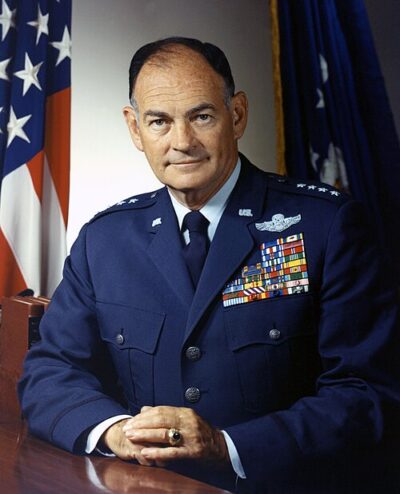
George Scratchley Brown
George Scratchley Brown was an US Air Force general. Born August 17, 1918, in Montclair. Died December 5, 1978, in Washington, D.C.. Positions held include Chairman of the Joint Chiefs of Staff (1974–1978) and Chief of Staff of the United States Air Force (1973–1974). Educated at University of Missouri and United States Military Academy. Awards include Distinguished Flying Cross, Bronze Star Medal and Legionnaire of Legion of Merit.
Facts
23 facts · 2 confirmed by two sources · 2 cited · 19 from one source
Where this comes from
Papalocal keeps its own record. It started from these sources; what each one said is kept here as it was copied, so a change on their side never changes this page by itself. Tap one to read its version.
What Wikidata says · copied November 19, 2026 · revision 2520815621
- Described as
- US Air Force general (1918-1978)
- Born
- August 17, 1918 · 3 references
- Died
- December 5, 1978 · 3 references
- Born in
- Montclair
- Died in
- Washington, D.C.
- Buried in
- Arlington National Cemetery (1978) · 1 reference
- Cause of death
- prostate cancer
- Citizen of
- United States
- Occupation
- military officer
- Positions held
- Chairman of the Joint Chiefs of Staff (1974–1978); Chief of Staff of the United States Air Force (1973–1974) · 1 reference
- Education
- University of Missouri; United States Military Academy
- Awards
- Distinguished Flying Cross; Bronze Star Medal; Legionnaire of Legion of Merit; Distinguished Flying Cross; Air Medal; Silver Star; National Aviation Hall of Fame (1985) · 1 reference; Eagle Scout · 1 reference; Knight Grand Cross of the Order of St. Olav (1976) · 1 reference
- Military branch
- United States Air Force
- Military rank
- general · 1 reference
- Wikipedias with a page
- 12
Wikidata item Q464262 (wikidata.org/wiki/Q464262), public domain (CC0). Copied November 19, 2026.
What Wikipedia says · copied November 19, 2026 · revision 1384038834
George Scratchley Brown (17 August 1918 – 5 December 1978) was a United States Air Force general who served as the eighth Chief of Staff of the Air Force from 1973 to 1974 and the eighth Chairman of the Joint Chiefs of Staff from 1974 to 1978. In this capacity, he served as the senior military adviser to the president of the United States, the National Security Council and the secretary of defense. Through the commanders of the unified and specified commands, he was also responsible for executing the decisions of the National Command Authorities regarding worldwide readiness and employment of combat forces of the United States Army, Navy, Air Force and Marine Corps. A graduate of the University of Missouri, he initially served in the Missouri National Guard during the interwar period, he later joined the US Army Air Corps following the attack on Pearl Harbor and the beginning of American involvement in the Second World War.
During his career as a pilot with the Eighth Air Force in Europe, Brown would become highly decorated officer and served in operational and command roles, earning the Distinguished Flying Cross. He later became a fighter pilot and served with distinction in the Korean War, before going on to serve in the Joint Staff as an aide to one of his future predecessors, General Earle Wheeler and later command the Seventh Air Force in the Vietnam War, playing a central role in Operation Rolling Thunder. After the 1968 Tet Offensive, he became deputy commander for operations of Military Assistance Command Vietnam and worked closely with General Creighton Abrams, the successor to General William Westmoreland. Brown played a key role in the highly controversial and destructive air campaign over Cambodia during the American intervention in its ongoing civil war ordered by President Richard Nixon, including Operation Menu and Operation Freedom Deal, which targeted North Vietnamese and Viet Cong sanctuaries on the border region.
After returning home in 1970, he initially led Air Force Systems Command, but his reputation among the national military leadership at the Pentagon led to him being nominated as Air Force Chief of Staff, and later Chairman of the Joint Chiefs, facing the reduction of American military involvement in Southeast Asia, helping the evacuation of Saigon before the eventual collapse of the Republic of Vietnam, and force modernization. During the presidency of Jimmy Carter, he supported the development of the B-1 bomber and advised him on the Strategic Arms Limitation Talks with the Soviet Union, as Detente progressed, still favoring a strong nuclear deterrent to prevent any future aggression, and also dealing with the future handover of the Panama Canal and the ongoing conflict with North Korea at the Demilitarized Zone.
- Born, in its opening lines
- August 17, 1918
- Died, in its opening lines
- December 5, 1978
From the Wikipedia article “George Scratchley Brown” (en.wikipedia.org/wiki/George_Scratchley_Brown), by its contributors, under CC BY-SA 4.0 (creativecommons.org/licenses/by-sa/4.0/). Copied November 19, 2026; not changed.
Confirmed Two sources agree. Cited One source, and it names where it got it. One source One source, without a reference of its own. Sources disagree The sources disagree. We show the best-supported value and keep theirs below.
