
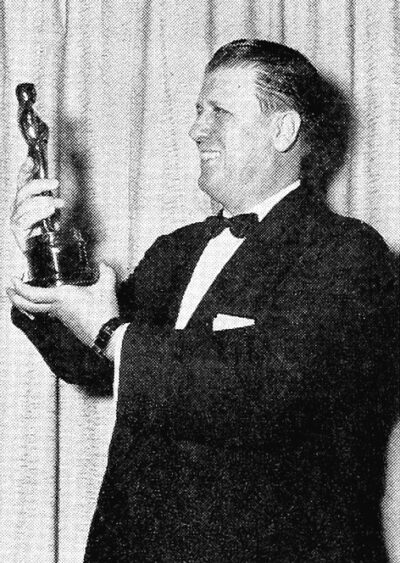
George Stevens
George Stevens was an American film director, producer, screenwriter and cinematographer. Born December 18, 1904, in Oakland. Died March 8, 1975, in Lancaster. Known for The Nazi Plan. Awards include Legionnaire of Legion of Merit, Directors Guild of America Award and Academy Award for Best Director (2 times).
Facts
28 facts · 2 confirmed by two sources · 9 cited · 17 from one source
Where this comes from
Papalocal keeps its own record. It started from these sources; what each one said is kept here as it was copied, so a change on their side never changes this page by itself. Tap one to read its version.
What Wikidata says · copied November 13, 2026 · revision 2565567856
- Described as
- American film director, producer, screenwriter and cinematographer (1904–1975)
- Other names
- George Cooper Stevens, George C. Stevens
- Born
- December 18, 1904 · 3 references
- Died
- March 8, 1975 · 13 references
- Born in
- Oakland · 2 references
- Died in
- Lancaster · 1 reference
- Buried in
- Forest Lawn Memorial Park
- Cause of death
- myocardial infarction
- Name at birth
- George Cooper Stevens
- Citizen of
- United States · 1 reference
- Occupation
- film director · 2 references; film producer · 3 references; cinematographer · 2 references; screenwriter; trade unionist; stage actor · 1 reference; director · 2 references; producer · 1 reference
- Known for
- The Nazi Plan
- Awards
- Legionnaire of Legion of Merit; Directors Guild of America Award; Academy Award for Best Director (2 times) (1952, 1957); National Board of Review Award for Best Film; star on Hollywood Walk of Fame · 1 reference; Irving G. Thalberg Memorial Award (1954)
- Spouse
- Yvonne Howell (1930–1947)
- Children
- George Stevens, Jr. · 1 reference
- Father
- Landers Stevens
- Mother
- Georgie Cooper
- Siblings
- Jack Stevens
- Wikipedias with a page
- 49
Wikidata item Q51490 (wikidata.org/wiki/Q51490), public domain (CC0). Copied November 13, 2026.
What Wikipedia says · copied November 13, 2026 · revision 1385356324
George Cooper Stevens (December 18, 1904 – March 8, 1975) was an American filmmaker. A prominent figure of the classical Hollywood era, Stevens demonstrated versatility across film genres, deep humanism, and visual precision. He won two Academy Awards for Best Director for A Place in the Sun (1951) and Giant (1956). He later became known for meticulously shooting coverage of a scene from every conceivable angle.
Born in Oakland, California, George Stevens worked for his parents' West Coast touring stock theater company as an actor and stage manager. When cinema was replacing live theater, Stevens's parents relocated to Los Angeles. At the age of 17, Stevens was hired as an assistant cameraman and worked on several Western films produced by Hal Roach. Within three years, Stevens became a cameraman on the Our Gang series. Impressed with Stevens's visual knowledge, Roach then appointed him to direct installments of The Boy Friends series.
Stevens next moved to Universal Pictures and then to RKO Pictures. There, he directed several genre films, including Alice Adams starring Katharine Hepburn; Swing Time starring Fred Astaire and Ginger Rogers; and Gunga Din starring Cary Grant. Stevens was loaned to MGM to direct Woman of the Year (1942) based on Hepburn's suggestion, whereby she was paired with Spencer Tracy for the first time. He also directed The Talk of the Town (1942) and The More the Merrier (1943).
In 1941, as the United States entered World War II, Stevens joined the U.S. Army Signal Corps. As the leader of a film unit, Stevens used his personal 16 mm film camera to capture footage of the Liberation of Paris and the entry of American soldiers into the Dachau concentration camp. Stevens later returned to Hollywood and directed more dramatic films such as I Remember Mama (1948).
Between 1951 and 1956, Stevens directed his American Trilogy, which includes A Place in the Sun (1951), Shane (1953), and Giant (1956). He next directed widescreen biographical films, The Diary of Anne Frank (1959) and The Greatest Story Ever Told (1965). His final film was The Only Game in Town (1970), which starred Elizabeth Taylor and Warren Beatty. Stevens died on March 8, 1975, at the age of 70.
- Born, in its opening lines
- December 18, 1904
- Died, in its opening lines
- March 8, 1975
From the Wikipedia article “George Stevens” (en.wikipedia.org/wiki/George_Stevens), by its contributors, under CC BY-SA 4.0 (creativecommons.org/licenses/by-sa/4.0/). Copied November 13, 2026; not changed.
Confirmed Two sources agree. Cited One source, and it names where it got it. One source One source, without a reference of its own. Sources disagree The sources disagree. We show the best-supported value and keep theirs below.
