
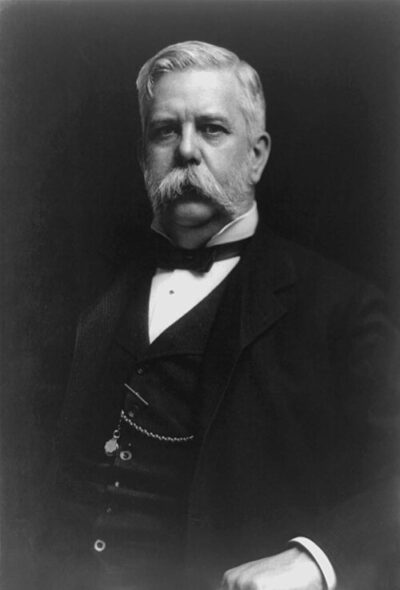
George Westinghouse
George Westinghouse was an American inventor and businessman. Born October 6, 1846, in Central Bridge. Died March 12, 1914, in New York City. Educated at Union College. Awards include Edison Medal, John Fritz Medal and National Inventors Hall of Fame.
Facts
17 facts · 2 confirmed by two sources · 8 cited · 7 from one source
Where this comes from
Papalocal keeps its own record. It started from these sources; what each one said is kept here as it was copied, so a change on their side never changes this page by itself. Tap one to read its version.
What Wikidata says · copied November 13, 2026 · revision 2537944292
- Described as
- American inventor and businessman (1846–1914)
- Other names
- George Westinghouse Jr.
- Born
- October 6, 1846 · 4 references
- Died
- March 12, 1914 · 4 references
- Born in
- Central Bridge
- Died in
- New York City · 1 reference
- Buried in
- Arlington National Cemetery · 1 reference
- Citizen of
- United States
- Occupation
- entrepreneur; inventor
- Education
- Union College
- Awards
- Edison Medal (1911) · 1 reference; John Fritz Medal (1906) · 1 reference; National Inventors Hall of Fame (1989) · 1 reference; Grashof Commemorative Medal (1913) · 1 reference
- Spouse
- Marguerite Erskine Walker · 1 reference
- Children
- George Westinghouse III · 1 reference
- Siblings
- Henry Herman Westinghouse
- Lived in
- George Westinghouse, Jr., Birthplace and Boyhood Home (1846–1856) · 1 reference
- Wikipedias with a page
- 57
Wikidata item Q262367 (wikidata.org/wiki/Q262367), public domain (CC0). Copied November 13, 2026.
What Wikipedia says · copied November 13, 2026 · revision 1381923512
George Westinghouse Jr. (October 6, 1846 – March 12, 1914) was a prolific American inventor, engineer, and entrepreneurial industrialist based in Pittsburgh, Pennsylvania. He is best known for his creation of the railway air brake and for being a pioneer in the development and use of alternating current (AC) electrical power distribution. During his career, he received 360 patents for his inventions and established 61 companies, many of which still exist today.
His invention of a train braking system using compressed air revolutionized the railroad industry around the world. He founded the Westinghouse Air Brake Company in 1869. He and his engineers also developed track-switching and signaling systems, which led to the founding of the company Union Switch & Signal in 1881.
In the early 1880s, he developed inventions for the safe production, transmission, and use of natural gas. This sparked the creation of a whole new energy industry.
During this same period, Westinghouse recognized the potential of using alternating current (AC) for electric power distribution. In 1886, he founded the Westinghouse Electric Corporation. Westinghouse's electric business directly competed with Thomas Edison's, who was promoting direct current (DC) electricity. Westinghouse Electric won the contract to showcase its AC system to illuminate the "White City" at the 1893 Columbian Exposition in Chicago. The company went on to install the world's first large-scale AC power generation plant at Niagara Falls, New York, which opened in August 1895.
Ironically, among many other honors, Westinghouse received the 1911 Edison Medal of the American Institute of Electrical Engineers "for meritorious achievement in connection with the development of the alternating current system".
- Born, in its opening lines
- October 6, 1846
- Died, in its opening lines
- March 12, 1914
From the Wikipedia article “George Westinghouse” (en.wikipedia.org/wiki/George_Westinghouse), by its contributors, under CC BY-SA 4.0 (creativecommons.org/licenses/by-sa/4.0/). Copied November 13, 2026; not changed.
Confirmed Two sources agree. Cited One source, and it names where it got it. One source One source, without a reference of its own. Sources disagree The sources disagree. We show the best-supported value and keep theirs below.
