
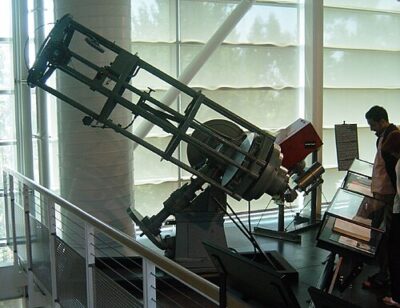
George Willis Ritchey
George Willis Ritchey was an American astronomer. Born December 31, 1864, in Tuppers Plains. Died November 4, 1945, in Azusa. Educated at University of Cincinnati. Awards include Prix Jules Janssen and Janssen Medal.
Facts
13 facts · 2 confirmed by two sources · 1 cited · 10 from one source
Where this comes from
Papalocal keeps its own record. It started from these sources; what each one said is kept here as it was copied, so a change on their side never changes this page by itself. Tap one to read its version.
What Wikidata says · copied November 18, 2026 · revision 2565591486
- Described as
- American astronomer (1864–1945)
- Other names
- G. W. Ritchey, George W. Ritchey
- Born
- December 31, 1864 · 3 references
- Died
- November 4, 1945 · 3 references
- Born in
- Tuppers Plains
- Died in
- Azusa
- Citizen of
- United States
- Occupation
- astronomer · 1 reference; optician
- Worked for
- Mount Wilson Observatory; Paris Observatory, PSL University · 1 reference
- Education
- University of Cincinnati
- Awards
- Prix Jules Janssen (1924); Janssen Medal (1924)
- Field
- astronomy · 1 reference
- Wikipedias with a page
- 17
Wikidata item Q559015 (wikidata.org/wiki/Q559015), public domain (CC0). Copied November 18, 2026.
What Wikipedia says · copied November 18, 2026 · revision 1338159010
George Willis Ritchey (December 31, 1864 – November 4, 1945) was an American optician and telescope maker and astronomer born at Tuppers Plains, Ohio.
Ritchey was educated as a furniture maker. He coinvented the Ritchey–Chrétien (R–C) reflecting telescope along with Henri Chrétien. The R-C prescription remains the predominant optical design for telescopes and has since been used for the majority of major ground-based and space-based telescopes.
He worked closely with George Ellery Hale, first at Yerkes Observatory and later at Mt. Wilson Observatory. He played a major role in designing the mountings and making the mirrors of the Mt. Wilson 60-inch (1.5 m) and 100-inch (2.5 m) telescopes. Hale and Ritchey had a falling-out in 1919, and Ritchey eventually went to Paris where he promoted the construction of very large telescopes. He returned to America in 1930 and obtained a contract to build a Ritchey-Chrétien telescope for the U.S. Naval Observatory. This last telescope produced by Ritchey remains in operation at the U.S. Naval Observatory Flagstaff Station in Flagstaff, Arizona.
In 1924, he received the Prix Jules Janssen, the highest award of the Société astronomique de France, the French astronomical society. Craters on Mars and the Moon were named in his honor.
A very readable biography of Ritchey and Hale is in Don Osterbrock's book "Pauper and Prince - Ritchey, Hale and the Big American Telescopes" (The university of Arizona Press, 1993) where the idiosyncratic personalities of both Ritchey and Hale are exposed.
- Born, in its opening lines
- December 31, 1864
- Died, in its opening lines
- November 4, 1945
From the Wikipedia article “George Willis Ritchey” (en.wikipedia.org/wiki/George_Willis_Ritchey), by its contributors, under CC BY-SA 4.0 (creativecommons.org/licenses/by-sa/4.0/). Copied November 18, 2026; not changed.
Confirmed Two sources agree. Cited One source, and it names where it got it. One source One source, without a reference of its own. Sources disagree The sources disagree. We show the best-supported value and keep theirs below.
