
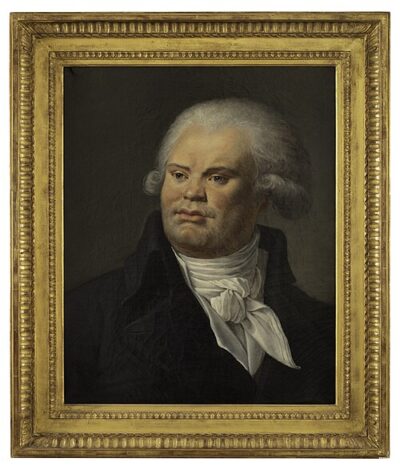
Georges Danton
Georges Danton was a French revolutionary. Born October 26, 1759, in Arcis-sur-Aube. Died April 5, 1794, in Paris. Positions held include President of the National Convention (1793), deputy to the National Convention (1792–1795) and Member of parliament for the Seine.
Facts
20 facts · 2 confirmed by two sources · 6 cited · 12 from one source
Where this comes from
Papalocal keeps its own record. It started from these sources; what each one said is kept here as it was copied, so a change on their side never changes this page by itself. Tap one to read its version.
What Wikidata says · copied November 16, 2026 · revision 2565594135
- Described as
- French revolutionary (1759–1794)
- Other names
- Danton, Georges Jacques Danton, George Jacques Danton
- Born
- October 26, 1759 · 2 references
- Died
- April 5, 1794 · 10 references
- Born in
- Arcis-sur-Aube · 1 reference
- Died in
- Paris · 3 references
- Buried in
- Errancis Cemetery
- Cause of death
- decapitation
- Citizen of
- France
- Occupation
- lawyer · 1 reference; revolutionary · 2 references; politician · 1 reference; jurist · 1 reference
- Positions held
- President of the National Convention (1793); deputy to the National Convention (1792–1795) · 1 reference; Member of parliament for the Seine; Minister of Justice
- Political party
- Cordeliers; Indulgents
- Member of
- Committee of Public Safety
- Spouse
- Antoinette Gabrielle Danton; Louise Sébastienne Danton
- Wikipedias with a page
- 92
Wikidata item Q184623 (wikidata.org/wiki/Q184623), public domain (CC0). Copied November 16, 2026.
What Wikipedia says · copied November 16, 2026 · revision 1384935352
Georges Jacques Danton (, US: also ; French: [ʒɔʁʒ dɑ̃tɔ̃]; 26 October 1759 – 5 April 1794) was a French politician and one of the leading figures of the French Revolution. A relatively obscure lawyer before the Revolution, he became a prominent orator of the Cordeliers Club and, following the overthrow of the monarchy on 10 August 1792, was appointed Minister of Justice. His role in the September Massacres has long been disputed. In early 1793, the National Convention sent him to Belgium in connection with the military and political crisis surrounding General Dumouriez. That spring, Danton supported the establishment of the Revolutionary Tribunal and helped establish the Committee of Public Safety, of which he became one of the first members.
During the Insurrection of 31 May – 2 June 1793, Danton supported the dissolution of the Commission of Twelve, while taking a more ambivalent position toward the use of force against the Girondins. After leaving the Committee of Public Safety in July 1793, Danton increasingly distanced himself from its policies and in September refused to rejoin it. In early October 1793, Danton withdrew from political life for a time, but returned to Paris mid-November and emerged as one of the leading moderates calling for greater clemency and end to the Terror. His criticism of the Committee of Public Safety brought him into growing conflict with its members. On 25 December 1793 (5 Nivôse, year II), Robespierre responded publicly to demands associated with Danton and his allies for greater clemency. In late March 1794, Danton again spoke in favour of ending the Terror. Within days he was arrested, tried on charges of conspiracy and venality, and executed by guillotine on 5 April 1794.
Danton's political role and historical reputation have long been subjects of debate. During the Third Republic (1870–1940), he was often portrayed as a central figure in the overthrow of the monarchy and the establishment of the First Republic.
- Born, in its opening lines
- October 26, 1759
- Died, in its opening lines
- April 5, 1794
From the Wikipedia article “Georges Danton” (en.wikipedia.org/wiki/Georges_Danton), by its contributors, under CC BY-SA 4.0 (creativecommons.org/licenses/by-sa/4.0/). Copied November 16, 2026; not changed.
Confirmed Two sources agree. Cited One source, and it names where it got it. One source One source, without a reference of its own. Sources disagree The sources disagree. We show the best-supported value and keep theirs below.
