
Georges de La Tour
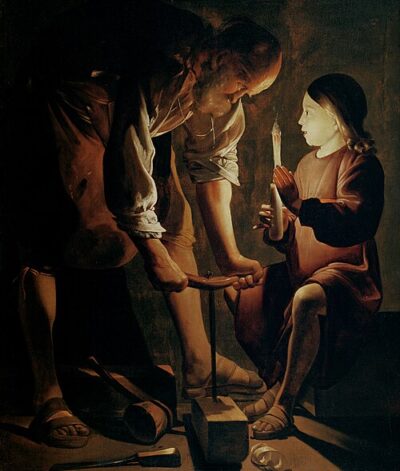
Georges de La Tour was a Lorrain painter. Born March 13, 1593, in Vic-sur-Seille. Died January 30, 1652, in Lunéville. Known for The Dream of Saint Joseph, Joseph the Carpenter and The Newborn.
Facts
15 facts · 2 confirmed by two sources · 7 cited · 6 from one source
Where this comes from
Papalocal keeps its own record. It started from these sources; what each one said is kept here as it was copied, so a change on their side never changes this page by itself. Tap one to read its version.
What Wikidata says · copied November 16, 2026 · revision 2548665287
- Described as
- Lorrain painter (1593–1652)
- Other names
- La Tour, Georges du Mesnil La Tour, Georges Dumesnil La Tour, Georges du Mesnil de La Tour, Latour, g. de la tour, Georges Du Mesnil De La Tour, de la Tour, Georges Latour, Claude du Menil de La Tour, Ménil La Tour, Georges de Latour
- Born
- March 13, 1593 · 2 references
- Died
- January 30, 1652 · 10 references
- Born in
- Vic-sur-Seille · 1 reference
- Died in
- Lunéville · 2 references
- Cause of death
- epidemic · 1 reference
- Citizen of
- Duchy of Lorraine
- Occupation
- painter · 3 references; architectural drafter · 1 reference
- Genre
- Caravaggisti; genre painting · 1 reference; religious painting · 1 reference
- Known for
- The Dream of Saint Joseph; Joseph the Carpenter; The Newborn
- Field
- painting · 2 references
- Wikipedias with a page
- 53
Wikidata item Q203371 (wikidata.org/wiki/Q203371), public domain (CC0). Copied November 16, 2026.
What Wikipedia says · copied November 16, 2026 · revision 1385338359
Georges de La Tour (French pronunciation: [ʒɔʁʒ də la tuʁ]; 13 March 1593 – 30 January 1652) was a French Baroque painter, who spent most of his working life in the Duchy of Lorraine, which was temporarily absorbed into France between 1641 and 1648. He painted mostly religious chiaroscuro scenes lit by candlelight.
An artist at the confluence of Nordic, Italian, and French cultures, and a contemporary of Jacques Callot and the Le Nain brothers. Likely inspired by Caravaggio, much of his work emphasizes light and shadow on simplified forms.
Recognised during his lifetime, he was quickly forgotten after his death. Rediscovered in the early 20th century by German art historian Hermann Voss, he later inspired writers as diverse as René Char, André Malraux, Pascal Quignard, and Charles Juliet.
- Born, in its opening lines
- March 13, 1593
- Died, in its opening lines
- January 30, 1652
From the Wikipedia article “Georges de La Tour” (en.wikipedia.org/wiki/Georges_de_La_Tour), by its contributors, under CC BY-SA 4.0 (creativecommons.org/licenses/by-sa/4.0/). Copied November 16, 2026; not changed.
Confirmed Two sources agree. Cited One source, and it names where it got it. One source One source, without a reference of its own. Sources disagree The sources disagree. We show the best-supported value and keep theirs below.
