
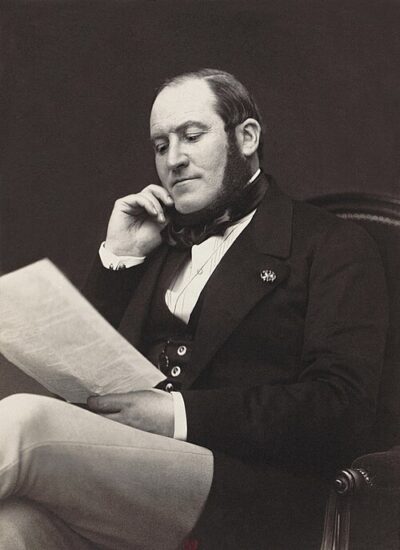
Georges-Eugène Haussmann
Georges-Eugène Haussmann was a French official and politician. Born March 27, 1809, in Paris. Died January 11, 1891, in Paris. Positions held include Prefect of Seine (1853–1870), Second Empire senator (1857–1870) and General secretary of prefecture of Vienne (1831–1832). Educated at Lycée Henri-IV and Lycée Condorcet. Awards include Grand Cross of the Legion of Honour, Grand Cross of the Order of the Immaculate Conception of Vila Viçosa and Commander of the Order of the Immaculate Conception of Vila Viçosa.
Facts
37 facts · 2 confirmed by two sources · 11 cited · 23 from one source · 1 where the sources disagree
What’s different
- Buried in: we show Père Lachaise Cemetery (Sources disagree). Wikidata also lists Grave of Haussmann
Where this comes from
Papalocal keeps its own record. It started from these sources; what each one said is kept here as it was copied, so a change on their side never changes this page by itself. Tap one to read its version.
What Wikidata says · copied November 16, 2026 · revision 2567360727
- Described as
- French official and politician (1809-1891)
- Other names
- Georges-Eugene Haussmann, George Eugène Haussman, Georges Eugène, Baron Haussmann, Georges Eugène Haussmann baron, Baron Georges Eugène Haussmann, Georges Eugene Haussmann baron, Baron Georges Eugene Haussmann, Haussmann, Georges Eugène Haussmann, Baron Haussmann, Georges Eugene Haussmann
- Born
- March 27, 1809 · 13 references
- Died
- January 11, 1891 · 11 references
- Born in
- Paris · 1 reference
- Died in
- Paris · 1 reference
- Buried in
- Père Lachaise Cemetery · 2 references; Grave of Haussmann
- Citizen of
- France
- Occupation
- politician · 2 references; official; architect · 2 references; urban planner · 2 references; Praefectus · 1 reference
- Positions held
- Prefect of Seine (1853–1870); Second Empire senator (1857–1870) · 1 reference; General secretary of prefecture of Vienne (1831–1832); sub-prefect of Yssingeaux (1832); sub-prefect of Nérac (1832–1840); Sub-prefect of Saint-Girons (1840–1841); sub-prefect of Blaye (1841–1848); Prefecture advisor (1848–1849); Prefect of Gironde (1851–1853); Prefect of Var (1849–1850); Prefect of Yonne (1850–1851); Deputy of the French Third Republic (1877–1881) · 1 reference
- Political party
- Bonapartism
- Education
- Lycée Henri-IV; Lycée Condorcet; Conservatoire de Paris
- Member of
- Académie des beaux-arts (1867–)
- Awards
- Grand Cross of the Legion of Honour (1862–) · 1 reference; Grand Cross of the Order of the Immaculate Conception of Vila Viçosa; Commander of the Order of the Immaculate Conception of Vila Viçosa; Knight Grand Officer of the Order of Carlos III · 1 reference
- Field
- Haussmann's renovation of Paris
- Spouse
- Louise Octavie de Laharpe (1838–) · 1 reference
- Children
- Valentine Haussmann
- Father
- Nicolaus-Valentin Haussmann
- Religion
- Protestantism · 1 reference
- Wikipedias with a page
- 58
Wikidata item Q191798 (wikidata.org/wiki/Q191798), public domain (CC0). Copied November 16, 2026.
What Wikipedia says · copied November 16, 2026 · revision 1375056406
Georges-Eugène Haussmann (French: [ʒɔʁʒ øʒɛn osman]; 27 March 1809 – 11 January 1891), known as Baron Haussmann ([baʁɔ̃ osman]), was a French official who supervised a radical urban renewal programme of new boulevards, parks, and public works in Paris, referred to as Haussmann's renovation of Paris, aimed at introducing grandeur in the city. First a prefect in Var (1849–1850), Yonne (1850–1851), and Gironde (1851–1853), his skills as an administrator led to his appointment in Paris by Emperor Napoleon III in 1853.
The signature architectural landmark of his works was the Paris Opera, the largest theatre in the world, designed by Charles Garnier, crowning the centre of Napoleon III's new Paris. Haussmann completely rebuilt Paris above and below ground; on his own estimation by 1870 one in five streets in central Paris were his creation, while revamped sewers now ran alongside miles of pipes to distribute gas for thousands of new streetlights. With his right-hand Adolphe Alphand and at the Emperor's direction, a plan was laid out for four major parks at the cardinal points of the compass around the city: the Bois de Boulogne to the west, Bois de Vincennes to the east, Parc des Buttes Chaumont to the north, and Parc Montsouris to the south. The major parks and their smaller counterparts in the city were an immediate success with all classes of Parisians.
Critics forced his dismissal as prefect of Seine in 1870, but his vision of the city still defines much of Paris today. He was made a senator in 1857 and a grand cross of the Legion of Honour in 1862. The Boulevard Haussmann as well as Haussmann–Saint-Lazare station in Paris bear his name.
- Born, in its opening lines
- March 27, 1809
- Died, in its opening lines
- January 11, 1891
From the Wikipedia article “Georges-Eugène Haussmann” (en.wikipedia.org/wiki/Georges-Eugène_Haussmann), by its contributors, under CC BY-SA 4.0 (creativecommons.org/licenses/by-sa/4.0/). Copied November 16, 2026; not changed.
Confirmed Two sources agree. Cited One source, and it names where it got it. One source One source, without a reference of its own. Sources disagree The sources disagree. We show the best-supported value and keep theirs below.
