
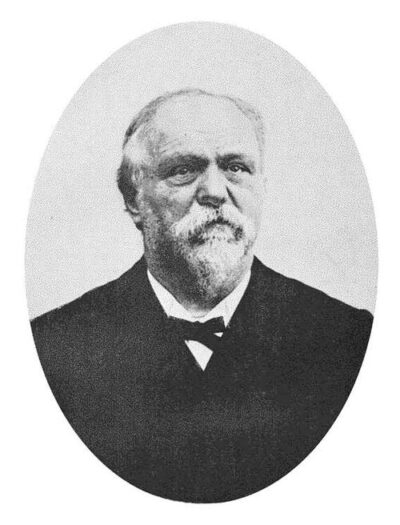
Georges Sorel
Georges Sorel was a French philosopher and sociologist. Born November 2, 1847, in Cherbourg. Died August 29, 1922, in Boulogne-Billancourt. Educated at École polytechnique and Collège-lycée Jacques-Decour. Awards include Knight of the Legion of Honour.
Facts
17 facts · 2 confirmed by two sources · 5 cited · 10 from one source
Where this comes from
Papalocal keeps its own record. It started from these sources; what each one said is kept here as it was copied, so a change on their side never changes this page by itself. Tap one to read its version.
What Wikidata says · copied November 16, 2026 · revision 2565598876
- Described as
- French philosopher and sociologist
- Other names
- Georges Eugène Sorel
- Born
- November 2, 1847 · 8 references
- Died
- August 29, 1922 · 3 references
- Born in
- Cherbourg
- Died in
- Boulogne-Billancourt
- Buried in
- cemetery of Tenay
- Citizen of
- France · 1 reference
- Occupation
- philosopher · 1 reference; engineer · 1 reference; sociologist; writer; trade unionist; social reformer · 1 reference; opinion journalist · 1 reference
- Education
- École polytechnique; Collège-lycée Jacques-Decour
- Awards
- Knight of the Legion of Honour
- Field
- philosophy
- Wikipedias with a page
- 54
Wikidata item Q313666 (wikidata.org/wiki/Q313666), public domain (CC0). Copied November 16, 2026.
What Wikipedia says · copied November 16, 2026 · revision 1379804459
Georges Eugène Sorel (; French: [ʒɔʁʒ øʒɛn sɔʁɛl]; 2 November 1847 – 29 August 1922) was a French social thinker, political theorist, historian, and later journalist. He has inspired theories and movements grouped under the name of Sorelianism. His social and political philosophy owed much to his reading of Proudhon, Fernand Pelloutier, Karl Marx, Giambattista Vico, Henri Bergson (whose lectures at the Collège de France he attended), and later William James. His notion of the power of myth in collective agency inspired socialists, anarchists, Marxists, and fascists. Together with his defense of violence, the power of myth is the contribution for which he is most often remembered.
Politically he evolved from his early liberal-conservative positions towards Marxism, social-democracy, and eventually syndicalism. Between 1909 and 1910 he was marginally involved with Charles Maurras' Action Française, and between 1911 and 1913 he wrote for the politically transversal L'Indépendance, established together with Édouard Berth – one of Sorel's main disciples – and Georges Valois, closer to Maurrassian circles. After a long silence during the war, Sorel came out in favour of Lenin and moved towards Bolshevist positions until his death in 1922.
His legacy in the interwar period embraced both ends of the political spectrum, as many former syndicalists welcomed the emerging fascism. According to historian Zeev Sternhell, Sorel's revision of Marxism broke the necessity of the link between revolution and working class, opening up the possibility of replacing the proletariat with the national community.
- Born, in its opening lines
- November 2, 1847
- Died, in its opening lines
- August 29, 1922
From the Wikipedia article “Georges Sorel” (en.wikipedia.org/wiki/Georges_Sorel), by its contributors, under CC BY-SA 4.0 (creativecommons.org/licenses/by-sa/4.0/). Copied November 16, 2026; not changed.
Confirmed Two sources agree. Cited One source, and it names where it got it. One source One source, without a reference of its own. Sources disagree The sources disagree. We show the best-supported value and keep theirs below.
