
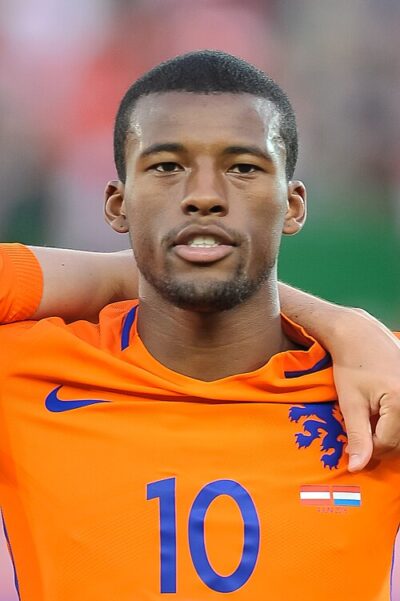
Georginio Wijnaldum
Georginio Wijnaldum is a Dutch association football player. Born November 11, 1990, in Rotterdam. Teams include Feyenoord Rotterdam (2007–2011), PSV Eindhoven (2011–2015) and Liverpool F.C. (2016–2021).
Facts
21 facts · 1 confirmed by two sources · 0 cited · 20 from one source
Where this comes from
Papalocal keeps its own record. It started from these sources; what each one said is kept here as it was copied, so a change on their side never changes this page by itself. Tap one to read its version.
What Wikidata says · copied November 16, 2026 · revision 2556849885
- Described as
- Dutch association football player (born 1990)
- Other names
- Georginio Gregion Emile Wijnaldum
- Born
- November 11, 1990 · 2 references
- Born in
- Rotterdam
- Name at birth
- Georginio Gregion Emile Wijnaldum
- Citizen of
- Kingdom of the Netherlands
- Occupation
- association football player
- Teams
- Feyenoord Rotterdam (2007–2011); PSV Eindhoven (2011–2015); Liverpool F.C. (2016–2021); Netherlands national under-17 football team (2005–2007); Netherlands national under-19 football team (2007–2009); Netherlands national under-21 football team (2009–2013); Netherlands national association football team (2011–); Paris Saint-Germain FC (2021–2023); AS Roma (2022–2023); Al-Ettifaq FC (2023–2026); Newcastle United F.C. (2015–2016); Al Ittihad FC (2026–)
- Sport
- association football
- Siblings
- Rajiv van La Parra; Giliano Wijnaldum
- Height
- 1.73 m (5 ft 8 in)
- Wikipedias with a page
- 57
Wikidata item Q372379 (wikidata.org/wiki/Q372379), public domain (CC0). Copied November 16, 2026.
What Wikipedia says · copied November 16, 2026 · revision 1385397942
Georginio Gregion Emile Wijnaldum (born Georginio Gregion Emile Boateng; pronounced [dʑoːrˈdʑiɲoː ʋɛiˈnɑldʏm]; 11 November 1990) is a Dutch professional footballer who plays as a midfielder for Saudi Pro League club Al-Ittihad.
A youth product of Eredivisie side Feyenoord, Wijnaldum became the youngest player ever to represent the club when he made his debut in 2007, and went on to play 134 matches over the course of a five-year spell, winning the KNVB Cup in 2008. Following his departure from Feyenoord, Wijnaldum spent four seasons at PSV, where he won the KNVB Cup in his first season and the Eredivisie in his last, a season where he also earned the Dutch Footballer of the Year award.
In 2015, Wijnaldum joined Premier League side Newcastle United for £14.5 million, before departing a year later to join fellow club Liverpool in a £23 million deal. At Liverpool, Wijnaldum took on a role deeper in the midfield than in his previous clubs. In the 2018–19 season, Wijnaldum scored twice against Barcelona in the Champions League semi-final second leg comeback as Liverpool went through 4–3 on aggregate, and he started as the club were victorious in the 2019 UEFA Champions League final. In the following season, he played an integral role as Liverpool won the UEFA Super Cup, FIFA Club World Cup and Premier League, the club's first league title in 30 years. Wijnaldum appeared 237 times for Liverpool and is often regarded as a club legend who played a major part in Liverpool's successes over his six years at the club. Wijnaldum signed for French club Paris Saint-Germain (PSG) in 2021 on a free transfer, spending a loan stint at Italy with Roma for the 2022–23 season. In 2023, he signed for Saudi Arabian side Al-Ettifaq.
Wijnaldum is a former Dutch youth and senior international, having earned over 90 caps since making his debut for the Netherlands national team in 2011, and was a member of the squads which finished third at the 2014 FIFA World Cup and runners-up in the 2018–19 UEFA Nations League. He also took part at the 2020 and 2024 editions of the UEFA European Championship.
- Born, in its opening lines
- November 11, 1990
From the Wikipedia article “Georginio Wijnaldum” (en.wikipedia.org/wiki/Georginio_Wijnaldum), by its contributors, under CC BY-SA 4.0 (creativecommons.org/licenses/by-sa/4.0/). Copied November 16, 2026; not changed.
Confirmed Two sources agree. Cited One source, and it names where it got it. One source One source, without a reference of its own. Sources disagree The sources disagree. We show the best-supported value and keep theirs below.
