
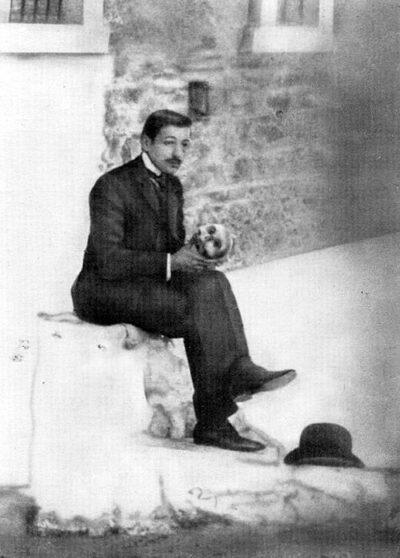
Georgios Papanikolaou
Georgios Papanikolaou was a Greek pathologist. Born May 13, 1883, in Kými. Died February 19, 1962, in Miami. Known for Pap test. Educated at National and Kapodistrian University of Athens and LMU Munich. Awards include Lasker-DeBakey Clinical Medical Research Award and Amory Prize.
Facts
22 facts · 2 confirmed by two sources · 4 cited · 16 from one source
Where this comes from
Papalocal keeps its own record. It started from these sources; what each one said is kept here as it was copied, so a change on their side never changes this page by itself. Tap one to read its version.
What Wikidata says · copied November 16, 2026 · revision 2555572442
- Described as
- Greek pathologist (1883-1962)
- Other names
- George Papanicolaou, Georgios Nikolaou Papanikolaou, George N. Papanicolaou
- Born
- May 13, 1883 · 4 references
- Died
- February 19, 1962 · 4 references
- Born in
- Kými
- Died in
- Miami
- Buried in
- Riverside Cemetery · 1 reference
- Citizen of
- Greece
- Occupation
- physician · 1 reference; oncologist; gynecologist · 1 reference
- Worked for
- Cornell University; University of Miami; Weill Cornell Medical Center
- Education
- National and Kapodistrian University of Athens (–1904) · 1 reference; LMU Munich
- Member of
- Panhellenic Musician Union; Academy of Athens
- Known for
- Pap test · 1 reference
- Awards
- Lasker-DeBakey Clinical Medical Research Award (1950) · 1 reference; Amory Prize (1947) · 1 reference
- Spouse
- Andromachi Papanikolaou
- Father
- Nikolaos Papanikolaou
- Lived in
- United States · 1 reference
- Wikipedias with a page
- 40
Wikidata item Q319321 (wikidata.org/wiki/Q319321), public domain (CC0). Copied November 16, 2026.
What Wikipedia says · copied November 16, 2026 · revision 1384341381
Georgios Nikolaou Papanikolaou (or George Papanicolaou ; Greek: Γεώργιος Ν. Παπανικολάου [papanikoˈlau]; 13 May 1883 – 19 February 1962) was a Greek physician, zoologist and microscopist who was a pioneer in cytopathology and early cancer detection, and inventor of the pap smear for detection of cervical cancer.
After studying medicine in Greece and Germany, in 1913 he emigrated to the United States and was on the faculty at Cornell Medical College. He first reported that uterine cancer cells could be detected in vaginal smears in 1928, but his work was not widely recognized until the 1940s. An extensive trial of his techniques was carried out in the early 1950s. In 1961 he was invited to the University of Miami to lead and develop there the Papanicolaou Cancer Research Institute.
- Born, in its opening lines
- May 13, 1883
- Died, in its opening lines
- February 19, 1962
From the Wikipedia article “Georgios Papanikolaou” (en.wikipedia.org/wiki/Georgios_Papanikolaou), by its contributors, under CC BY-SA 4.0 (creativecommons.org/licenses/by-sa/4.0/). Copied November 16, 2026; not changed.
Confirmed Two sources agree. Cited One source, and it names where it got it. One source One source, without a reference of its own. Sources disagree The sources disagree. We show the best-supported value and keep theirs below.
