
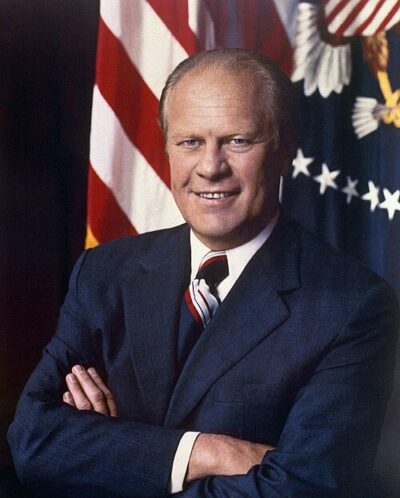
Gerald Ford
Gerald Ford was a president of the United States from 1974 to 1977. Born July 14, 1913, in Gerald R. Ford Birthsite and Gardens. Died December 26, 2006, in Rancho Mirage. Positions held include President of the United States (1974–1977), United States representative (1949–1973) and Vice President of the United States (1973–1974). Educated at University of Michigan and Yale Law School. Awards include Presidential Medal of Freedom, Profile in Courage Award and Congressional Gold Medal.
Facts
64 facts · 2 confirmed by two sources · 21 cited · 41 from one source
Where this comes from
Papalocal keeps its own record. It started from these sources; what each one said is kept here as it was copied, so a change on their side never changes this page by itself. Tap one to read its version.
What Wikidata says · copied November 13, 2026 · revision 2567576714
- Described as
- president of the United States from 1974 to 1977 (1913–2006)
- Other names
- Gerald R. Ford, Gerald R. Ford, Jr., Leslie Lynch King Jr., Gerald Ford Jr., Gerald Rudolph Ford Jr., Ford, Leslie Lynch King, Gerald R. Ford Jr., Leslie King, President Ford, Gerald Rudolph "Jerry" Ford Jr., G. R. Ford
- Born
- July 14, 1913 · 11 references
- Died
- December 26, 2006 · 11 references
- Born in
- Gerald R. Ford Birthsite and Gardens · 1 reference
- Died in
- Rancho Mirage · 1 reference
- Buried in
- Gerald R. Ford Presidential Museum
- Cause of death
- arteriosclerosis · 1 reference
- Name at birth
- Leslie Lynch King Jr.
- Citizen of
- United States
- Occupation
- politician · 1 reference; naval officer; lawyer; gridiron football player; autobiographer; American football player; statesperson; vice president · 1 reference
- Positions held
- President of the United States (1974–1977); United States representative (1949–1973); Vice President of the United States (1973–1974)
- Political party
- Republican Party
- Worked for
- Princeton University; Harvard University; Columbia University
- Education
- University of Michigan (–1935) · 1 reference; Yale Law School (–1941) · 1 reference; University of Michigan Law School; Yale University · 1 reference; Alexandria City High School; Gordon–Conwell Theological Seminary
- Member of
- American Legion; Veterans of Foreign Wars; Scouting America (1924–1930) · 2 references
- Teams
- Michigan Wolverines football · 1 reference
- Sport
- American football
- Awards
- Presidential Medal of Freedom (1999) · 1 reference; Profile in Courage Award (2001) · 2 references; Congressional Gold Medal; Theodore Roosevelt Award (1975); Horatio Alger Award (1983) · 1 reference; World War II Victory Medal; Francis Boyer Award (1977) · 1 reference; doctor honoris causa of Keiō University; honorary doctor of the Ohio State University; Order of the Cross of Terra Mariana, 1st Class (1997) · 2 references; Eagle Scout (1927) · 2 references; American Campaign Medal · 1 reference; Asiatic-Pacific Campaign Medal · 1 reference; Distinguished Eagle Scout Award · 1 reference; honorary doctor of the Hofstra University
- Field
- gun control
- Spouse
- Betty Ford (1948–2006) · 1 reference
- Children
- Michael Gerald Ford · 1 reference; John Gardner Ford · 1 reference; Steven Ford · 1 reference; Susan Ford · 1 reference
- Father
- Leslie Lynch King, Sr. · 1 reference
- Mother
- Dorothy Ayer Gardner Ford · 1 reference
- Siblings
- Thomas Gardner Ford
- Religion
- Episcopal Church
- Military branch
- United States Navy (1942–1946) · 1 reference
- Military rank
- lieutenant commander
- Lived in
- Gerald R. Ford, Jr., House (1955–1974) · 1 reference; President Gerald R. Ford, Jr. Boyhood Home (1921–1930) · 1 reference
- Height
- 1.83 m (6 ft 0 in) · 1 reference
- Wikipedias with a page
- 175
Wikidata item Q9582 (wikidata.org/wiki/Q9582), public domain (CC0). Copied November 13, 2026.
What Wikipedia says · copied November 13, 2026 · revision 1383976819
Gerald Rudolph Ford Jr. (born Leslie Lynch King Jr.; July 14, 1913 – December 26, 2006) was the 38th president of the United States, serving from 1974 to 1977. He assumed the presidency after the resignation of Richard Nixon, under whom he served as the 40th vice president from 1973 to 1974 after the resignation of Spiro Agnew. A member of the Republican Party, Ford previously served in the United States House of Representatives from 1949 to 1973.
Ford was born in Omaha, Nebraska, and raised in Grand Rapids, Michigan. He attended the University of Michigan, where he also played for the university football team, winning two national championships, before coaching football at Yale University, and eventually graduating from Yale Law School with a Bachelor of Laws. Afterward, he served in the U.S. Naval Reserve from 1942 to 1946. Ford was elected to the House of Representatives in 1948 from Michigan's 5th congressional district, and served in this capacity for nearly twenty-five years, the final eight of them as the House minority leader. During his career in the House, he was also part of the Warren Commission, which investigated the assassination of President John F. Kennedy. In December 1973, two months after the resignation of vice president Agnew, Ford was appointed to the vice presidency, becoming the first person appointed to become vice president under the terms of the twenty-fifth amendment. After the resignation of President Nixon in August 1974, Ford immediately assumed the presidency.
Domestically, Ford presided over the worst economy in the four decades since the Great Depression, with growing inflation and a recession. His presidency was also overshadowed by the Watergate Scandal. In one of his most controversial acts, he granted a presidential pardon to Nixon for his role in the Watergate scandal. Foreign policy was characterized in procedural terms by the increased role Congress began to play, and by the corresponding curb on the powers of the president. Ford signed the Helsinki Accords, which marked a move toward détente in the Cold War. With the collapse of South Vietnam eight months into his presidency, U.S. involvement in the Vietnam War essentially ended. In the 1976 Republican presidential primary, he narrowly defeated Ronald Reagan for the Republican nomination, but narrowly lost the general election to the Democratic candidate, Jimmy Carter. Ford remains the only person to serve as president without winning a presidential election for president or vice president.
After leaving office in 1977, Ford remained active in the Republican Party, but his moderate views on various social issues increasingly put him at odds with conservative members of the party in the 1990s and early 2000s. He also set aside the enmity he had felt towards Carter following the 1976 presidential election and the two former presidents developed a close friendship. After experiencing a series of health problems, he died at his home in Rancho Mirage, California, in 2006. Surveys of historians and political scientists have ranked Ford as a below-average president, though retrospective public polls on his time in office were more positive.
- Born, in its opening lines
- July 14, 1913
- Died, in its opening lines
- December 26, 2006
From the Wikipedia article “Gerald Ford” (en.wikipedia.org/wiki/Gerald_Ford), by its contributors, under CC BY-SA 4.0 (creativecommons.org/licenses/by-sa/4.0/). Copied November 13, 2026; not changed.
Confirmed Two sources agree. Cited One source, and it names where it got it. One source One source, without a reference of its own. Sources disagree The sources disagree. We show the best-supported value and keep theirs below.
