
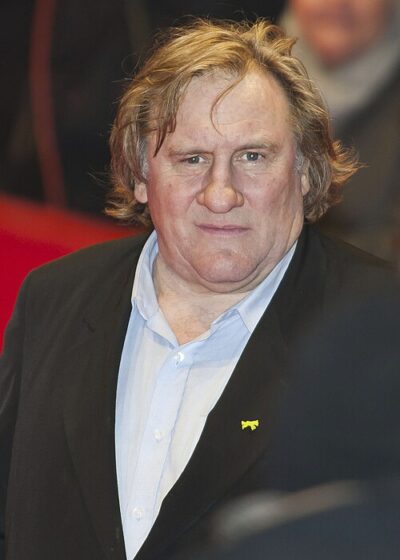
Gérard Depardieu
Gérard Depardieu is a French actor. Born December 27, 1948, in Châteauroux. Positions held include President of the Jury at the Cannes Festival (1992). Awards include Knight of the Legion of Honour, Knight of the National Order of Merit and Volpi Cup for Best Actor.
Facts
39 facts · 1 confirmed by two sources · 19 cited · 19 from one source
Where this comes from
Papalocal keeps its own record. It started from these sources; what each one said is kept here as it was copied, so a change on their side never changes this page by itself. Tap one to read its version.
What Wikidata says · copied November 16, 2026 · revision 2568323782
- Described as
- French actor (born 1948)
- Other names
- Gérard Xavier Marcel Depardieu, Depardieu, Gerard Depardieu, Gerard Xavier Marcel Depardieu
- Born
- December 27, 1948 · 12 references
- Born in
- Châteauroux · 2 references
- Name at birth
- Gérard Xavier Marcel Depardieu · 1 reference
- Citizen of
- Russia (2013–) · 4 references; France · 1 reference; United Arab Emirates · 1 reference
- Occupation
- film actor · 1 reference; stage actor · 1 reference; film director · 3 references; film producer · 3 references; television producer · 2 references; businessperson · 2 references; actor · 1 reference; voice actor · 1 reference
- Positions held
- President of the Jury at the Cannes Festival (1992)
- Sport
- association football · 2 references
- Awards
- Knight of the Legion of Honour (1996) · 1 reference; Knight of the National Order of Merit (1985); Volpi Cup for Best Actor (1985) · 1 reference; 7 d'Or; Lumière Award, Lyon Festival of cinema; César Award for Best Actor (2 times) (1981, 1991); National Society of Film Critics Award for Best Actor (1983); Golden Globe Award for Best Actor – Motion Picture Musical or Comedy (1990); Cannes Film Festival Award for Best Actor (1990); London Film Critics Circle Award for Actor of the Year (1992); Stanislavsky Award (2006); Lumière Award for Best Actor (2007) · 1 reference; Golden Lion for Lifetime Achievement (1997) · 2 references
- Spouse
- Élisabeth Depardieu (1971–1996)
- Children
- Julie Depardieu; Guillaume Depardieu · 1 reference; Roxane Depardieu; Jean Depardieu · 1 reference
- Father
- René Depardieu
- Mother
- Alice Depardieu
- Siblings
- Alain Depardieu
- Religion
- Eastern Orthodoxy (2020–) · 1 reference
- Height
- 1.80 m (5 ft 11 in)
- Wikipedias with a page
- 102
Wikidata item Q106508 (wikidata.org/wiki/Q106508), public domain (CC0). Copied November 16, 2026.
What Wikipedia says · copied November 16, 2026 · revision 1385906929
Gérard Xavier Marcel Depardieu (UK: , US: , French: [ʒeʁaʁ ɡzavje maʁsɛl dəpaʁdjø] ; born 27 December 1948) is a French actor. Considered an icon of French cinema in the same way as Jean Gabin and Alain Delon, he has appeared in over 200 films since 1967, mostly in leading roles. Depardieu has worked with more than 150 film directors, including major filmmakers such as François Truffaut, Alain Resnais, Ridley Scott, Peter Weir and Bernardo Bertolucci. He is the second highest-grossing actor in the history of French cinema behind Louis de Funès, with roughly 60 of his films selling more than one million admissions in France. He has portrayed various well-known historical and fictitious figures, including Cyrano de Bergerac, Georges Danton, Christopher Columbus, Jean Valjean, Edmond Dantès and Porthos, as well as Obelix in four of the live action Asterix films. Beyond acting, Depardieu is a film producer, businessman and vineyard owner. He has occasionally directed films and performed as a singer. His body of work includes extensive television productions, several records and, as of 2025, 19 stage plays and 9 books.
Growing up in poverty in Châteauroux, central France, Depardieu experienced a difficult youth and was a juvenile delinquent before settling in Paris, where he became an actor. His breakthrough came in 1974 with the film Going Places, which propelled him to overnight stardom. He quickly established himself as a major figure in European cinema and demonstrated his versatility by appearing in a wide variety of films, spanning both mainstream and auteur productions. He has received acclaim for his performances in The Last Metro (1980), where he won the César Award for Best Actor, Police (1985), for which he won the Volpi Cup for Best Actor, Jean de Florette (1986), and Cyrano de Bergerac (1990), where he won the Best Actor award at the Cannes Film Festival and his second César Award for Best Actor as well as garnering a nomination for the Academy Award for Best Actor. He started a Hollywood career with Green Card (1990), winning a Golden Globe Award for Best Actor, and later appeared in several high-budget English-language films, including 1492: Conquest of Paradise (1992), The Man in the Iron Mask (1998), and Life of Pi (2012).
Besides his acting accolades, Depardieu has garnered various honors, including appointments as a Chevalier of the Légion d'honneur and the Ordre national du Mérite. He was granted citizenship of Russia in January 2013. During the early 2010s, his tax exile in Russia and his support of Vladimir Putin caused controversy in France.
Depardieu was accused of sexual misconduct as early as the 1990s, though this did not develop into formal complaints until the late 2010s. In December 2020, French authorities charged him with rape. Depardieu denied any wrongdoing but a number of controversies, not limited to the accusations of rape, have since damaged his popularity in France and abroad. This resulted in several of his honors being rescinded in 2023, notably the National Order of Quebec. In May 2025, he was convicted of sexual assault against two women in a separate case. He appealed his sentencing, but withdrew his appeal in November 2026.
- Born, in its opening lines
- December 27, 1948
From the Wikipedia article “Gérard Depardieu” (en.wikipedia.org/wiki/Gérard_Depardieu), by its contributors, under CC BY-SA 4.0 (creativecommons.org/licenses/by-sa/4.0/). Copied November 16, 2026; not changed.
Confirmed Two sources agree. Cited One source, and it names where it got it. One source One source, without a reference of its own. Sources disagree The sources disagree. We show the best-supported value and keep theirs below.
