
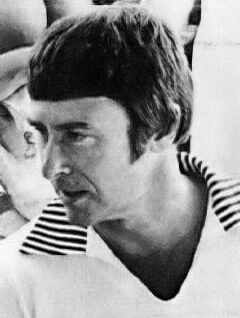
Gerard K. O'Neill
Gerard K. O'Neill was an American physicist and futurologist. Born February 6, 1927, in Brooklyn. Died April 27, 1992, in Redwood City. Known for The High Frontier: Human Colonies in Space. Educated at Cornell University and Swarthmore College.
Facts
19 facts · 2 confirmed by two sources · 3 cited · 14 from one source
Where this comes from
Papalocal keeps its own record. It started from these sources; what each one said is kept here as it was copied, so a change on their side never changes this page by itself. Tap one to read its version.
What Wikidata says · copied November 15, 2026 · revision 2567856768
- Described as
- American physicist and futurologist (1927–1992)
- Other names
- Gerard Kitchen O'Neill, Gerard O'Neill
- Born
- February 6, 1927 · 3 references
- Died
- April 27, 1992 · 3 references
- Born in
- Brooklyn · 1 reference
- Died in
- Redwood City · 1 reference
- Buried in
- Celestis 01
- Cause of death
- leukemia
- Citizen of
- United States
- Occupation
- physicist · 1 reference; astronomer; university teacher; astrophysicist · 1 reference
- Worked for
- Princeton University; Stanford University
- Education
- Cornell University; Swarthmore College
- Member of
- Phi Beta Kappa Society
- Known for
- The High Frontier: Human Colonies in Space
- Field
- physics
- Military branch
- United States Navy
- Wikipedias with a page
- 29
Wikidata item Q538399 (wikidata.org/wiki/Q538399), public domain (CC0). Copied November 15, 2026.
What Wikipedia says · copied November 15, 2026 · revision 1384340067
Gerard Kitchen O'Neill (February 6, 1927 – April 27, 1992) was an American physicist and space activist. As a faculty member of Princeton University, he invented a device called the particle storage ring for high-energy physics experiments. Later, he invented a magnetic launcher called the mass driver. In the 1970s, he developed a plan to build human settlements in outer space, including a space habitat design known as the O'Neill cylinder. He founded the Space Studies Institute, an organization devoted to funding research into space manufacturing and colonization.
O'Neill began researching high-energy particle physics at Princeton in 1954, after he received his doctorate from Cornell University. Two years later, he published his theory for a particle storage ring. This invention allowed particle accelerators at much higher energies than had previously been possible. In 1965 at Stanford University, he performed the first colliding beam physics experiment.
While teaching physics at Princeton, O'Neill became interested in the possibility that humans could survive and live in outer space. He researched and proposed a futuristic idea for human settlement in space, the O'Neill cylinder, in "The Colonization of Space", his first paper on the subject. He held a conference on space manufacturing at Princeton in 1975. Many who became post-Apollo-era space activists attended. O'Neill built his first mass driver prototype with professor Henry Kolm in 1976. He considered mass drivers critical for extracting the mineral resources of the Moon and asteroids. His award-winning book The High Frontier: Human Colonies in Space inspired a generation of space exploration advocates. He died of leukemia in 1992.
- Born, in its opening lines
- February 6, 1927
- Died, in its opening lines
- April 27, 1992
From the Wikipedia article “Gerard K. O'Neill” (en.wikipedia.org/wiki/Gerard_K._O'Neill), by its contributors, under CC BY-SA 4.0 (creativecommons.org/licenses/by-sa/4.0/). Copied November 15, 2026; not changed.
Confirmed Two sources agree. Cited One source, and it names where it got it. One source One source, without a reference of its own. Sources disagree The sources disagree. We show the best-supported value and keep theirs below.
