
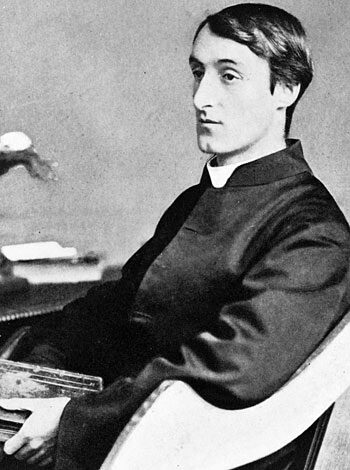
Gerard Manley Hopkins
Gerard Manley Hopkins was an English poet. Born July 28, 1844, in Stratford. Died June 8, 1889, in Dublin. Known for The Wreck of the Deutschland. Educated at Balliol College and Highgate School.
Facts
23 facts · 2 confirmed by two sources · 18 cited · 3 from one source
Where this comes from
Papalocal keeps its own record. It started from these sources; what each one said is kept here as it was copied, so a change on their side never changes this page by itself. Tap one to read its version.
What Wikidata says · copied November 16, 2026 · revision 2568735696
- Described as
- English poet (1844–1889)
- Other names
- Hopkins
- Born
- July 28, 1844 · 18 references
- Died
- June 8, 1889 · 17 references
- Born in
- Stratford · 7 references
- Died in
- Dublin · 5 references
- Buried in
- Glasnevin Cemetery (1889–) · 3 references
- Cause of death
- peritonitis · 2 references
- Citizen of
- United Kingdom of Great Britain and Ireland; United Kingdom · 1 reference
- Occupation
- poet · 7 references; writer · 1 reference; teacher · 1 reference; Catholic priest · 1 reference; librettist · 1 reference
- Education
- Balliol College (1863–1867) · 1 reference; Highgate School (1854–1863) · 1 reference; St Beuno’s Ignatian Spirituality Centre (1874–1877) · 1 reference
- Known for
- The Wreck of the Deutschland
- Father
- Manley Hopkins · 1 reference
- Mother
- Kate Smith
- Siblings
- Arthur Hopkins · 1 reference; Everard Hopkins · 1 reference
- Religion
- Catholicism (1866–) · 2 references; Anglicanism (–1866) · 1 reference
- Wikipedias with a page
- 43
Wikidata item Q313693 (wikidata.org/wiki/Q313693), public domain (CC0). Copied November 16, 2026.
What Wikipedia says · copied November 16, 2026 · revision 1385869225
Gerard Manley Hopkins (28 July 1844 – 8 June 1889) was an English poet and Jesuit priest.
The eldest of nine children, he was the son of a deeply religious High Anglican couple. His father, Manley Hopkins, was a prolific writer as well as having founded a marine insurance company, and his mother was the daughter of a physician.
Hopkins initially intended to become a painter, but soon gravitated towards poetry, as well as showing an early interest in asceticism. He studied Classics at Balliol College, Oxford, where he became friends with Robert Bridges, and was influenced by the work of Christina Rossetti and Digby Mackworth Dolben. After this he converted to Roman Catholicism, which caused an estrangement between Hopkins and some members of his family, and eventually became a Jesuit priest.
Hopkins was troubled by anxiety and melancholy throughout his life, as well as by a perceived conflict between the austerity of his religious faith and his portrayal of the natural world. Although he attempted several times to give up writing poetry, he nevertheless continued to do so. He also sketched and kept prose journals throughout his career. Although Hopkins's poetry was not widely known during his lifetime, his prosody – notably his concept of sprung rhythm – made him an innovator, as did his praise of God through vivid use of natural imagery.
After Hopkins's death, Robert Bridges published a few of his mature poems in anthologies. By 1930 Hopkins's work was seen as one of the most original literary advances of his century.
- Born, in its opening lines
- July 28, 1844
- Died, in its opening lines
- June 8, 1889
From the Wikipedia article “Gerard Manley Hopkins” (en.wikipedia.org/wiki/Gerard_Manley_Hopkins), by its contributors, under CC BY-SA 4.0 (creativecommons.org/licenses/by-sa/4.0/). Copied November 16, 2026; not changed.
Confirmed Two sources agree. Cited One source, and it names where it got it. One source One source, without a reference of its own. Sources disagree The sources disagree. We show the best-supported value and keep theirs below.
