
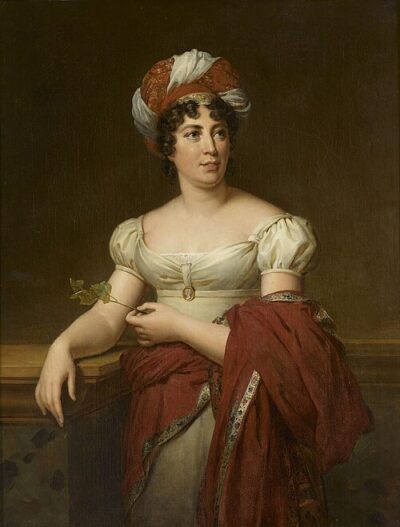
Germaine de Staël
Germaine de Staël was a Genevan-French author. Born April 22, 1766, in Paris. Died July 14, 1817, in Paris. Known for On Germany and Corinne ou l'Italie.
Facts
29 facts · 2 confirmed by two sources · 13 cited · 14 from one source
Where this comes from
Papalocal keeps its own record. It started from these sources; what each one said is kept here as it was copied, so a change on their side never changes this page by itself. Tap one to read its version.
What Wikidata says · copied November 16, 2026 · revision 2569087288
- Described as
- Genevan-French author (1766-1817)
- Other names
- Baroness de Staël-Holstein Anne-Louise-Germaine Necker, Anne-Louise-Germaine, Mme de Staël-Holstein, Anne-Louise-Germaine Necker, Germaine de Staël-Holstein, Anne Louise Germaine de Stael-Holstein, Mme de Staël, Madame de Staël, Madame Anne-Louise-Germaine de Staël, Anne-Louise-Germaine de Staël, Anne-Louise Germaine Necker
- Born
- April 22, 1766 · 10 references
- Died
- July 14, 1817 · 10 references
- Born in
- Paris · 3 references
- Died in
- Paris · 3 references
- Buried in
- Coppet Castle · 2 references
- Name at birth
- Anne-Louise Germaine Necker
- Citizen of
- Republic of Geneva · 1 reference; France · 1 reference
- Occupation
- writer · 4 references; salonnière · 1 reference; diarist; literary critic · 1 reference; politician · 1 reference; correspondent; philosopher; translator
- Political party
- Club de Clichy
- Known for
- On Germany; Corinne ou l'Italie
- Spouse
- Erik Magnus Staël von Holstein (1786–1800) · 1 reference; Albert Jean Michel de Rocca (1811–1817) · 1 reference
- Children
- Albertine, baroness Staël von Holstein · 1 reference; Auguste-Louis de Staël-Holstein · 1 reference; Louis Alphonse de Rocca
- Father
- Jacques Necker · 1 reference
- Mother
- Suzanne Curchod · 1 reference
- Religion
- reformed · 1 reference
- Lived in
- Coppet (2 times) (1793–1812) · 1 reference; Geneva (1793–1794) · 1 reference
- Wikipedias with a page
- 92
Wikidata item Q123041 (wikidata.org/wiki/Q123041), public domain (CC0). Copied November 16, 2026.
What Wikipedia says · copied November 16, 2026 · revision 1385624929
Anne Louise Germaine de Staël-Holstein (French: [an lwiz ʒɛʁmɛn də stal ɔlstajn]; née Necker; 22 April 1766 – 14 July 1817), commonly known as Madame de Staël ( də-STAHL; French: [madam də stal]), was a prominent Genevan and French novelist, woman of letters, philosopher, and political theorist in both Parisian and Genevan intellectual circles. She was the daughter of banker and French finance minister Jacques Necker and Suzanne Curchod, a respected salonist and writer. Throughout her life, she held a moderate stance during the tumultuous periods of the French Revolution and the Napoleonic era, persisting until the time of the French Restoration.
Her presence at critical events such as the Estates General of 1789 and the 1789 Declaration of the Rights of Man and of the Citizen underscored her engagement in the political discourse of her time. However, Madame de Staël faced exile for extended periods: initially during the Reign of Terror and subsequently due to personal persecution by Napoleon. She claimed to have discerned the tyrannical nature and ambitions of his rule ahead of many others.
During her exile, she fostered the Coppet group, a network that spanned across Europe, positioning herself at its heart.
Her literary works, emphasizing individuality and passion, left an enduring imprint on European intellectual thought. De Staël's repeated championing of Romanticism contributed significantly to its widespread recognition. Within her work, de Staël not only advocates for the necessity of public expression but also sounds cautionary notes about its potential hazards.
- Born, in its opening lines
- April 22, 1766
- Died, in its opening lines
- July 14, 1817
From the Wikipedia article “Germaine de Staël” (en.wikipedia.org/wiki/Germaine_de_Staël), by its contributors, under CC BY-SA 4.0 (creativecommons.org/licenses/by-sa/4.0/). Copied November 16, 2026; not changed.
Confirmed Two sources agree. Cited One source, and it names where it got it. One source One source, without a reference of its own. Sources disagree The sources disagree. We show the best-supported value and keep theirs below.
