
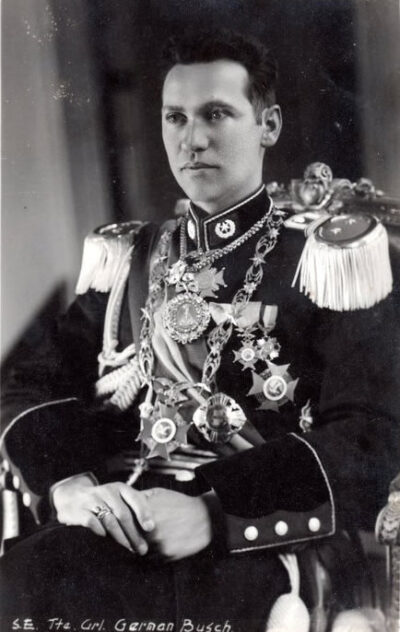
Germán Busch
Germán Busch was a President of Bolivia. Born March 23, 1903, in San Javier. Died August 23, 1939, in La Paz. Positions held include president of Bolivia (1936–1939).
Facts
11 facts · 2 confirmed by two sources · 2 cited · 7 from one source
What’s different
- Born: we show March 23, 1903 (Confirmed). Wikidata also lists March 23, 1904
- Died: we show August 23, 1939 (Confirmed). Wikidata also lists August 22, 1939
Where this comes from
Papalocal keeps its own record. It started from these sources; what each one said is kept here as it was copied, so a change on their side never changes this page by itself. Tap one to read its version.
What Wikidata says · copied November 18, 2026 · revision 2567789383
- Described as
- President of Bolivia (1937-1939)
- Other names
- German Busch, German Busch Becerra
- Born
- March 23, 1903; March 23, 1904 · 2 references
- Died
- August 23, 1939 · 1 reference; August 22, 1939 · 1 reference
- Born in
- San Javier
- Died in
- La Paz · 1 reference
- Buried in
- Cementerio General de La Paz
- Cause of death
- gunshot wound
- Citizen of
- Bolivia
- Occupation
- politician · 1 reference
- Positions held
- president of Bolivia (1936–1939)
- Father
- Pablo Busch
- Military rank
- Lieutenant Colonel
- Wikipedias with a page
- 21
Wikidata item Q734606 (wikidata.org/wiki/Q734606), public domain (CC0). Copied November 18, 2026.
What Wikipedia says · copied November 18, 2026 · revision 1376830680
Víctor Germán Busch Becerra (23 March 1903 – 23 August 1939) was a Bolivian military officer and statesman who served as the 36th president of Bolivia from 1937 until his death in 1939. Prior to his presidency, he served as the Chief of the General Staff and was the Supreme Leader of the Legion of Veterans, a veterans' organization founded by him after his service in the Chaco War.
Busch was born in either El Carmen de Iténez or San Javier and was raised in Trinidad. He attended the Military College of the Army and served with distinction in the Chaco War. For his actions, he rose to prominence among the high command of the armed forces, participating in the military-led ousters of presidents Daniel Salamanca in 1934 and José Luis Tejada Sorzano in 1936. The latter propelled his mentor, Colonel David Toro, to the presidency of a military junta of which Busch was a member. On 13 July 1937, Busch orchestrated a soft-coup which forced Toro's resignation, elevating himself to the presidency of the junta.
A war hero, drawn in by the reformist social movements of the time, Busch spearheaded the development of Toro's Military socialist ideology, convening the 1938 National Convention which legally elected him president and promulgated the 1938 Political Constitution, hailed as a "Social Constitution" as it established the State's right to the country's natural wealth, alluded to the social function of property, and recognized the communal lands of indigenous Bolivians. However, his political inexperience and accustomation to rigid military structure weakened his ability to lead the disparate factions of the left-wing movements and led him to ultimately suspend the legislature and declare dictatorial rule in 1939. During this time, he issued a profusion of executive decrees including a new labor and school code and the mining currency law, the latter of which proved to be the most popular of his policies though it gained him the ire of the Rosca, the country's powerful mining oligarchy.
By the end of 1939, pressure from resurgent conservative parties, a corruption scandal, and a deepening personal depression led Busch to commit suicide on 23 August 1939, bringing an end to the era of military socialism in Bolivia. An enigmatic character who came from outside the political realm, he was wrapped in legend and controversy, even about his birthplace. His sudden and unexpected death in office is still disputed as either suicide or an assassination.
During his presidency, a Labor Code was introduced which provided for various rights for workers, together with social insurance for typographical employees and workers and railwaymen.
- Born, in its opening lines
- March 23, 1903
- Died, in its opening lines
- August 23, 1939
From the Wikipedia article “Germán Busch” (en.wikipedia.org/wiki/Germán_Busch), by its contributors, under CC BY-SA 4.0 (creativecommons.org/licenses/by-sa/4.0/). Copied November 18, 2026; not changed.
Confirmed Two sources agree. Cited One source, and it names where it got it. One source One source, without a reference of its own. Sources disagree The sources disagree. We show the best-supported value and keep theirs below.
