
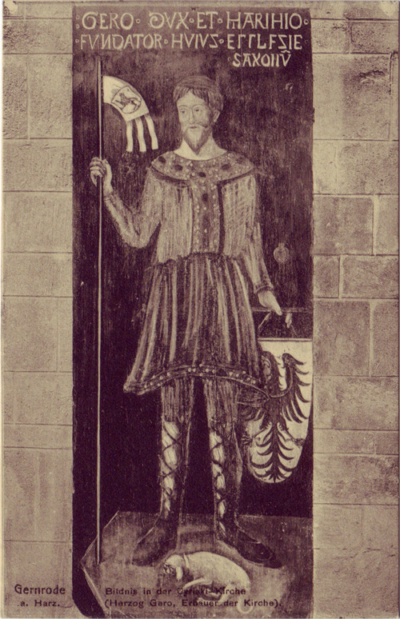
Gero was a German nobleman (c.900–965). Born 900. Died May 20, 965, in Gernrode.
Facts
9 facts · 2 confirmed by two sources · 1 cited · 6 from one source
Where this comes from
Papalocal keeps its own record. It started from these sources; what each one said is kept here as it was copied, so a change on their side never changes this page by itself. Tap one to read its version.
What Wikidata says · copied November 18, 2026 · revision 2568888657
- Described as
- German nobleman (c.900–965)
- Born
- 900; 900 · 1 reference
- Died
- May 20, 965
- Died in
- Gernrode
- Buried in
- St. Cyriakus
- Occupation
- ruler
- Field
- military affairs · 1 reference
- Father
- Thietmar, Count of Merseburg
- Mother
- Hildegard von Lahngouw · 1 reference
- Siblings
- Siegfried, Count of Merseburg
- Wikipedias with a page
- 23
Wikidata item Q63166 (wikidata.org/wiki/Q63166), public domain (CC0). Copied November 18, 2026.
What Wikipedia says · copied November 18, 2026 · revision 1366110045
Gero I (c. 900 – 20 May 965), sometimes called the Great (Latin: magnus), was a prominent German noble from the Duchy of Saxony in the East Francia, who held several offices during the reign of king and later emperor Otto I (936–973). As one of the most notable counts in northern regions of Otto's realm, Gero was appointed as king's representative (legate) in the Saxon duchy. He was also appointed as margrave (Latin: marchio), thus ranking above other counts. The nature and scope of his jurisdiction as margrave was indicated in several sources, such as the Thietmar's Chronicle from the beginning of the 11th century, that mentions Gero as Margrave of the East (Latin: Gero Orientalium marchio). Since various sources provide data on Gero's continuous and frequent involvement in German expansion towards the lands of Polabian Slavs, that lied to the east of Saxon and Thuringian lands, traditional historiography regarded Gero as margrave over the subdued Slavic regions, thus coining the term March of Gero (Latin: Marca Geronis). Newer scholarly analyses have shown that some charters that contain data on Gero's march (frontier region) should be considered as later forgeries, thus leading modern researchers to question or reject various traditional views regarding the nature and effective scope of such a frontier province in the middle of the 10th century.
In traditional historiography, it was assumed that Gero's march was initially centred on Merseburg, in the present German state of Saxony-Anhalt, and gradually expanded into a vast territory, encompassing almost all lands of Polabian Slavs, thus viewing Gero as leader of early German Ostsiedlung (settlement of the East).
- Born, in its opening lines
- c. 900
- Died, in its opening lines
- May 20, 965
From the Wikipedia article “Gero” (en.wikipedia.org/wiki/Gero), by its contributors, under CC BY-SA 4.0 (creativecommons.org/licenses/by-sa/4.0/). Copied November 18, 2026; not changed.
Confirmed Two sources agree. Cited One source, and it names where it got it. One source One source, without a reference of its own. Sources disagree The sources disagree. We show the best-supported value and keep theirs below.
