
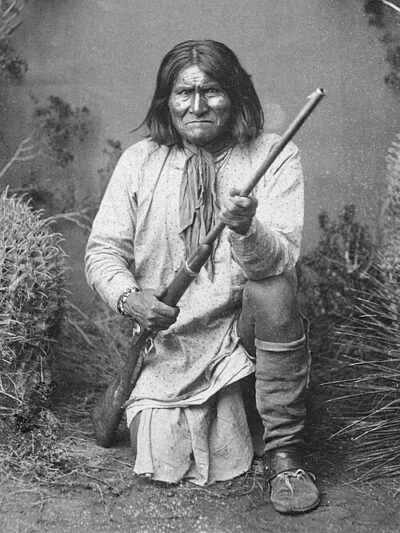
Gerónimo
Gerónimo was a leader of the Bedonkohe Apache. Born June 16, 1829, in Gila River. Died February 17, 1909, in Fort Sill. Positions held include war chief.
Facts
22 facts · 2 confirmed by two sources · 6 cited · 14 from one source
Where this comes from
Papalocal keeps its own record. It started from these sources; what each one said is kept here as it was copied, so a change on their side never changes this page by itself. Tap one to read its version.
What Wikidata says · copied November 13, 2026 · revision 2568844890
- Described as
- leader of the Bedonkohe Apache (1829-1909)
- Other names
- Goyaałé, Goyathlay, Goyahkla, José Gerónimo Monteso Chagori
- Born
- June 16, 1829 · 2 references
- Died
- February 17, 1909 · 5 references
- Born in
- Gila River
- Died in
- Fort Sill · 1 reference
- Buried in
- Beef Creek Apache Cemetery
- Cause of death
- pneumonia
- Name at birth
- José Gerónimo Monteso Chagori
- Citizen of
- United States · 1 reference; Mexico
- Occupation
- military leader; warrior · 1 reference; traditional leader or chief · 1 reference; medicine man · 1 reference
- Positions held
- war chief
- Spouse
- Alope; Ta-ayz-slath; Chee-hash-kish; Nana-tha-thtith; Zi-yeh; She-gha
- Religion
- syncretism · 1 reference; Catholicism · 1 reference
- Wikipedias with a page
- 77
Wikidata item Q2791 (wikidata.org/wiki/Q2791), public domain (CC0). Copied November 13, 2026.
What Wikipedia says · copied November 13, 2026 · revision 1382552448
Gerónimo (Mescalero-Chiricahua: Goyaałé, lit. 'the one who yawns', [kòjàːɬɛ́]; June 16, 1829 – February 17, 1909) was a military leader and medicine man from the Bedonkohe band of the Ndendahe Apache people. From 1850 to 1886, Geronimo joined with members of three other Central Apache bands – the Tchihende, the Tsokanende (called Chiricahua by Americans) and the Nednhi – to carry out numerous raids, as well as fight against Mexican and U.S. military campaigns in the northern Mexico states of Chihuahua and Sonora and in the southwestern American territories of New Mexico and Arizona.
Geronimo's raids and related combat actions were a part of the prolonged period of the Apache–United States conflict, which started with the Americans continuing to take land, including Apache lands, following the end of the war with Mexico in 1848. Reservation life was confining to the free-moving Apache people, and they resented restrictions on their customary way of life.
Geronimo led breakouts from the reservations in attempts to return his people to their previous nomadic lifestyle. During Geronimo's final period of conflict from 1876 to 1909, he surrendered three times and eventually accepted life on the Apache reservations. While well-known, Geronimo was not a chief of the Bedonkohe band of the Central Apache but a shaman. However, since he was a superb leader in raiding and warfare, he frequently led large parties of 30 to 50 Apache warriors.
In 1886, after an intense pursuit in northern Mexico by American forces that followed Geronimo's third 1885 reservation breakout, Geronimo surrendered for the last time to Lt. Charles Bare Gatewood. Geronimo and 27 other Apaches were later sent to join the rest of the Chiricahua tribe, which had been previously exiled to Florida. While holding him as a prisoner, the United States capitalized on Geronimo's fame among non Native Americans by displaying him at various fairs and exhibitions. In 1898, for example, Geronimo was exhibited at the Trans-Mississippi Exposition in Omaha, Nebraska; seven years later, the Indian Office provided Geronimo for use in a parade at the second inauguration of President Theodore Roosevelt. He died at the Fort Sill hospital in 1909, as a prisoner of war, and was buried at the Fort Sill Indian Agency Cemetery, among the graves of relatives and other Apache prisoners of war.
- Born, in its opening lines
- June 16, 1829
- Died, in its opening lines
- February 17, 1909
From the Wikipedia article “Geronimo” (en.wikipedia.org/wiki/Geronimo), by its contributors, under CC BY-SA 4.0 (creativecommons.org/licenses/by-sa/4.0/). Copied November 13, 2026; not changed.
Confirmed Two sources agree. Cited One source, and it names where it got it. One source One source, without a reference of its own. Sources disagree The sources disagree. We show the best-supported value and keep theirs below.
